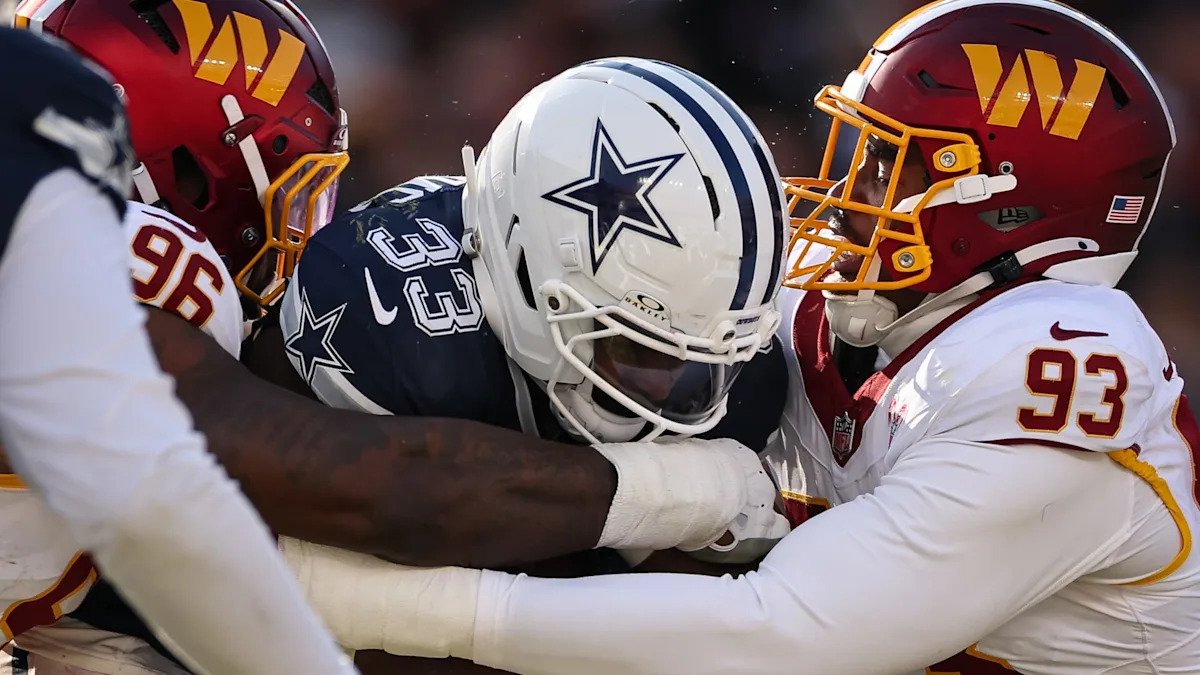
Running back Javonte Williams bet on himself last year, signing a one-year, $3 million deal. He delivered, with a career-high 1,200 rushing yards.
His reward was a three-year, $24 million deal to remain with the Cowboys.
Advertisement
Since the Williams deal was the first significant contract signed by a looming free agent, it’s important to remember a few things as we approach new-contract season. The initial reports routinely overstate the true value of the contract. For example, the reported $16 million in guarantees for Williams surely aren’t fully guaranteed at signing, and there’s little about the structure of the deal. There could be a little fudging at play to make the deal look better than it is, with the reporters who rush to Twitter with the early information rarely if ever insisting on full and accurate details. (If they do, someone else gets the scoop.)
For now, even the potentially inflated initial reporting reinforces an important point: The running back position continues to be undervalued.
The deal, if it’s truly worth $8 million per year, puts Williams at 16th among all current running backs. And he took the offer before the annual tampering festival in Indianapolis, where he may have learned that someone would have offered significantly more than that.
It’s possible the Cowboys tried aggressively to keep that from happening, perhaps by trotting out their CBA-violating practice of negotiating directly with the player.
Advertisement
Still, what would Williams have gotten on the open market? Only the superstars at the position get market value. Eagles running back Saquon Barkley leads the way, at $20.6 million per year. 49ers running back Christian McCaffrey’s current deal has a new-money average of $19 million.
It happens for one very simple reason. The supply of capable running backs outweighs demand. Teams can resort to the draft for a younger, cheaper, and usually healthier player in lieu of paying a veteran who may not be able to duplicate his performance in a contract year.
Every year, college football generates plenty of running backs who can play at the NFL level, if they can be trusted to hold onto the ball and if they are able to pick up blitzers in pass protection. Most of them have their best years under slotted rookie contracts. When those expire, teams look for another young player to replace them.
And while the Cowboys may have done themselves a favor by getting Williams locked in before he was able to see what else was out there, the Cowboys have given other teams a data point that will become relevant to their negotiations with running backs. The other players who’ll be trying to get paid (Kenneth Walker III, Breece Hall, Travis Etienne, Rico Dowdle, Rachaad White, Isiah Pacheco, JK Dobbins) will have to deal with the argument that a guy who rushed for 1,200 yards in 2025 got only $8 million per year.
Advertisement
Then there’s Lions running back Jahmyr Gibbs. Currently eligible for a second deal, he has shown the kind of superstar ability that would justify a market-level contract. Will the Williams deal hold down what the Lions will offer?
It shouldn’t. Gibbs is far closer to Barkley and McCaffrey than the players who are hitting the market. Still, all running backs who are ready to become free agents will have to deal with the fact — as underscored by the Williams deal — that the running back market continues to be not what it could be, or perhaps what it should be.

