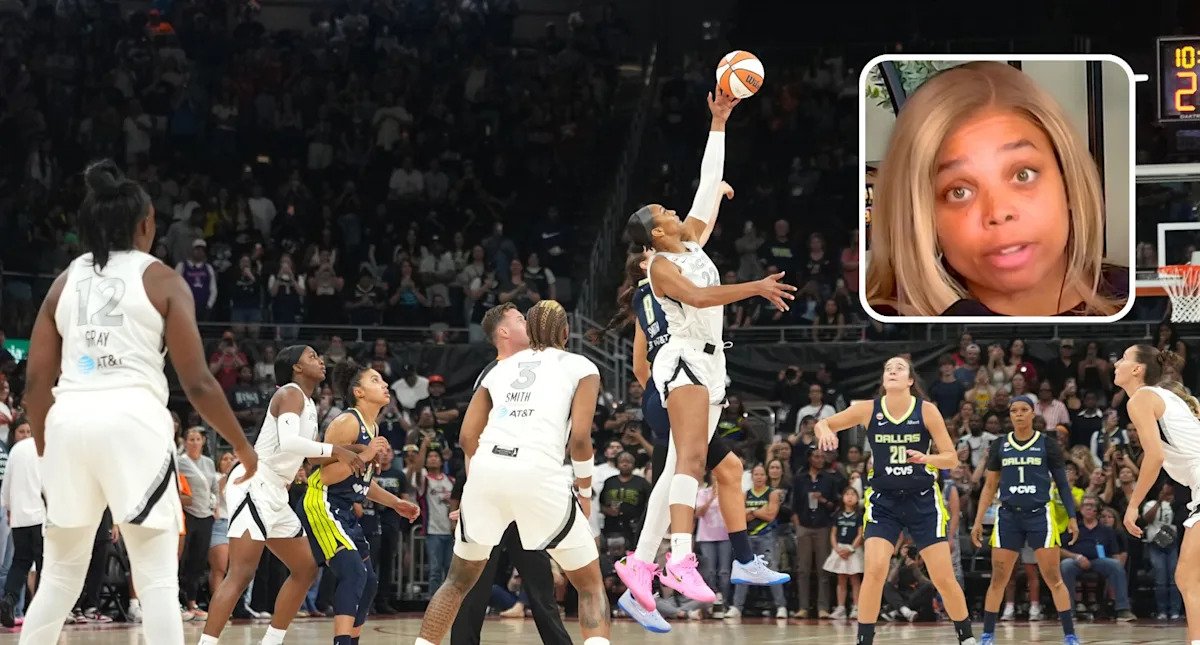
Earlier this week, longtime sports reporter Jemele Hill clashed with WNBA fans online over her criticism of the league’s locker-room access policy.
Hill joined ESPN NFL reporter Ben Baby (who is also a journalism professor at SMU) in calling out the WNBA for keeping reporters out of locker rooms and significantly restricting media access compared with other major U.S. sports leagues. In response, several high-profile content creators, commentators, and fans online pushed back strongly against Hill, arguing that players are entitled to privacy and that the access policies are not inhibiting the league’s growth.
Advertisement
Following up in an episode of her podcast Flagrant & Funny, Hill called out what she sees as a broader sentiment among WNBA fans who feel that the media is supposed to be on the players’ side, or even an extension of the PR machine for teams and the league.
“The issue is that, I think for a long time, not every journalist but a lot of the journalists that covered women’s sports and covered the league, the fans saw the journalists as a ‘we’ and not a ‘they,’” Hill said.
‘Now they’re confused, because … there’s more people covering the league now, it’s under more scrutiny, and (the fans) have had the expectation that the journalists are supposed to be extensions of teams. And the journalists are not supposed to be that. And unfortunately, because of how everything is covered in this country … people can’t even recognize what journalists are supposed to do.”
Hill’s comments came as part of a larger conversation with cohost Cari Champion about WNBA coverage. They referenced the recent stir around the Dallas Wings, which began with a question about No. 1 overall draft pick Azzi Fudd’s relationship with reigning Rookie of the Year Paige Bueckers and ended with a statement from Bueckers saying she and Fudd would not address their dynamic any further.
Advertisement
While Jemele Hill expressed openness to a different type of coverage for women’s athletes that could right some of the wrongs men’s stars have been put through, she admitted she is unsure what that looks like — and doesn’t believe fans’ perspectives on the issue are reasonable, either.
“They expect our jobs to be to support the women,” she said. “And while the support is, to me, in the fact that we have built an entire podcast around discussing women’s sports and all the culture and the issues and all the things that come with it, they expect the journalists to be cheerleaders.”
To Hill’s point, a lack of media literacy, or misunderstanding of the role of journalism in communities and industries, is a problem that runs far deeper than sports. Athletes are exercising their leverage in the situation to sidestep sensationalized or cruel reporting.
Perhaps one path forward could be a plan recently set forth by Angel Reese and endorsed by Megan Rapinoe: to impose fines whenever questions veer into unacceptable territory. But that can likely only last so long.
Advertisement
Instead, Jemele Hill seems to suggest that the only hope for a more respectful model of coverage is for fans and players to trust reporters to do their jobs and be professional, even when the questions and stories are not always easy to stomach.
The post Jemele Hill: Too many WNBA fans ‘expect the journalists to be cheerleaders’ appeared first on Awful Announcing.

