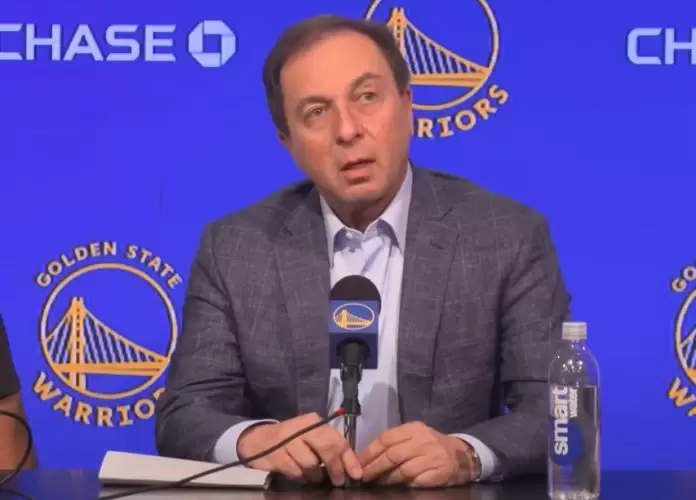
Golden State Warriors owner Joe Lacob revealed the franchise made at least two “very big” trade offers between the 2026 trade deadline and the offseason, indicating the team explored significant roster changes despite ultimately maintaining much of its veteran core.
Lacob told Tim Kawakami of The San Francisco Standard that Golden State included multiple draft picks in those proposals but did not find a deal it considered worthwhile.
“We made at least two very big offers in the last six months,” Lacob said. “Between the trade deadline and the summer, at least two. There were multiple draft choices. So it’s not like we wouldn’t move them if we thought it was the right thing to do.”
Lacob emphasized that the Warriors are willing to use their draft capital when the right opportunity emerges, but the organization does not want to make a trade simply for the sake of changing the roster.
“We have to make a good trade, we have to make a trade that makes sense,” Lacob said.
The comments provide additional context for Golden State’s relatively conservative offseason. The Warriors retained Stephen Curry, Jimmy Butler, Draymond Green, Kristaps Porzingis, Al Horford, De’Anthony Melton and Gary Payton II while adding 11th overall pick Yaxel Lendeborg and 54th pick LaJae Jones in the draft.
Curry remains the centerpiece after averaging 26.6 points, 4.7 assists and 3.6 rebounds in 43 games during the 2025-26 season. He shot 46.8% from the field, 39.3% from three-point range and 92.3% from the free-throw line while making 4.4 three-pointers per game.
Butler averaged 20.0 points, 5.6 rebounds and 4.9 assists in 38 games. Porzingis added 16.1 points and 5.3 rebounds in 15 games, although his limited availability remains relevant to Golden State’s frontcourt depth.
The Warriors finished 37-45 last season, 10th in the Western Conference, and entered the play-in tournament after going 3-7 over their final 10 games. They were 27 games behind the Western Conference-leading Oklahoma City Thunder, which finished 64-18.
Golden State’s decision to hold onto its assets therefore comes with a clear competitive context. The Warriors were not among the West’s top eight teams in the regular season, while the conference’s eventual champion, San Antonio, finished second at 62-20 before defeating Oklahoma City in seven games in the Western Conference finals.

