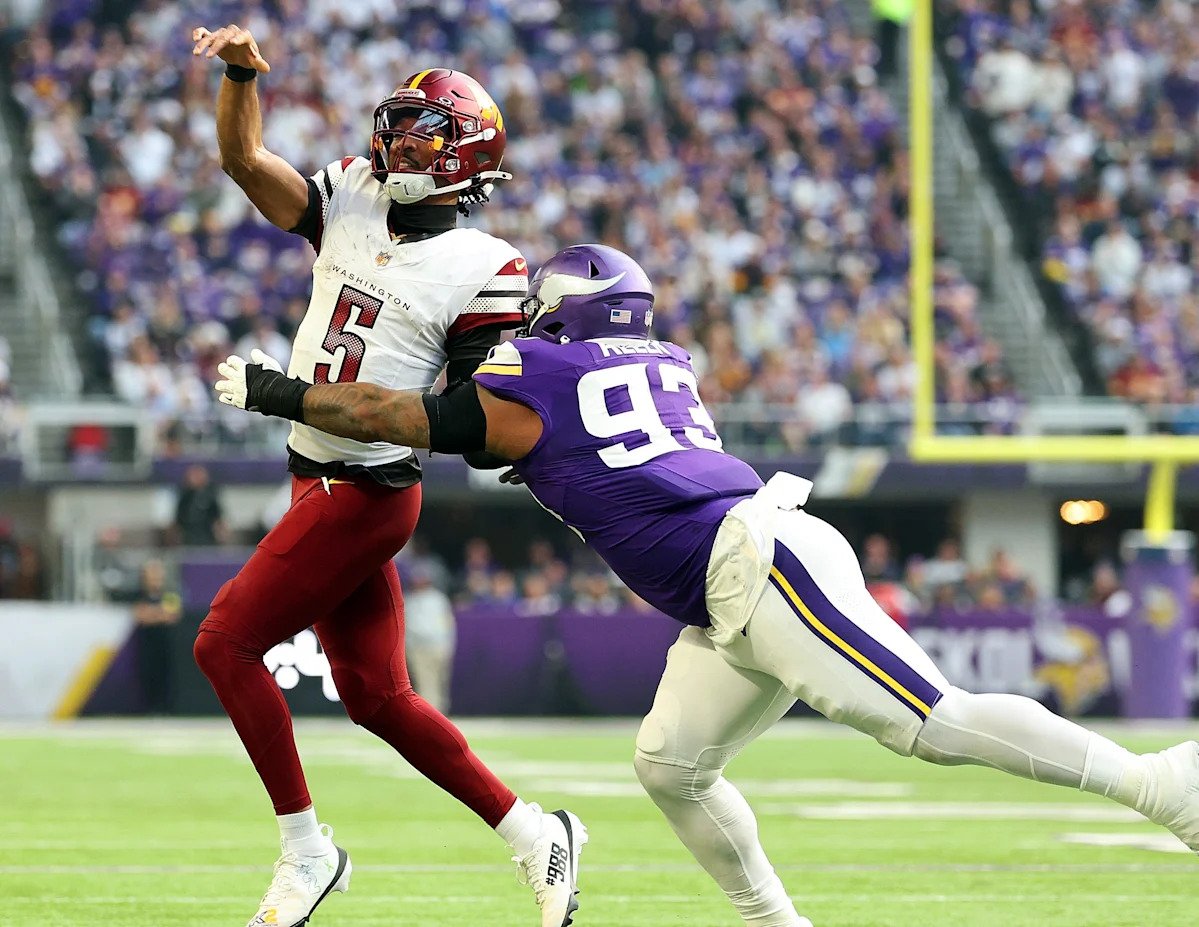
The Cincinnati Bengals made a solid move to bolster their defensive line by bringing in decorated veteran Jonathan Allen. He’ll undoubtedly provide a nice boost to the interior while also offering valuable leadership to the squad.
Initial reports had the club signing the 31-year-old to a two-year deal worth up to $25 million. Over the Cap has divulged further details about the deal, including the breakdown of cap hits, cash dispersal, and the outlook for both 2026 and 2027.
Advertisement
Cincinnati alleviated the first-year cap hit ($9.75 million) to some degree, but it balloons in the second year ($15.2 million). This structure gives the Bengals flexibility to exit the second year of the contract should Allen not pan out after this season, as they would free up $11.5 million in 2027 cap space with minimal dead cap.
After the signings of Allen, Boye Mafe, and Bryan Cook, the Bengals have a little north of $20 million in cap space. A new class of rookies will eat into that, likely leaving the Bengals with minimal “rental-type” deals with veterans over the next few weeks and months.
The next couple of nuances exemplify how the Bengals operate differently from almost every other NFL franchise. Restructuring the recent mega-deals for Joe Burrow and/or Ja’Marr Chase to limit their respective 2026 cap hits (which combine for roughly $74 million of the team’s 2026 cap) could be an option, but that would be unprecedented territory for Cincinnati’s front office.
When asked at the Combine about restructuring Burrow’s deal to allow more free-agency flexibility, he noted the team was “open” to that idea but also toed the company line about maintaining cap integrity for future years.
Advertisement
And for those wondering why the Bengals didn’t make a splash at linebacker in the first week in conjunction with their early moves, the trio of starting defenders they signed has the three highest 2026 cap hits of any free-agent signees in the league. This pushed the Bengals closer to the cap than it would have for most other teams, given Cincinnati’s structuring of deals with high Year 1 cap hits and lower hits afterward.
Now, given that the Bengals should have about another $8–$10 million to work with after setting aside the rookie pool, they could still find some nice pieces on short-term deals. However, many names that the masses felt would be good fits for the team—particularly at linebacker—have largely dried up after the first week.
While Allen’s number is largely manageable this year, the contract structuring of the Bengals’ biggest free-agent signings is opening up another layer of discussion. If Cincinnati had structured deals to spread out the cap hits more evenly for these veteran stars (all good players in their own right), the team could have had more space to work with—likely well into the double-digit millions.
Advertisement
As Joe Goodberry astutely breaks down above, a different structure could allow the Bengals to sign another couple of impact players or make them more serious contenders in high-level sweepstakes in which they were rumored to have involvement (Devin Lloyd, John Franklin-Myers, etc.).
Regardless, Cincinnati did net three quality defenders in the first week of free agency, upping the overall talent on Al Golden’s embattled unit.

