This article was first published in the Ute Insiders newsletter. Sign up to receive the newsletter in your inbox each Wednesday night.
If it ain’t broke, don’t fix it.
That’s the attitude that new Utah offensive coordinator Kevin McGiven is bringing into his first year on the job in Salt Lake City.
Advertisement
Last season, OC Jason Beck helped reverse the Utes’ offensive fortunes, guiding the team to 41.2 points per game (No. 5 in the nation), including 266.3 rushing yards per game (No. 2 in the nation).
His run-heavy approach resulted in school records for rushing yards and rushing touchdowns, and paired with quarterback Devon Dampier, Utah’s offense found success in an 11-2 season.
After longtime coach Kyle Whittingham stepped down, then eventually took the Michigan job, Beck had a choice to make — stay at Utah with new head coach Morgan Scalley or follow his current boss to Ann Arbor. Beck did the latter, which meant Scalley had to hire a new OC in his first year.
“You keep names throughout your journey. Well, being a head-coach-in-waiting, there’s a lot of people that will reach out to you because they think any year’s the next year. And every year (McGiven’s) name comes up,” Scalley said at a January press conference.
Advertisement
As he went through the interview process with McGiven, Scalley liked what he saw from his offenses.
“He creates issues at levels in football. … He’s really good at what he does. He’s efficient at what he does and he’s done it at a level that hasn’t necessarily had the resources that we have. So get ready for Kevin,” Scalley said.
The 48-year-old McGiven has already amassed a lengthy résumé, including 17 seasons as an offensive coordinator. He’s called the offense at Oregon State, San Jose State and had two stints at Utah State, including last season.
Under McGiven’s leadership in 2025, the Aggies scored 30.9 points per game (No. 36 in the country) and averaged 409.5 yards per game (No. 39 in the country), and that’s with an offensive line that didn’t play up to par most of the season.
Advertisement
He was able to get the most out of former Utah quarterback Bryson Barnes, helping unlock his rushing ability to the tune of 740 yards and 10 scores in 2025. Barnes also threw for 2,803 yards and 18 touchdowns with five interceptions on 59.3% accuracy and was named to the All-Mountain West second team.
“He bought into the system and then we were able to do some things to try to capitalize on his skill set,” McGiven said. “I think with the quarterback run game, with the RPOs and try to isolate it to some things that he did well. We were able to develop his pass game a little bit into getting him into a little bit more progression-based pass game and he was able to thrive at times in that.”
Flexible system
Like Beck, McGiven employs a flexible offensive system that can adapt to the strength of each team.
Advertisement
“I’ve always wanted a system that has that type of versatility to be able to cater it to the personnel group, to the personnel that you have,” McGiven said.
“I would say multiple, first and foremost, just in trying to change up the looks and again, just in an attempt to create as much conflict for the defense as possible, reducing and expanding with your formations, shifting in motion and just different layers any way you can to attack a defense and trying to be able to dictate a game that way.”
Last season, McGiven’s offense leaned into Barnes’ rushing ability and decision-making in the RPO. He can utilize a similar scheme with Dampier, who rushed for 835 yards and 10 touchdowns and threw for 2,490 yards and 24 scores in Beck’s RPO offense.
“That’s the beauty is you pull that film up and go, ‘Look boys, doesn’t that look similar?’” Scalley said.
Advertisement
McGiven is his own man, with his own offensive ideas, but in following the one-year stint by Beck at Utah, he also wants to build off of the success that the Utes had last season.
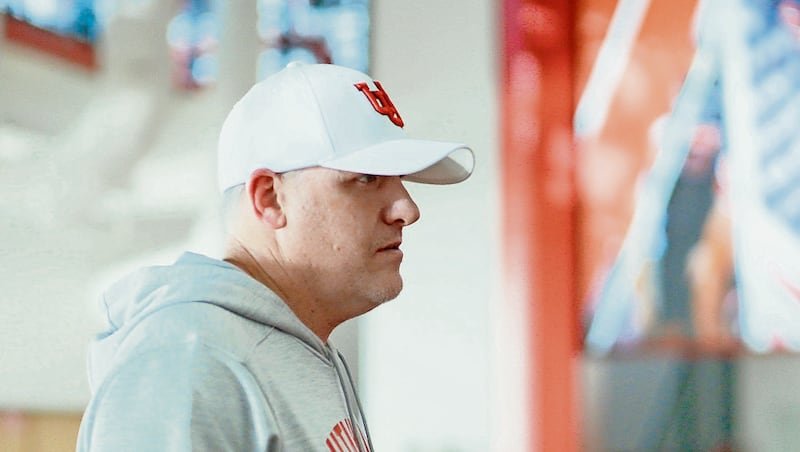
New Utah offensive coordinator Kevin McGiven acknowledges the Huntsman Center crowd during a Runnin’ Utes game this season. | Anna Fuder
“To me as a coordinator, you are not coming in necessarily trying to rebuild something that was broken because it wasn’t broken,” McGiven said. “It’s an offense that averaged 40 points a game and moved the ball up and down the field and they were able to capitalize on the strengths of the quarterback, which is what I want to do first and foremost.”
Since he arrived at Utah, McGiven has been learning from his players about the verbiage of Beck’s offense and trying to incorporate that to make the transition easier.
Advertisement
“From a verbiage standpoint, if there’s terms that you can adapt to because they already know it as something with the way different concepts are named to me, that speeds up their learning progression systematically,” McGiven said.
What he likes from the film
Watching film from last season, McGiven liked the misdirection that Utah used on offense and the way they used the quarterback run game.
“I thought they did a very good job using obviously the quarterback skill set with the quarterback run game, but the misdirection that came off of it, there were a lot of things that were complementary going on with the misdirection, the fly sweep, the potential for play action,” McGiven said.
Advertisement
“There were a lot of different elements with plays and presentations of plays that, where it could have gone to the quarterback, could have gone to the running back, could have gone to a sweeper, or it could have been play action off of it. And so all of those elements create that conflict, that level of difficulty for the defense.”
Those elements, which make things tough for the defense, are ones that McGiven likes to use in his offenses, so Ute fans will be seeing some familiar concepts on Saturdays this fall.
Tailor-made
At the core of McGiven’s offensive philosophy is his ability to tailor each offense to each team each year — a must in an age where 50% of a college football roster is overhauled every offseason.
Advertisement
“What I think it boiled down to is just (Scalley) going back and looking at the body of work over the years and trying to bring someone in that he felt like was creative and could get best usage out of the personnel and could adapt that,” McGiven said. “I think those are important attributes in the world we’re living in with roster turnover being what it is with NIL, transfer portal and things like that.
“You can adapt to your personnel and be creative with what you have and then you’re doing different things to try to cause defensive conflict.”
As such, McGiven hasn’t zeroed in on exactly how much his offense will feature specific position groups like tight ends. Those decisions will happen in the upcoming months as Utah goes through spring and fall practices and McGiven targets who the talented players are.

Utah State receiver Braden Pegan fights for yardage during game against San Jose State Friday, Oct. 17, 2025, in Logan. Pegan, the Aggies’ leading receiver in 2025, followed his Aggie OC Kevin McGiven from Logan to the University of Utah. | Eli Lucero/Herald Journal
At San Jose State, where he had now-Minnesota Vikings tight end Josh Oliver, McGiven built a lot of the offense around the tight ends. At Utah State, it was receiver Braden Pegan — now at Utah — and running back Javen Jacobs being featured in the pass game.
Advertisement
“It’s just kind of what you feel like you want to feature and who you feel like your best personnel groups are,” McGiven said.
Run game
One thing you can count on from McGiven’s offense at Utah is that it will continue to feature the run game, both through Dampier and running backs like Wayshawn Parker, who rushed for 981 yards and six touchdowns despite splitting carries with NaQuari Rogers in the first half of the season.
“We’re going to lean heavily on the run game. We feel like we have, between the backs and the quarterback, the style of football that we want to play, the complementary nature of the run game in terms of what we want to do, what we want to look like as a program,” McGiven said.
Advertisement
“To me, that’s Utah football and Morgan Scalley doesn’t want it any other way. We want to be physical. We want that to be kind of our MO and play complementary football to the defense in terms of being able to stay on the field and extend drives and control the game that way.”
As Utah steps into a new era for the first time since 2005, both Scalley and McGiven are going to put their stamp on things, but they are also going to build on the foundation of what’s worked in the past.
The hope? An offense that is just as productive as last season.
Utah retained key pieces like Dampier, Parker and backup quarterback Byrd Ficklin, among others, and filled gaps in the transfer portal.
Advertisement
The three key questions: What will Utah’s rebuilt offensive line look like, will the passing game be improved from last year, and who will emerge as pass catchers?
McGiven is hard at work answering those, and more, as he prepares for his first season.
More from our conversation with McGiven
Portions of this interview have been edited for clarity and length.
On his pitch to retain key players Dampier and Ficklin
“I don’t always know with those guys, what they have going on elsewhere or behind the scenes. You don’t really hear those kind of things in terms of offers that they were getting or anything like that. But from a retention standpoint, it was you just kind of try to explain to them and the experience and the body of work and coaching like players and the way you’ve developed guys at their position, what they’ve been able to accomplish.
Advertisement
“You try to show them those things and then sitting down with them, showing them what it looks like from a schematic and philosophical standpoint; try to get them excited about some of the things that they’re going to be doing.
“They’re both really cerebral kids, they’re really outgoing, but they’re both football junkies. I mean, they’re studying all the time. They want to get better, and so I really think the challenge to them of even further developing their game to where hopefully with the experience they’ve already accumulated and then being able to do some similar things, build upon that and then doing some different things that may help in their development and aid in their progress toward helping us win first and foremost, but then getting to the next level.”
On what excites him about working with Dampier
“It’s really fun just to have football conversations with him. He sees the field, he’s got a high football IQ and so they’ve already done a great job with his knowledge base and so you can have higher-level football conversations with him that maybe you couldn’t have with a really, really young player that was just starting out.

Utah quarterback Devon Dampier runs the ball during game against Kansas, Friday, Nov. 28, 2025, in Lawrence, Kan. | Charlie Riedel, Associated Press
“And I think because of that you’re able to maybe put a little bit more on his plate, not to the point where you want to cloud his process or confuse his process, but I think the possibilities with them are endless, not only building upon what he’s done, but also some things that we can do to develop him that he’s really buying into and that we can do schematically to take his game to another level. So all this is what really excited me about the opportunity to work with him, plus just what he gives you as a competitor and as a leader, it takes pressure off you when you have a built-in leader and someone that’s as competitive as he is.”
Advertisement
On how he could use Ficklin in his offense
“He’s a really good athlete. Obviously people were able to see that last year. He’s someone that needs to be able to use his skill set to impact games. He does have a multiple skill set that you can utilize in some different ways.
“I think some of those things yet to be seen in terms of a pitch count or a snap count that he’s involved in, but definitely needs to be impacting the game, I think more so than even last year, whether that’s having two quarterbacks on the field at the same time or him getting in there on a rotational basis, and then even his ability to give some different presentations in terms of where he lines up and being able to capitalize on his skill set that way. I think all those are things that were in the preliminary stages of looking at, but it’s neat to have an athlete to be able to do that with.”
On Utah’s wide receiver room, and its many new faces
“From what I’ve seen just in workouts, I think there’s some good potential there. I think there’s some depth in that room. There’s going to be some competition in spring ball. There’s some guys, there’s some size, there’s some good speed, some guys that can play some different roles and do some different things.
Advertisement
“And so I think Devon’s going to have a really good supporting cast on the perimeter, and I think a big part of it will just be starting to gain some chemistry with those guys and some trust. And so that’ll be developed as we go, but I really like some of the options that we’re going to have out there.”
On Utah State transfer receiver Braden Pegan
“I think a big part of his success was kind of like I talked about, I think it was that chemistry that he had with Bryson. They worked a lot together in the offseason, and so they were able to develop that where he became a little bit of a security blanket.
“We were able to, based on his learning curve, we were able to move him around a little bit where he could play on the left or the right, he could play inside or outside with the intent to get him targeted a little bit more often, make him a primary receiver.
Advertisement
“And so I think he was able to capitalize on that and benefit from that. And then just a big target that can run and can transition really well for his size. And so he’s got a unique skill set for his size that we plan on using to the fullest extent.”
On Wayshawn Parker and the run game
“Wayshawn to me brings a bell cow, a kid that rushed for almost a thousand yards, is someone that you can really lean on, is someone that can take extended carries. And I think he’s even capable physically of getting more carries than what he got last year. That level was distributed pretty heavily, mostly between him and Devon.

Utah running back Wayshawn Parker, center, is tackled by Kansas safety Lyrik Rawls, left, and defensive back Austin Alexander, right, during game Friday, Nov. 28, 2025, in Lawrence, Kan. | Charlie Riedel, Associated Press
“But being able to have a feature back in the system where, like I said, last year a little bit more by committee at the running back position.”
Advertisement
On Jordan Gross and Utah’s offensive line
“I think Jordan’s incredible, really, really good to work with in terms of he’s embracing everything that we want to do. Schematically with that group, he’s really pouring into those guys. And I think at this point, obviously we’re in the early stages of it and haven’t been through spring ball yet, but he’s investing a lot in those guys and they’re, from what I can see, really, really buying into him.
“He’s really a technician, not just a student of the game, but a technician. You can tell that he has experience in it, may not be coaching it (at college level), but he has experience in it at a very, very high level, and he’s able to lean on that.
“That already kind of gives him that street cred. But he’s been fabulous to work with up to this point. And I think as soon as he gets a little bit more well-versed in the scheme application to defense, he’s a superstar in the making, there’s no doubt about it.”
Advertisement
On the quarterback run game
“I think there’s different ways to go about it. I think from a first-level read standpoint, because I think a big key is that you’re getting different guys involved, that the ball’s being distributed, that you’re attacking the defense appropriately, not necessarily trying to force-feed a run game.
“Where there’s a run-game element or a quarterback run-game element, but where there’s a lot of different possibilities coming off of that, whether it’s a first-level read to run, whether it’s RPO, whether it’s misdirection with quarterback run, all those things are done from, at least from a schematic or a philosophical standpoint, to try to get plus-one in the run game. And if you have a quarterback that can do it, then I think you always want to capitalize off their feet and having that threat.”

Utah quarterback Devon Dampier (4) and Utah quarterback Byrd Ficklin (15) look on during warmups before an NCAA football game against the Kansas State Wildcats held at Rice-Eccles Stadium in Salt Lake City on Saturday, Nov. 22, 2025. | Rio Giancarlo, Deseret News
In case you missed it
A banner honoring Elaine Elliott now hangs in the Huntsman Center rafters. This is what it means to her.
Advertisement
From the archives
Extra points
Red Rocks top BYU with their best score of the season, Avery Neff gets a 10.0
Here’s how much Utah football season tickets will cost in 2026

