If you go looking through the Knicks’ biggest playoff rivals, the Hawks aren’t the first matchup that comes to mind. They’re not Miami, they’re not Indiana, and they haven’t been a consistent playoff opponent at all. In fact, it’s a pretty rare matchup. But when these two teams do meet in the postseason, it usually ends up reflecting exactly where the Knicks are as a franchise in that moment. There have only been three playoff matchups between the Knicks and the Hawks, and each one sits in a completely different era, with a completely different identity behind it.
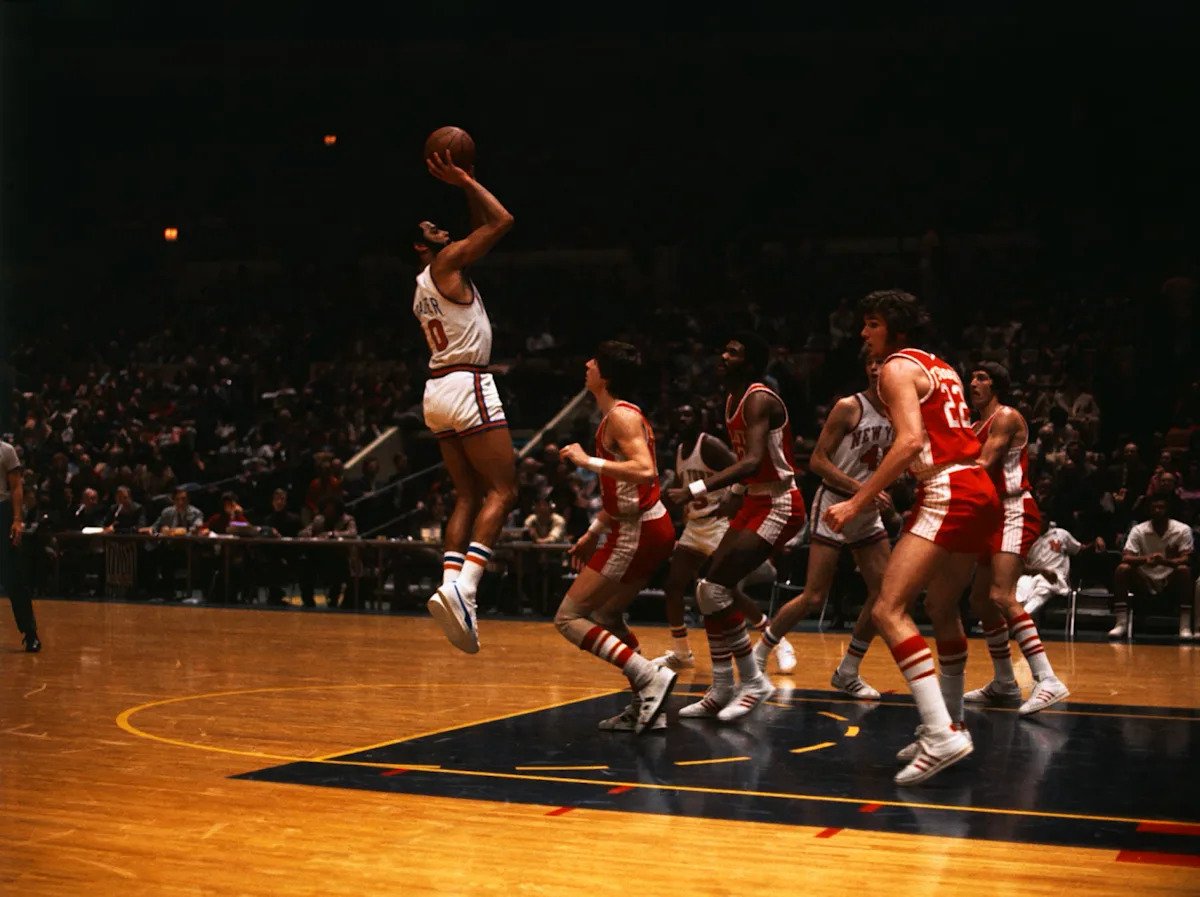
The first matchup between the two teams came in 1971, when the Knicks were at the height of their powers. This was a championship-caliber team, built on structure, depth, and discipline, and they approached the series against Atlanta the way great teams typically do when facing an opponent they are simply better than. The Knicks won the series 4-1 to move on to the Eastern Conference Finals. This was a team loaded with five players whose jerseys now hang in the Garden rafters, led by Walt Frazier and Dick Barnett, and they controlled the series from start to finish. Even when games got competitive, it never really felt like the outcome was in doubt. New York controlled pace, executed consistently, and imposed its style over the course of the series.
UNITED STATES – MARCH 26: Atlanta Hawks’ Pistol Pete Maravich is trying to faze New York Knicks Walt Frazier this time at Madison Square Garden. Walt got around the young Hawk to make a two-pointer, but shot was nullified because of violation of three point rule. (Photo by Frank Hurley/NY Daily News Archive via Getty Images) | NY Daily News via Getty Images
The numbers tell part of it, but the feel of that series says even more. The Knicks averaged 110 points per game, with Walt Frazier leading the way at 25.6 a night while doing a little bit of everything. Dick Barnett gave them another 22 per game. Inside, Willis Reed and Dave DeBusschere controlled the paint, combining for over 30 rebounds per game and setting the physical tone that Atlanta couldn’t match. It was not about individual brilliance as much as it was about collective reliability. That Knicks team knew exactly who it was, and Atlanta did not have the personnel or cohesion to disrupt that.
Advertisement
Nearly three decades later, the two teams met again in 1999, and this series carries far more weight when viewed in context. The Knicks entered that postseason as an 8 seed in a lockout-shortened season, having gone just 27-23 in the regular season. Expectations were minimal, and their first-round matchup against the top-seeded Miami Heat was widely viewed as a formality. Instead, the Knicks pulled off one of the most memorable upsets in franchise history, winning that series in five games and completely shifting the trajectory of their season. Waiting for them in the second round was Atlanta, a team that had finished 31-19 and was considered far more stable and complete at that point in time.
The Knicks had already adjusted to life without Patrick Ewing before the playoffs. This wasn’t a team scrambling to replace him, it was a team that had already evolved. Marcus Camby brought a completely different dynamic with his length, mobility, and defensive activity, anchoring a more aggressive and disruptive approach. He didn’t just fill a role, he changed the energy. His weakside shot blocking, quick rotations, and ability to cover ground gave the Knicks a defensive presence that felt everywhere at once, and when he got going, the Garden felt it. The rejections at the rim, the putback slams, the transition finishes, it all brought a level of electricity that fed into the team’s identity. On both ends, Camby made the game feel faster, more chaotic, and more alive, and Atlanta never adjusted to it.

NEW YORK – MAY 23: Marcus Camby #23 of the New York Knicks shoots a layup against Dikembe Mutombo #55 of the Atlanta Hawks in Game Three of the Eastern Conference Semifinals during the 1999 NBA Playoffs at Madison Square Garden on May 23, 1999 in New York, New York. The Knicks won 90-78. NOTE TO USER: User expressly acknowledges that, by downloading and or using this photograph, User is consenting to the terms and conditions of the Getty Images License agreement. Mandatory Copyright Notice: Copyright 1999 NBAE (Photo by Nathaniel S. Butler/NBAE via Getty Images) | NBAE via Getty Images
Offensively, the Knicks were led by Allan Houston and Latrell Sprewell, with Sprewell averaging 22.5 points per game and Houston adding 18. The offense controlled the pace, but it was the defense that dictated the series, leading to a second-round sweep of the Hawks.
Advertisement
That sweep wasn’t just another series win, it was a continuation of one of the most improbable runs in franchise history. As an 8 seed, the Knicks weren’t supposed to be there, and they definitely weren’t supposed to dominate a higher-seeded Hawks team the way they did. Instead, they stayed in control, carried their momentum from Miami, and moved straight through to the Eastern Conference Finals. From there, the run kept building, all the way to the NBA Finals, marking the franchise’s first appearance on that stage since 1994.
After 1999, the matchup disappeared again for more than two decades, as the two franchises moved through different cycles without ever aligning in the postseason. It was not until 2021 that they met for the third time, and this series carried a very different kind of significance. The Knicks entered the playoffs as the 4 seed in the Eastern Conference after a 41-31 season, marking their first postseason appearance since 2013. More importantly, they entered with a renewed identity under Tom Thibodeau, built around defense, physicality, and the emergence of Julius Randle as an All-NBA level player. Madison Square Garden, limited in capacity but fully engaged, provided an atmosphere that felt like a reintroduction of playoff basketball to New York.
Game 1 immediately shifted the tone of the series and added Trae Young to the list of Garden villains. Tie game, under 10 seconds left, ball in his hands. He waves off the screen, drives straight down the middle, freezes the defense just enough, and floats it in with 0.9 seconds left. No panic, no rush, just complete control in the biggest moment of the night. Atlanta stole a 107-105 win, but it felt bigger than just one game. That moment set the tone for the entire series. It gave Atlanta confidence, put the Knicks on their heels, and from there, the series steadily tilted in Atlanta’s favor.

NEW YORK, NY – JUNE 2: Trae Young #11 of the Atlanta Hawks smiles after the game against the New York Knicks during Round 1, Game 5 of the 2021 NBA Playoffs on June 2, 2021 at Madison Square Garden in New York City, New York. NOTE TO USER: User expressly acknowledges and agrees that, by downloading and or using this photograph, User is consenting to the terms and conditions of the Getty Images License Agreement. Mandatory Copyright Notice: Copyright 2021 NBAE (Photo by Nathaniel S. Butler/NBAE via Getty Images) | NBAE via Getty Images
Julius Randle, who had been the focal point of the Knicks’ offense throughout the regular season, struggled to find efficiency against Atlanta’s defensive schemes. The Hawks consistently sent help, crowded his space, and forced him into difficult shot attempts, disrupting both his rhythm and the overall flow of the Knicks’ offense. As a result, New York found itself relying on contested looks and late-clock possessions, unable to generate consistent scoring opportunities. Atlanta, on the other hand, maintained balance and execution. They spaced the floor effectively, created quality looks through pick-and-roll action, and received timely contributions from multiple players. Each time the Knicks appeared close to building momentum, Atlanta responded quickly, preventing any sustained shift in control.
Advertisement
The series returned to Madison Square Garden for Game 5 with the Knicks facing elimination, and while the energy remained present, the outcome increasingly felt inevitable. Atlanta closed out the series with a 103-89 win, taking it 4-1 and ending what had been a promising season for New York. The loss was not just about the result, but about how it unfolded. It exposed limitations, highlighted the difficulty of adjusting within a series, and underscored how quickly a playoff matchup can turn once control is lost early.

NEW YORK, NY – JUNE 2: Julius Randle #30 of the New York Knicks plays defense on John Collins #20 of the Atlanta Hawks during Round 1, Game 5 of the 2021 NBA Playoffs on June 2, 2021 at Madison Square Garden in New York City, New York. NOTE TO USER: User expressly acknowledges and agrees that, by downloading and or using this photograph, User is consenting to the terms and conditions of the Getty Images License Agreement. Mandatory Copyright Notice: Copyright 2021 NBAE (Photo by Nathaniel S. Butler/NBAE via Getty Images) | NBAE via Getty Images
Looking at the full history, the Knicks have won two of the three playoff series between the teams, taking the matchups in 1971 and 1999, while the Hawks claimed the most recent meeting in 2021. Each series reflects a different version of the Knicks. In 1971, they were a championship team executing at a high level. In 1999, they were a resilient, adaptive group that found a new identity under pressure and made an unexpected run to the Finals. In 2021, they were a team on the rise that encountered a moment it was not fully prepared to handle.
Now, with another opening round matchup set for this Saturday evening at the Garden for Game 1, the focus isn’t so much on the history between these two teams, but on what this round represents for the Knicks.
Advertisement
Over the past two seasons, they’ve taken clear steps forward, from a hard-fought second-round exit to last year’s Eastern Conference Finals appearance. With that kind of progression, expectations have shifted. This is no longer just about competing, it’s about breaking through.
That’s what makes this first round feel different. It’s the starting point of a run that needs to go further than it has the last two years. Knicks fans aren’t just hoping for another deep playoff push, they’re expecting one.

