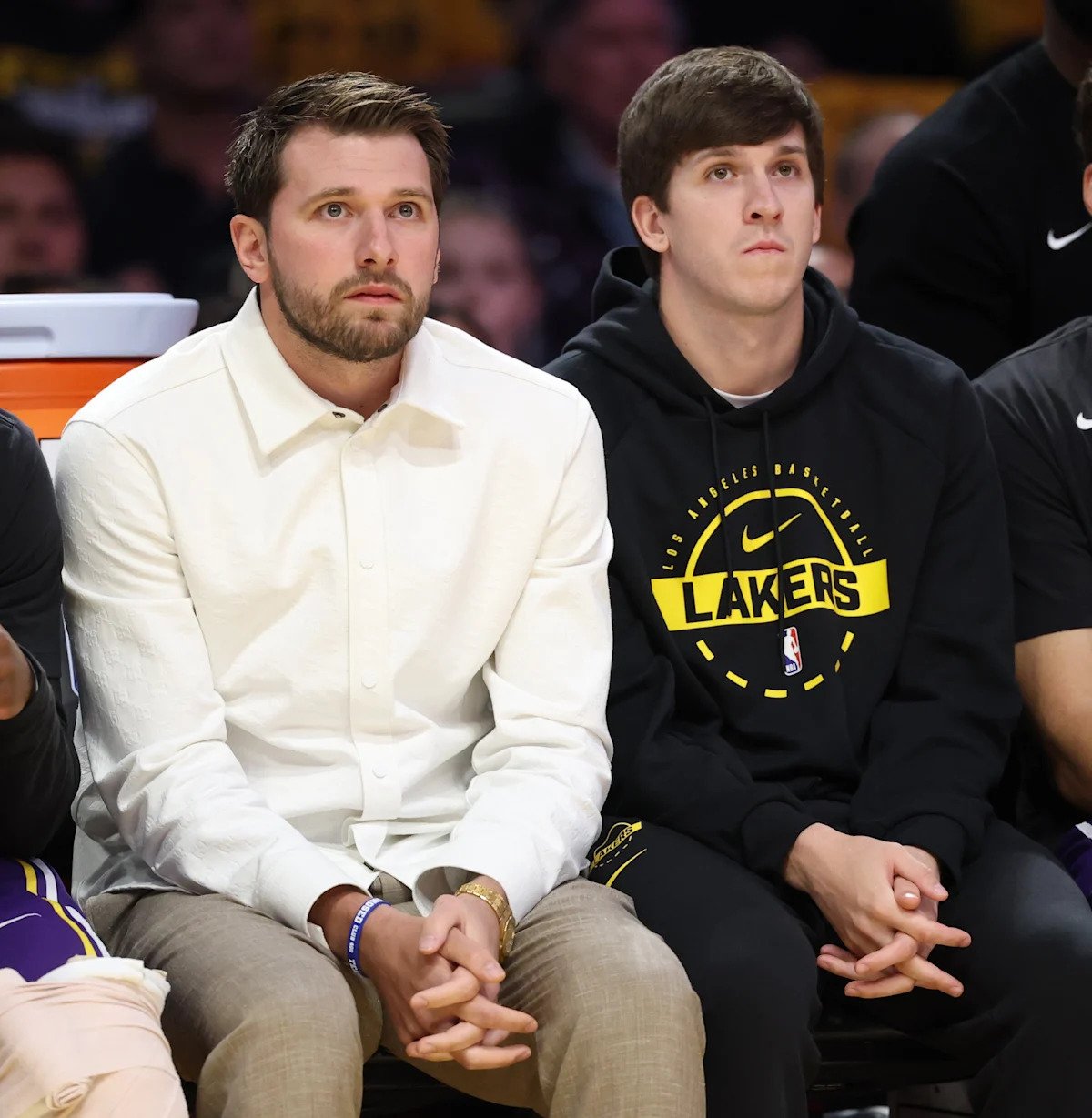
We’ve already gotten plenty of fireworks this offseason. Giannis Antetokounmpo is heading to the Miami Heat. LaMelo Ball is joining Anthony Edwards in Minnesota. Just yesterday, the Toronto Raptors traded for Kawhi Leonard again.
On the actual free agency front, we are, impressively at this stage, monitoring the status of LeBron James. The news — and later, confirmation from the man himself — that he’d be playing elsewhere set the sports world ablaze. It also leads to a pair of obvious questions:
Advertisement
1) Where is LeBron going to end up?
2) In light of the Lakers officially shifting to the Luka Dončić Era, how do they plan to build a contender around him?
Our own Kevin O’Connor recently ranked the field, but we have some time before we get the actual answer on LeBron’s next stop. We’ve gotten plenty of answers to the second question, though.
They officially kicked off their offseason last week by bringing back Austin Reaves on a four-year, $185 million max deal. As for outside free agents, they swung a sign-and-trade for Jazz restricted free agent center Walker Kessler, then agreed to terms with a forward in Sandro Mamukelashvili, a wing in Quentin Grimes and a guard in Collin Sexton.
Advertisement
(Somehow, we were alerted to all four of those outside acquisitions within 35 minutes of each other. Talk about a whirlwind!)
There’s still plenty of time for the Lakers to make other margin moves, but this initial wave of moves certainly warrants some analysis.
Let’s dig in, shall we?
Why was the price so high for Walker Kessler?
My earnest answer: While the intentions were positive and small market-minded, the concept of restricted free agency is an absolute scam.
The more practical answer: Because of the match rules tied to restricted free agents — incumbent teams have a right to match an offer sheet from an outside team, allowing them to keep young talent — outside teams have to provide ample incentive to pry away said talent.
Advertisement
That can be done in a couple of ways. You can drop the bag, hoping to present a price tag so high that the team decides not to match. You can also attempt to work out a sign-and-trade, offering picks (or other players) as an incentive so a team won’t match the offer sheet.
The Lakers chose the latter: sending two unprotected first-round picks in 2031 and 2033, along with first-round swap rights in 2028 and 2030 for the right to give Kessler a four-year, $130 million deal.
I don’t think the Jazz ever wanted to lose Kessler, but it’s hard to turn down that kind of pick haul.
Is Walker Kessler actually worth that contract and haul?
There’s going to be some natural sticker stock when it comes to the Kessler contract, though I’d say:
Advertisement
-
There’s an inherent level of “overpaying” when trying to pry a restricted free agent away from his original team.
-
While it may seem “nerdy,” it makes more sense to look at the percentage of cap a deal takes up instead of the pure dollar figure. The good folks at Spotrac project Kessler’s year-one salary to take up 18.3% of the cap this year; that’s well below a max number, and it puts him 10th among centers. Of the nine ahead, only two (Chet Holmgren and Alperen Şengün) are younger than Kessler.
To the actual player, Kessler fits a position and service of need for the Lakers.
The conversation should start with defense, as Kessler has been a tremendous interior defender since he stepped into the league. He’s averaged at least two blocks per game in all but one season — his most recent one, when he played five games and only averaged 1.8.
Per Cleaning The Glass, opposing offenses have taken a lower share of shots at the rim with Kessler on the floor. They’ve been less efficient at the rim with Kessler on the floor in all but last season’s five-game sample. There’s legitimate rim protection and deterrence with him.
One of the quieter subplots of Kessler’s Utah stint — and the Will Hardy era as a whole — is that the Jazz have been pretty liberal with shifting coverages. While Kessler is at his best in a drop, he’s been asked to do wildly different things throughout his career.
Advertisement
Most notably, he switched nearly 22% of the pick-and-rolls he defended during the 2024-25 campaign (fifth among centers to defend at least 500 picks) and was at the level (or higher) on over 40% of the pick-and-rolls he defended before going down last season.
Of course, there’s a difference between being asked to do different things and being proficient at different things, but the (late) switching piece in particular feels important.
Under JJ Redick, the Lakers have been among the switchiest teams in the league. Arguably more pressing, they simply haven’t been a team that’s wanted to put two-on-the-ball — the first-round series against the Thunder notwithstanding.
To mask their lack of high-level rim protection, they’ve paired their switching with aggressive gap help. This year, they married all of it together with a hybrid-zone look that often threw opposing offenses for a loop. With Kessler in the building, the Lakers may be able to mix in “softer” coverages with him on the backline, allowing the switching, gap help and zone usage to feel more like complements than necessities.
Advertisement
Raising the floor and ceiling of the defense should give the offense more room to breathe. In theory, having Dončić and Reaves should lock you into a high-level unit when they’re available. Kessler should help pry them open with screens, and their cadence as drivers should give Kessler time to roll and make himself available.
Kessler’s experience spacing on the wing — not to shoot, but to act as a release valve and handoff hub — should provide some secondary value to the half-court offense and enhance its flow a bit.
In short, this is a good, young center who should complement the Lakers’ offensive stars while hopefully taking the defense to another level. It’s not hard to map out why the Lakers had interest, or how he makes them better.
Advertisement
It’s still a pretty steep price. The contract is inoffensive to me for the reasons stated earlier, but the pick haul is a lot. Not being able to dump a contract on Utah as part of this deal — at least Dalton Knecht‘s, for example — feels like a miss, though I’m working at an information deficit.
(I’d like to believe that, during negotiations, the Lakers attempted to pull this off but were ultimately rebuffed by Utah. You could make the argument the Lakers should’ve walked away in light of that, but clearly they felt like they needed to get this done.)
It’d be one thing if the Lakers were just giving up those picks and swaps; the fact that those were their last (valuable) chips to play is where my head tilts a little bit. It’s less “Is Kessler good and helpful” — because the answer is an easy “yes” for me — and more “Is Kessler so good that he’s worth playing (arguably) your best hand.” I don’t know if I can quite get there.
Of the other free-agent additions, who should start?
Before directly answering that one, I’d just like to say I like all of these signings in a vacuum.
Advertisement
With Dončić and Reaves handling more of the creation duties, you need players who can consistently maintain or capitalize on the advantages created by those two. The trio of Sexton, Grimes and Mamukelashvili should be able to do that.
On a basic level, all three have been able to knock down spot-ups throughout their careers. Their career catch-and-shoot numbers, per Second Spectrum:
-
Grimes: 1,194 attempts, 38.9% from 3
-
Sexton: 963 attempts, 43.3% from 3
-
Mamukelashvili: 626 attempts, 36.1% from 3
And here’s their career work against closeouts:
-
Grimes: 2,144 closeouts, 1.13 points per direct attack
-
Sexton: 2,144 closeouts, 1.13 points per direct attack
-
Mamukelashvili: 1,270 closeouts, 1.04 points per direct attack
(Quick note: the league average for points per direct closeout attack since 2013-14 is 1.03.)
Grimes and Sexton are willing shooters (though there’s room for more aggression from Sexton), competent drivers against tilted defenses and capable self-creators when called upon.
Advertisement
Mamukelashvili is a quality connector due to his rare combination of ball skills and passing vision as a big. I’d also keep an eye on the initiation capabilities for Mamu; because he’s comfortable making plays, we’ve seen him have the freedom to grab-and-go after misses:
While none of the three profiles as a high-level defender, there’s a do-your-job element to each that could slot in well enough here.
Sexton lacks positional versatility, but it wouldn’t shock me if the Lakers ramp up their pick-up points with him on the floor. He can bother guards with early pressure and activity, though it’s worth monitoring his recoveries after navigating screens. Grimes generally fares better against wings than smaller guards, but he’s largely been a competent defender throughout his career.
Advertisement
I’ve had my questions about Mamu defensively; he’s not a traditional rim protector, and things have been dicey for him in space in the past. He felt more at home during his Raptors stint; I was particularly intrigued by some of the comfort he displayed when operating at the level or mixing in hedges (0.8 PPP allowed on those possessions, postseason included).
In terms of who should start among the three, I think Grimes should be a lock. His blend of 3-point volume, comfort as a secondary creator, (ghost) screener usage and defensive chops would complement the Dončić/Reaves duo nicely.
I think I’d prefer Sexton and Mamu as change-of-pace reserves with this group. You’d give both more freedom to create, with the hub/handoff work of Mamu popping with Sexton plus whichever of the stars get staggered with them (I’d lean Reaves in this case).
Advertisement
That would leave the fifth starter slot open. That could be Jake LaRavia (again) if the Lakers want to lean into more size and switchability on the perimeter to start games; maybe it’s if you really want to solidify the defense early — though that comes with understandable spacing questions if he and Kessler share the floor together.
Perhaps the answer isn’t on the roster yet; we just entered July, after all. To that end …
How close are the Lakers to true contention?
The combination of Dončić and Reaves, if healthy, should put them in the top-six discussion off the rip. Per Cleaning the Glass, the Lakers had a plus-8.2 net rating — including a blistering 120.2 offensive rating — with Dončić and Reaves on the court without LeBron. We’re naturally going to get a larger sample this year, but I have faith in the virtuosic talent of Dončić and the ascension of Reaves to maintain that level — if not improve upon it.
Advertisement
As we saw after the All-Star break, the Lakers can scheme and compete their way into a better-than-you-think defense. With Kessler in the mix, the floor and ceiling of this group should be higher. If this trio is healthy, it’s not hard to map out a pathway to 50-plus wins in the regular season.
When it comes to challenging the Spurs and Thunder, the last two Finals representatives from the West, they still feel a wing short. There’s room for more athleticism overall on the roster; I’ll quickly add that I love the Cameron Carr first-round draft pick, but I’m not sure how physically ready he’ll be this year.
I can’t get to Tier 1 with this group, at least not yet.

