PHOENIX — At times it is easy to forget how unusual the Minnesota Vikings‘ operation has been this offseason. There is no recent precedent for their decision to move through the primary team-building months of the year — February, March and April — with an interim general manager.
And without any assurances that he will get the permanent job — and no clear indication that he wants it — Rob Brzezinski has led the team through what he called this week a “strategic offseason.” The approach is geared in large part toward 2027, he said at the annual NFL league meeting, “to make sure that what we’re building now, we can sustain.”
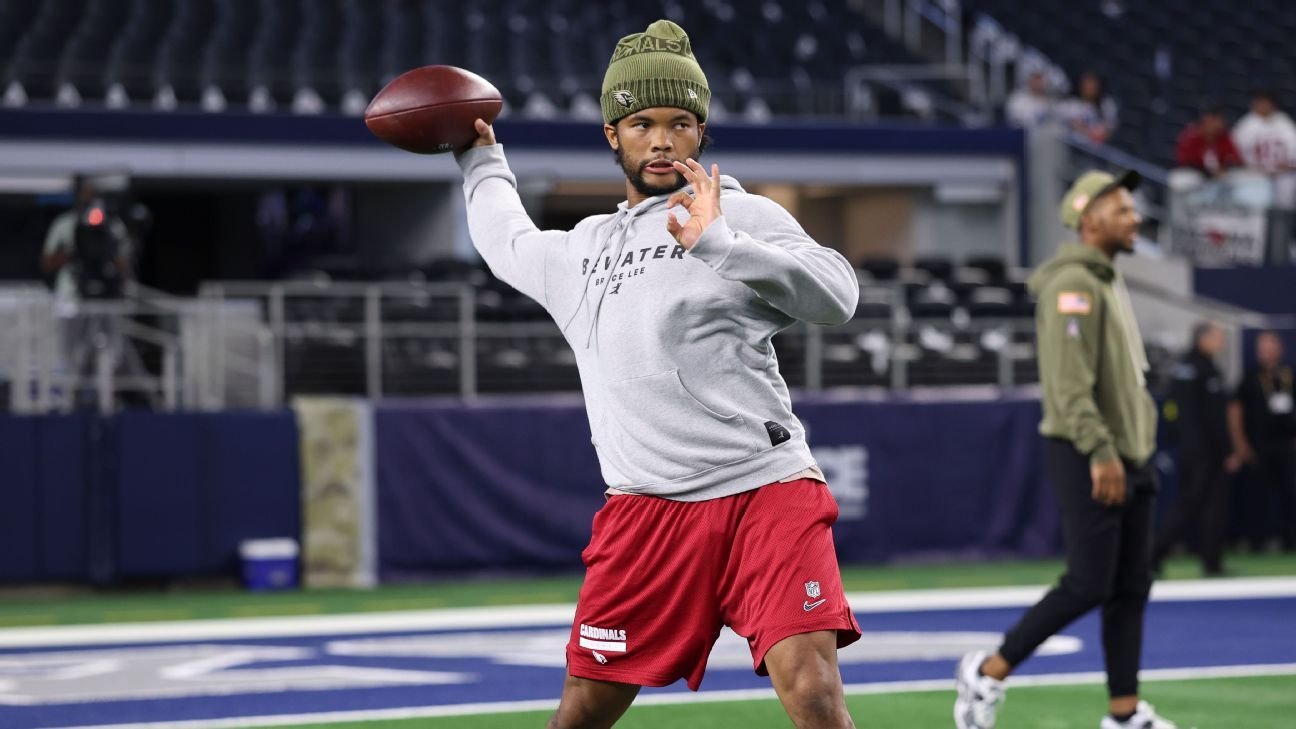
The Vikings have been the NFL’s lowest spenders on the free agent market, with a total commitment of $43.1 million, according to Over the Cap. That’s due in part to the fact that their most significant move, signing quarterback Kyler Murray, cost them only $1.3 million because the Arizona Cardinals were already on the hook for almost all of his $37.6 million salary.
Sources have said the Wilf family ownership did not order a reduction in cash spending. But Murray’s arrival, the overall depth at quarterback and the swift rightsizing of the financial picture have clearly boosted the franchise’s esteem.
“I think we achieved some really important things that we wanted to achieve,” Brzezinski said. “And I think there were some other things that we could have forced just to try to fill another need and we didn’t do that. I feel really good about that because we don’t kick off until September. We have some dry powder. There are going to be opportunities that present themselves, and we want to be in a position to capitalize between now and September for those opportunities.”
As reported earlier this week, coach Kevin O’Connell said he expects linebacker Jonathan Greenard to remain with the team. The Vikings also picked up the fifth-year option on wide receiver Jordan Addison‘s contract.
Let’s take a closer look at what else we saw, heard and surmised during three days in Phoenix.
No obvious answers to the GM question
When the Vikings fired general manager Kwesi Adofo-Mensah on Jan. 30 and replaced him on an interim basis with Brzezinski, the team’s longtime executive vice president, league sources were split on the future of the GM job.
Some thought that Zygi and Mark Wilf were clearing a path for the return of former assistant general manager George Paton, who has spent the past five seasons as general manager of the Denver Broncos and is entering the final year of his contract. Others assumed Brzezinski would eventually be promoted to the permanent role and that the Wilfs’ public neutrality on the question was mostly a function of the NFL mandate to conduct diverse search processes for every open GM job.
Based on conversations in Phoenix, it’s clear that neither scenario has begun materializing — raising the real possibility that the organization will go through a second change of direction in a matter of months.
There are no indications that Paton is on his way out in Denver or wants to leave. ESPN senior national NFL reporter Jeremy Fowler reported that Paton appears set to return, and Broncos coach Sean Payton has expressed hope that Paton will sign a contract extension.
Mark Wilf, meanwhile, spoke in decidedly neutral terms when asked about Brzezinski’s future. He noted Brzezinski’s experience and said “there is no one better in the business than Rob” at managing the salary cap and negotiating contracts.
But Wilf also laid out a process that would cast a wide net, including hiring a third party to help cull the list of candidates. A small group of existing staffers will assist in the process. That is expected to include O’Connell, who has a strong relationship with Brzezinski, as well as chief operating officer Andrew Miller, who led the committee that hired Adofo-Mensah. Wilf said the process would be “ownership-driven,” but the degree to which O’Connell or Miller play a leading role could well tip the scales in the Wilfs’ final decision.
Regardless, many NFL teams enter a GM or coach search with a preferred candidate in mind. In this case, the Vikings clearly do not have one.
A more Kyler Murray-friendly offense
One of the goals in hiring assistant head coach Frank Smith was to elevate and diversify the run game. O’Connell’s comments in Phoenix should have piqued the interest of anyone who has watched the Vikings’ offense during his tenure.
Smith’s arrival, O’Connell said, was “not necessarily foreshadowing for any one particular player we might add, but the idea of really being able to apply a lot of different principles in the run game: zone-based principles, gap, pull-based principles. But also doing it out of the gun, offset gun, pistol. I was thinking out in front of what might be to come, regardless of who we were fortunate enough to add at the position, but that’s kind of where the league is going anyway.”
Murray famously played in shotgun-heavy offenses during his seven seasons with the Cardinals. The Vikings, on the other hand, have put their quarterbacks under center much more frequently during O’Connell’s tenure — especially in the running game. Over that period, the Vikings have had the third-fewest run plays (404) out of shotgun or pistol formations.
Whether by design or not, Murray’s arrival and presumptive role as the starter should coincide with different types of runs — and run formations — than Vikings fans might be used to.
To the extent that anyone wondered how McCarthy would react to Murray’s arrival, his actions have spoken volumes. McCarthy concluded his offseason training in California, where he had been working with former NFL quarterback John Beck, and resumed work at the Vikings’ facility. NFL offseason rules prohibit McCarthy from working with Vikings coaches on the field, but he has been in the team’s weight room regularly.
“Obviously, the rules keep us from simulating what we’ll be able to do when the offseason program starts,” O’Connell said. “But I think J.J.’s had a really good offseason. I think he’s got perspective now. … He definitely has experience. He knows what it’s felt like to go in there and do some things at a really high level.
“Now, it’s just about consistency, and it’s about being in a competitive situation … to continue the arc of trying to become the best player he can possibly become. And I think he’s going to have a really good [OTA and minicamp], and I think it’s going to be a very competitive situation.”
Blake Brandel is a center, but maybe not the center
The departure of Garrett Bradbury after the 2024 season and the retirement of Ryan Kelly last month will leave the Vikings with a new starting center for the third consecutive season.
Based on conversations in Phoenix, the best way to describe the position is that it’s in flux. O’Connell has made one important decision by declaring Brandel — who has played all five offensive line positions — a center for the purposes of this offseason and likely for the 2026 season, as well.
It seems premature to call him the likely starter, however. O’Connell talked extensively about Brandel when asked generally about the position, saying he has “some pretty unique athleticism in his lower half that really bodes well for him to be able to get to the second level on different angles and get to different defenders.” But the coach also noted the presence of 2024 seventh-round pick Michael Jurgens and, notably, said he “wouldn’t hesitate” to add another center via late-spring/early summer free agency or in the draft if the opportunity presents itself.
At 6-foot-6, Brandel doesn’t have the typical build as a center. Last season, a center 6-6 or taller started roughly 25% of NFL games.
Brandel has spent most of his six-year career as a backup tackle and guard, with one season as a full-time starter in 2024. He played center last season only because Kelly and Jurgens were injured. Players with similar profiles don’t often emerge as long-term starters at this point in their careers, especially at a new position. The Vikings consider Brandel an option but not necessarily an ideal one.
At end of the last season, it was fair to wonder what the future held for Darrisaw after a particularly frustrating return from an October 2024 knee injury. He was on the active roster at the start of the campaign but managed only 10 starts at left tackle, five of which he left early, and finished on injured reserve.
The Vikings did not look to replace him this offseason, although they did sign a formidable backup in restricted free agent Ryan Van Demark. In Phoenix, O’Connell was asked if he thinks Darrisaw will be ready to play a full season in 2026. O’Connell expressed optimism for him playing 17 games, although it seems possible that Darrisaw will continue to follow a maintenance plan that limits his practice time.
“With an injury like that, sometimes time is truly the only thing that will ultimately get us to where we want to get to,” O’Connell said. “And I do believe we’re at that point now. He’s having a really good offseason. What that looks like, what his daily practice schedule and plan looks like, we’re going to do what we think is best to get Christian ready to play 17 games and feel at his absolute best to do so.”

