Back in 1993, the promoters of a heavyweight title fight between Evander Holyfield and Riddick Bowe had themselves a great idea. What if they did the bout outdoors at Caesar’s Palace in Las Vegas?
Just picture it. The cooling night air in early November. The fake Roman architecture looming in the backyard. Two heavyweights in the ring, slugging it out in the open air like they used to in the bare-knuckle days, when titles would be contested in a farmer’s field or offshore barge.
Advertisement
It was all going well enough. Then, in Round 7, a man dropped out of the sky.
“Somebody in a parachute has just landed on the edge of the ring,” commentator Jim Lampley informed viewers on the HBO broadcast. “He’s been pulled away by security guards. The fight has been brought to a halt. There’s a massive melee at ringside. … This is a monumental disaster.”
His name was James Miller, but he would henceforth be known simply as “Fan Man.” He’d jumped out of a plane with a parachute and a large motorized propeller on his back that helped him hit this small glowing target on the Vegas strip. For his trouble he was beaten by members of Bowe’s team, as well as other ringside bystanders, and was eventually released on $200 bail.
Advertisement
“It was a heavyweight fight, and I was the only guy who got knocked out,” Miller said later.
As for the fight? It was paused right there in the seventh round by referee Mills Lane. Marc Ratner, now the UFC vice president of regulatory affairs, was then the executive director of the Nevada State Athletic Commission, and still new on the job. As he later told the Las Vegas Review-Journal: “There’s nothing in the athletic commission rulebook that says what do you do when a guy flies into the ring.”
Ratner noted the time of the pause in the action and then, after a 21-minute delay that eventually saw “Fan Man” carted off to the hospital, the fight was restarted. There were still about two minutes left in the seventh round. The show would go on. Holyfield would win a majority decision. Bowe, whose pregnant wife at ringside had to be taken to the hospital following the sudden, stressful debacle, would lose his heavyweight title.
Maybe no one came right out and said it at first, but you know some had to be thinking it: This never would have happened at an indoor arena.
Nov. 6, 1993: James Miller, known as “Fan Man,” lands at ringside during Holyfield vs. Bowe.
(Holly Stein via Getty Images)
There are many potential pitfalls to an outdoor prize fight. So many variables, ranging from weather to wildlife to bizarre acts of man. This is why UFC CEO Dana White has strongly resisted setting up his octagon outside the friendly confines of an enclosed arena — until now.
Advertisement
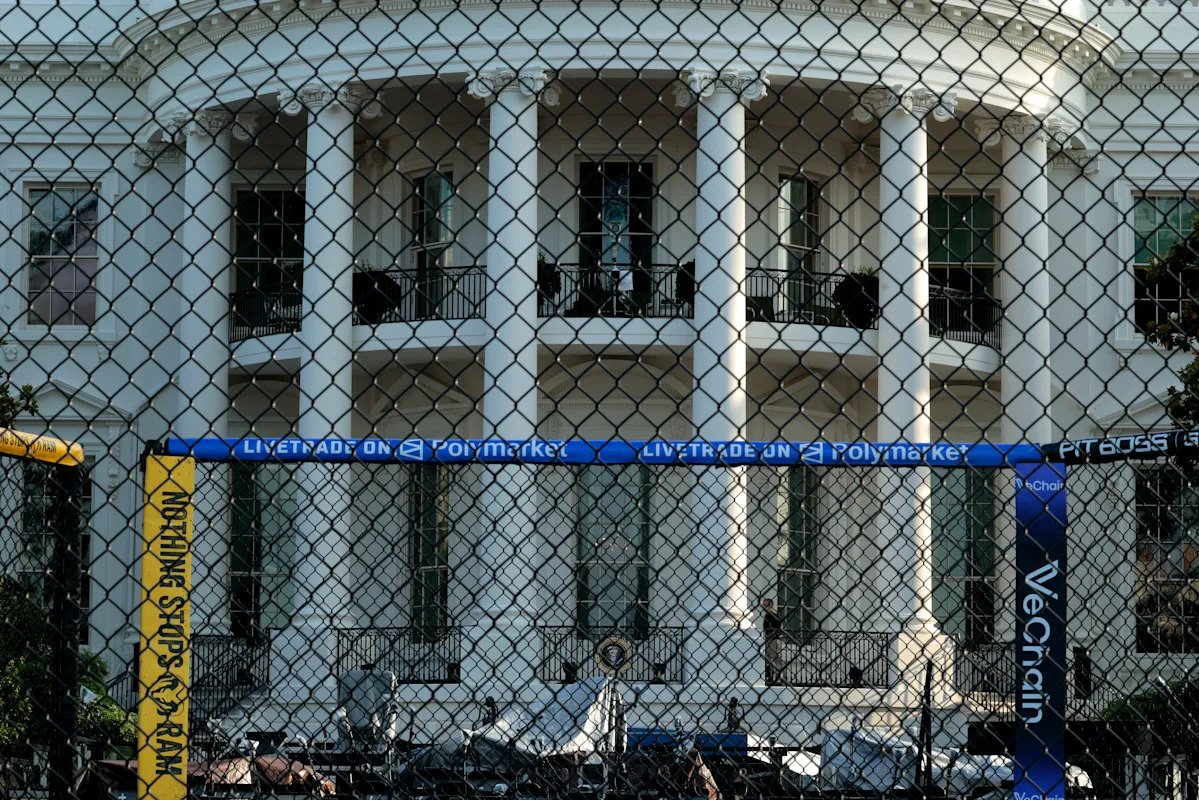
This Sunday, the UFC will put on the rarest of outdoor events, becoming the first promoter to ever stage professional bouts on the White House lawn. For this occasion the UFC has built a massive structure, known as “the Claw,” which serves as part lighting rig and part weather shield. In the event of a sudden, violent thunderstorm — not at all unheard of in Washington D.C. in June — there are concerns that it could also act as a lightning rod.
But having made it this far, White insists the show will go on regardless.
“I don’t care if it snows, rains, whatever — we’re going,” White told reporters earlier this week. “And even lightning. You guys all played sports when you were growing up. Whenever there was lightning, you’d sit the lightning out, and then when it was over, you played. That’s what we’ll do. And if there would be lightning, we’d know it days before, and then we would work around it.”
Ask the people who’ve done some outdoor MMA and they’ll tell you, it’s harder than it looks. And it’s not just the variables you worry about well in advance, like rain or even clouds of insects, which White has previously said could be an issue for this event. It’s also the little things you never thought to worry about until they became an issue.
Advertisement
Longtime MMA matchmaker Rich Chou found this out the hard way over the course of his career. He was working for Bellator when the promotion signed a deal to put on fights at various racetracks as part of the Monster Energy NASCAR Cup Series. Chou figured he knew what to expect, having been a part of multiple outdoor events in Hawaii and even the K-1 Dynamite!! event that saw the pro debut of Brock Lesnar at the Los Angeles Memorial Coliseum in 2007.
But when the Bellator crew went to set up their cage at the Charlotte Motor Speedway in late May, they encountered a problem.
“I remember the crew we had calling me over and saying, ‘Hey, we’re having some issues,'” Chou said. “The wood was warping as they were laying down the wood surface for the cage. The humidity, it was an issue. The weather was affecting the wood and they didn’t know if they’d have to cut it or what. I told them, ‘Boys, I’ve got the credit card right here. Tell me what you need.’ Because one way or another, we were figuring this out.”
Advertisement
Those events also faced obstacles that the UFC White House event should mostly manage to avoid, Chou noted. For one thing, they took place earlier in the day, under the full force of a hot sun. Simply walking around on the canvas with bare feet was unpleasant, Chou said, to say nothing of being planted on one’s back by a takedown.
“We started just grabbing bottles of water and walking around the cage pouring that water all over the canvas,” Chou said “And it was so hot and humid that it didn’t soak the canvas and drench it. It actually helped it. It cooled it down to where we could have the guys fight, because guys were stepping in the cage and saying, ‘Oh man, my feet are burning.’ So we had to address it.”

Bellator and NASCAR staged several events around the latter’s Cup Series.
(Sarah Crabill via Getty Images)
Over in Iowa many years prior, promoter and longtime fighter manager Monte Cox dealt with very different issues. In the wide open MMA world of the late 1990s, Cox said, he promoted multiple outdoor events, including at local minor league baseball stadiums. There, the big concerns were insects and rain.
Advertisement
Having attended summer baseball games in Iowa, Cox was familiar with the insect problems. He recalled emerging from games and finding his car “just covered with bugs.” So prior to his outdoor MMA events, he said, he sprayed various insecticides that mostly worked to combat the issue. But the weather in the Quad Cities region, that was another story.
Cox, who has since written a fascinating memoir about his experiences in that bygone era of MMA, recalled one outdoor event headlined by Pat Miletich, who would go on to become an influential coach and early UFC champion.
“I was monitoring the weather. You could see it, just dark clouds in the distance, moving closer,” he said. “I’m on the phone with the weather service, trying to figure out how much time we’ve got until it hits. Finally I just said, I’ve got to make a move. Everyone is here to see Miletich.”
With two fights left before the main event, Cox went to the fighter dressing rooms and told them there had been a change of plans. Miletich’s bout was happening now. The other two fights would go on after the main event, whether there was anyone left to see it or not.

Pat Miletich fought in plenty of bizarre settings in MMA’s early era.
(Zuffa LLC via Getty Images)
“I just made it with the Miletich fight,” Cox said. “It started raining but we got that one done. We went ahead and did the other two, but everyone [in the crowd] was bailing.”
Advertisement
As for what happens when you try to let an MMA bout go on in the rain, well, Cox found that out at an event in Wisconsin. Prior to the main event, rain starting pelting the outdoor arena at the casino venue. Cox told the last two fighters backstage that conditions were deteriorating, but he’d let them at least give it a shot if they were up for it.
“They were both good guys, so I told them, ‘Here’s what we’re going to do. I’m going to have you guys go out there and the first round, you guys are just going to go all out. And if someone submits somebody or knocks somebody out, we’re going to count it. If you don’t finish in the first round, I’m going to call it and it’s going to be a no-contest, because I’m not going to make you go three rounds in that stuff.'”
But then Cox had to find a way to sell this unorthodox idea to the paying attendees who’d been sitting in the rain, waiting for the headliner. The method he settled on was some minor sleight of hand.
“I went out and I told the crowd that I’d talked to the athletic commission, which was all bulls*** because we were in a casino, but I said the commission had told me it was too dangerous to continue. And I probably had a thousand people there, it wasn’t huge. But everyone starts booing. So then I told them I’d gone back to tell this to the fighters and they said, ‘Bulls***, we’re fighting.’ Then they all start cheering. The place went crazy. They loved that. So then when I called it after one round, they weren’t pissed off, because they felt like they’d gotten something that they shouldn’t have gotten. Plus I think by then they were tired of sitting in the rain. But it really was way too wet for a fight to happen. They were slipping and sliding. It was a mess.”

Rain or shine, “The Claw” is ready for UFC Freedom 250.
(ANNE LEBRETON via Getty Images)
One consistent narrative that emerges in most of these stories? In more or less any conditions, the fighters are game to compete. After all the hard work in training, they typically remain undeterred by heat or rain or humidity or acts of God. Even in searing temperatures at those NASCAR races, Chou said, he never heard a fighter voice opposition to the idea of fighting outdoors.
Advertisement
“They were just excited for the opportunity,” Chou said. “It was something new. They just wanted to get out there and fight.”
For the promoters, however, the experience often feels different. Cox said that his outdoor events usually left him walking away saying “never again” — until the next time. Chou recalled early on in his career, putting on events in Hawaii’s Aloha Stadium and waking up to rain on the morning of the fight.
“That is not a good feeling. We were nervous all day,” Chou said. “But also, we were young and excited. We wanted to do big things. We embraced it, and for us it was more about all the reasons to do it and not the reasons not to do it. And now, looking back, I’m really glad I got to be a part of that.”
As for the “Fan Man” Miller, people later wondered what he’d been trying to accomplish by parachuting into the Holyfield-Bowe fight. What was the goal? What could the best-case scenario have possibly looked like?
Advertisement
They wondered it again when he continued with similar stunts, like circling an NFL playoff game in 1994 and then getting himself banned for life from the United Kingdom after interrupting an FA Cup match one month, only to land on the roof of Buckingham Palace the next. When asked what his aims had been, his answers sometimes seemed vague or even contradictory.
“He basically was bucking society,” his brother, Eric, told the Associated Press after Miller’s death by suicide in 2002. “He was mocking our rules, making up his own as he went along, kind of just making a mockery of our society and the way it works and what our expectations are.”
He’d always been that way, Miller’s brother said. “I always thought he was capable of anything — good or evil — you never knew what he was going to do.”
There are such people in the world. Which is one more variable you have to account for in your carefully laid plans. There’s always someone willing to disrupt those plans, maybe for no other reason than to show that he can.

