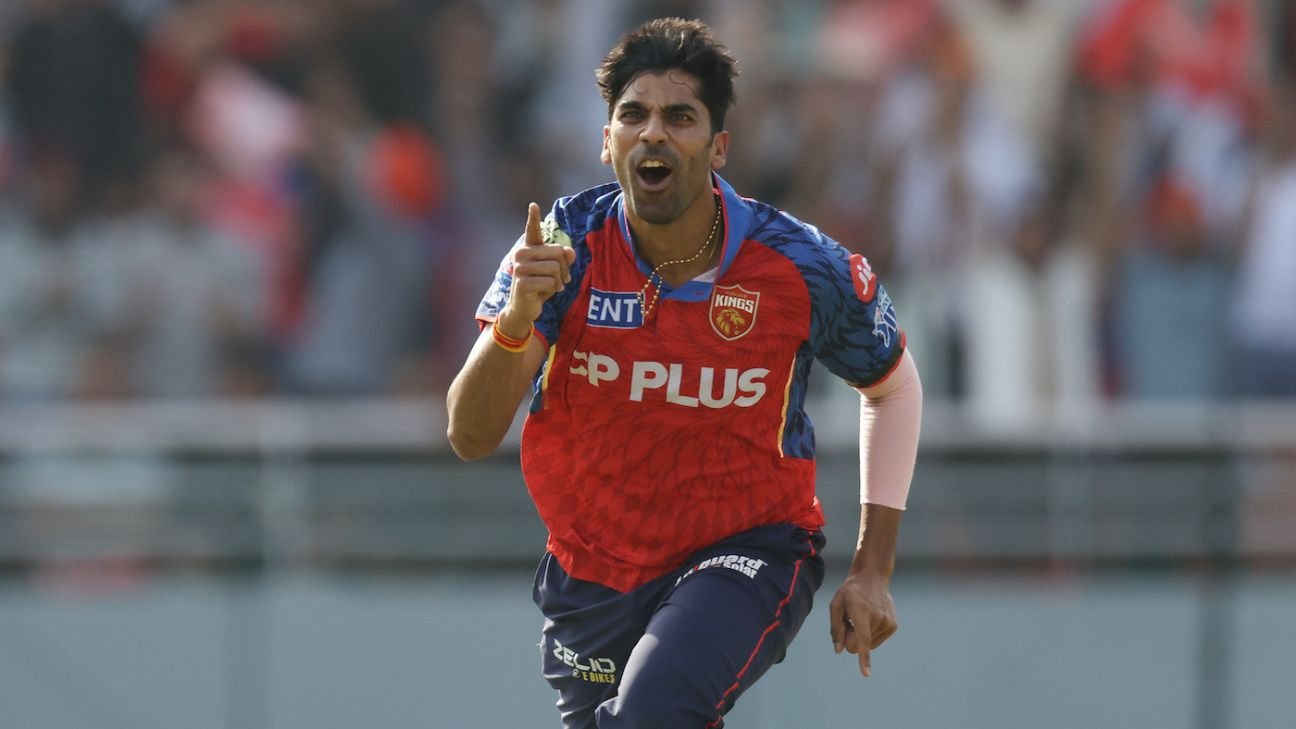
If there was one bowler Sunrisers Hyderabad could reasonably have left out of their plans, it was Shashank Singh.
Before Shreyas Iyer tossed him the ball in a bid to stop the Travishek surge, Shashank had sent down just 426 deliveries across 100 T20s – barely four balls a game. Over more than a decade in the format, he had picked up 30 wickets in total, and only one in the IPL.
All he had seen until then was carnage; SRH had surged to 107 without loss in the powerplay. Arshdeep Singh had been plundered for 33 in two overs, Vyshak Vijaykumar for 24. Even Marco Jansen, with his height and steep bounce, had been hit for 16.
What chance, then, did a dibbly-dobbly medium-pacer, barely nudging 120kph, have on a surface offering no seam movement and no swing? Not certainly against the powerplay OGs of the Impact Player era.
Abhishek Sharma had just ransacked an 18-ball half-century, and Travis Head was playing second fiddle while striking at 200. And yet, this was exactly the kind of moment Shashank had been waiting for.
As Iyer would later reveal, the move wasn’t entirely his own. Shashank walked up to his captain and asked for the ball. With the batters “going bonkers”, Iyer felt a change of pace could disrupt their rhythm. It was still a gamble. Even coach Ricky Ponting, during the time-out, checked in with Iyer: “What’s your thought?”
“I said I’m going to go with Shashank because I need someone who bowls at around 120kph. I need to take the pace off against these two batsmen,” Iyer explained later. “He lived up to his expectations… he said he’d take a wicket, and he did that. Kudos to him and his thought process.”
So what did Shashank actually do?
For starters, there was acceptance of his limitations, and a plan built around it. He set two sweepers on the off side, seemingly keen on keeping the ball away from the left-handers’ hitting arc. If he could shut down their strongest scoring zones, he could force them into riskier options elsewhere. Head felt that almost immediately when he was drawn into a low-percentage scoop in Shashank’s first over, which went for just six.
Having started strongly, Shashank wasn’t swayed into experimenting with variations and stayed true to the method that had kept the lid on. He kept angling the ball across the left-handers, refusing to bowl into their arc. He opened his second over with a cutter, and Head was drawn into the trap. The bottom hand came off as he tried to swat it down the ground, but he was neither to the pitch nor in control, as the miscue tamely carried to long-on.
Two balls later came the double blow. Abhishek holed out to deep cover, undone while trying to keep the momentum going. In truth, it was there to be hit, but this was also the reward for persistence, for sticking to a plan that had already begun to sow doubt. Shashank’s celebration said it all.
At that moment, there may have been a sense of déjà vu. Two years ago, he had dismissed Abhishek for his first IPL wicket in eerily similar fashion – a blazing innings was cut short as he mistimed a hit to cover.
“Whenever I bowl in the nets, I plan for these situations only,” Shashank said after the game. “We have a good bowling attack, so I know I’ll only bowl when something like this happens. I’ve planned my lines and lengths much before the IPL, so whenever I bowl, I’ll bowl that way. And Abhishek is a world-class batsman… getting him out twice feels good.”
His opportunities with the ball in the IPL may have been limited, but Shashank is not a complete stranger. On slow, black-soil surfaces in Bhopal and Bhilai, where three T20 games are sometimes played on the same day, he has benefited from these methods: cutters, change of pace, and forcing batters to generate their own power on tiring surfaces of varying degrees.
Therefore, it seemed like no coincidence that the cutter remained his default option on Saturday.
“I love my bowling, to be honest,” he said. “I love these kinds of situations when the chips are down, because I can use my smartness. I know I have limitations, and I don’t run away from that. But with some smartness, I can do something for the team.”
Shashank had bowled three overs by the 11th and wasn’t thrown the ball for the back half. By then, he had given the PBKS bowlers some sort of blueprint on what could work better. It went a long way in restricting SRH to just 219 when 250 seemed likely at one stage.
And that made a massive difference in the end against a batting order in rip-roaring form. Fittingly, the icing on the cake was Shashank hitting the winning runs long after he had left his imprint.

