PRETORIA — With South Africa‘s eyes upon Wednesday’s crunch Betway Premiership clash between Mamelodi Sundowns and Kaizer Chiefs at Loftus Versfeld, officiating controversy overshadowed a 1-1 draw.
It was a potentially decisive blow to Sundowns’ title charge, and justification for anyone who believes Video Assistant Referee (VAR) technology is needed in the country.
In fairness to experienced referee Luxolo Badi and assistants Romario Phiri and Romeo Matibidi, it was a difficult game to officiate, with several tight calls which could only be decided subjectively.
There were some decisions, however, that were objectively wrong and damaging to South African football. This applies not only to the image of the Premier Soccer League (PSL) – rightly renowned across the continent as one of Africa’s most professional governing bodies – but potentially to Bafana Bafana ahead of the FIFA World Cup.
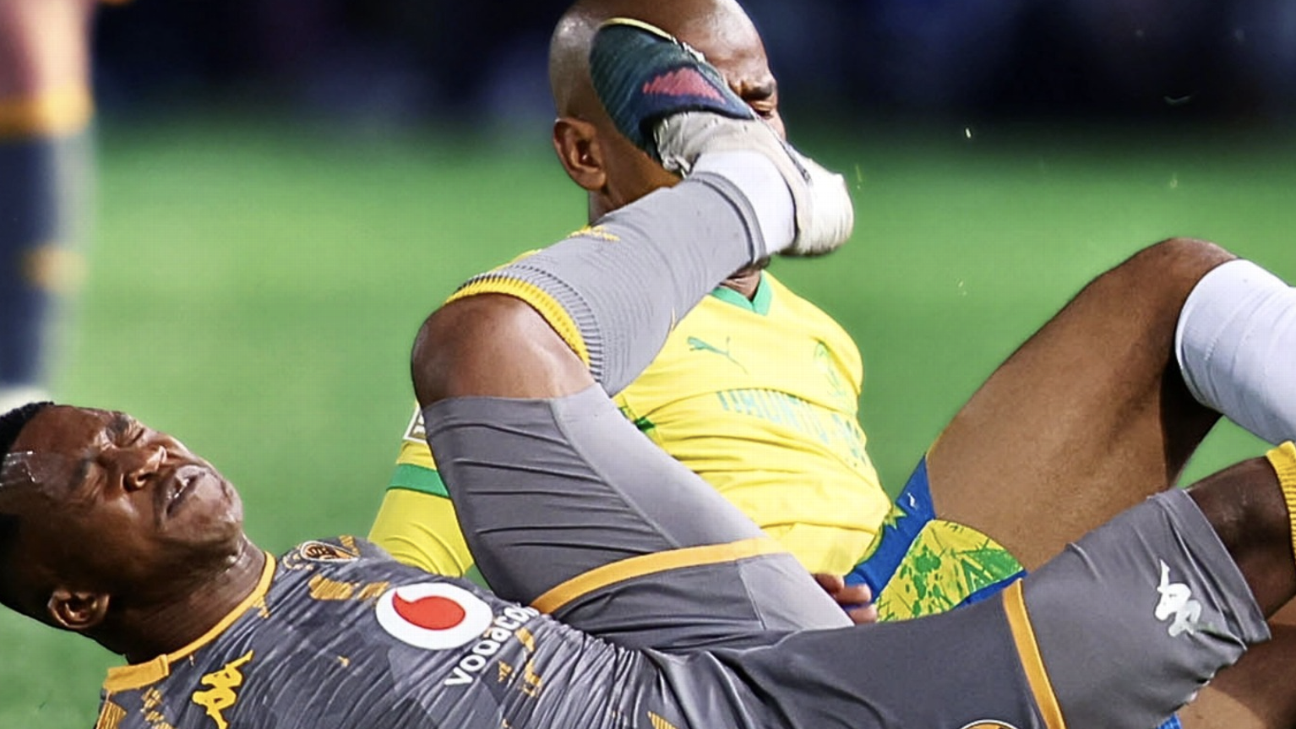
Chiefs’ Mduduzi Shabalala has been knocking on the door of Hugo Broos’ Bafana Bafana squad in recent months. Sundowns and Bafana Bafana midfielder Jayden Adams was lucky not to be sent off for the challenge which injured Shabba late in the first half.
When Adams was shown a second yellow card for simulation and ultimately given his marching orders in the 64th minute, it was for a far less clear-cut infringement than the lunge on Shabalala in the first, which produced only his first yellow.
However, the luckiest player of all was Kaizer Chiefs midfielder Siphesihle Ndlovu, who could easily have been sent off three times over, but was given no more than a yellow card before he was substituted off around the same time as Adams was sent off.
Prior to Adams’ challenge on Shabalala, Ndlovu had been given a yellow card for a late challenge on Keanu Cupido, which saw the Sundowns centre-back suffer heavy impact to the collarbone and arm, which had been forced into an unnatural position by the time he thudded on the turf.
Major doubts now hang over Cupido’s availability for Mamelodi Sundowns ahead of the two-legged CAF Champions League final against AS FAR (May 17 & 24).
Ndlovu had led with a high boot, but attempted to retract it before the collision. There is a reading of that incident which could see Ndlovu given the benefit of the doubt for the challenge, though Mamelodi Sundowns head coach Miguel Cardoso certainly did not see it that way.
“Something is broken… but he didn’t fall on his arm. When he fell, the arm was already broken,” Cardoso said in response to ESPN’s question at the post-match press conference.
“That is different from what happened with the player from Kaizer Chiefs because [the foul on Shabalala] is an action which is a yellow card – correct – the first yellow card on Jayden. When [Cupido] falls, the arm is already broken. That is completely different,” an irate Cardoso continued.
In fairness, the Portuguese tactician’s frustration is well-founded. Even if one offers a more generous reading of Badi’s interpretation of that foul from Ndlovu, the referee cannot be given the benefit of the doubt on Ndlovu’s subsequent elbow on Khuliso Mudau, or his unsporting grab of Tashreeq Matthews‘ head – neither of which produced a second yellow card.
IFAB law 12.4 stipulates: “Violent conduct is when a player uses or attempts to use excessive force or brutality against an opponent when not challenging for the ball, or against a team-mate, team official, match official, spectator or any other person, regardless of whether contact is made.
“In addition, a player who, when not challenging for the ball, deliberately strikes an opponent or any other person on the head or face with the hand or arm, is guilty of violent conduct unless the force used was negligible.”
While the elbow on Mudau and grab on Matthews may not have resulted in serious injuries, the force from Ndlovu cannot reasonably be described as “negligible” – and he should therefore have been given his marching orders even if he were not already on a yellow card.
A separate pull from the midfielder on Adams could equally have seen Ndlovu pick up another yellow card.
In fairness to Chiefs, Aubrey Modiba could also have been sent off for his 82nd minute lunge on Gastón Sirino, which produced only a yellow card – as co-head coach Khalil Ben Youssef was at pains to point out in the post-match press conference.
One can only infer from the consistency of Badi’s leniency on several heavy challenges from both sides that he likely made a conscious decision to lean on the side of letting the game flow when in doubt.
However, he erred on several occasions, and VAR could have come to his assistance if in use.
His assistants could also doubtlessly have used some help with several tight offside calls – two of which involved Matthews, whose natural style of play often leaves him right on the borderline as he seeks to latch onto a ball in behind. At the very least, Matthews deserves to have the timing of some of his runs reviewed by a second pair of eyes through VAR.
Sports, Arts & Culture minister Gayton McKenzie said in March that his department had paid the South African Football Association (SAFA) for the introduction of VAR in South African football next season.
SAFA, it should be noted, is the body overseeing referees in the PSL. This, in and of itself, is a matter of some controversy. Former ref Victor Hlungwani recently told the Switch On Network YouTube channel that while compensation for match officials has improved, there are still unresolved issues regarding the full professionalisation of the field in South Africa.
Regardless of the politics involved, it is clear after a potentially decisive match in the Betway Premiership title run-in that the rollout of VAR simply cannot afford to be delayed any longer.

