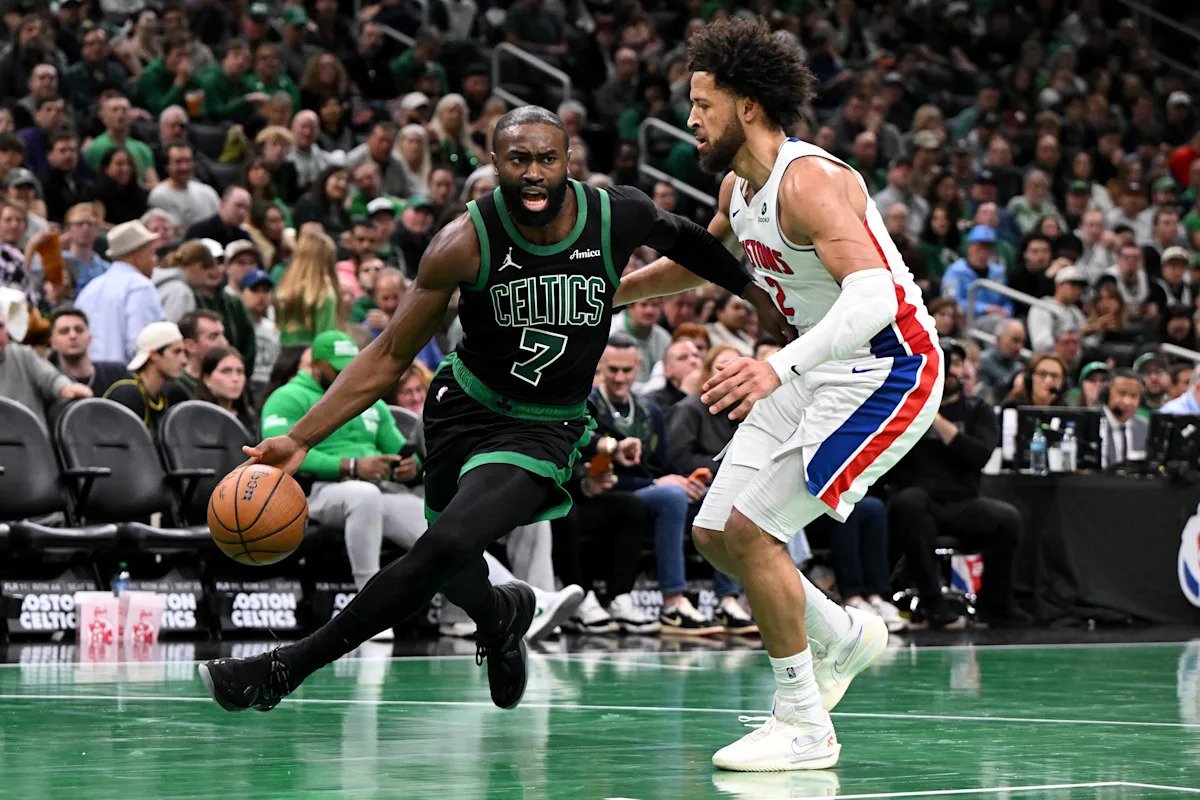
Jaylen Brown had some things to say about the NBA’s regular season awards on Wednesday.
In the wake of Cade Cunningham’s lung collapse, robbing him of consideration for All-NBA and MVP awards, Jaylen Brown reminded everyone that back when the 65-game minimum threshold was written into the current CBA—by the NBPA and the league—it was met with largely unalloyed approval from fans and players alike.
We felt that players should be expected to appear in a significant majority of their team’s game in order to qualify for season awards that are, after all, awards for performance over the entire season.
On his Twitch stream, Brown said, “You can’t have dudes playing 45-50 games and winning First-Team All-NBA. You basically came to work half the time and got rewarded for it.”
And that, friends, is the rub.
Consider a pile of sand.
Remove one grain.
Is it still a pile of sand?
Yes?
Remove another grain.
Is it still a pile of sand?
Yes?
Remove another grain.
At some point in time, your pile of sand will stop being a pile of sand.
And so it goes with this notion that there shouldn’t be any game limit for regular season awards. You can say that you don’t think there should be a limit, but common sense dictates that there is, in fact, a limit.
After all, absent any limits, you could make a case for an All-NBA nod for a guy who plays one game, scores 40 points, and then tears his ACL in his next game out. I mean, the guy has a 40 PPG average!
Obviously, no one who wants the games played limit abolished would say that a guy who plays a single game deserves consideration for All-NBA status, which means that they have a games played limit—even if they don’t admit to it.
The only thing this dictated games played limit does is put the limit out there in the open for everyone to apply. It doesn’t establish a limit, it standardizes it.
It stops voters from shading things so that they’ll give LeBron consideration for All-NBA status (played in 53 games so far), while dismissing Victor Wembanyama—who’s been subject to more obvious load management—and who’s appeared in five more games than LeBron thus far.
This way, the arbitrary rule—and it is as arbitrary as most rules of this sort are—is at least universally arbitrary.
The fact that some players are going to be ineligible due to the existence of the rule is hardly a plausible argument against the existence of that rule. The whole point of rules is to set boundaries, to establish limits. Rules define things, and definitions, by their very nature, exclude as well as include.
That some of these players received consideration in the past despite missing a significant number of games is not an argument in favor of abolishing this rule, and the fact that some players have been hampered by injuries is, to be blunt, the nature of the game.
Look, if you play in fifty games and look absolutely amazing in those 50 games, and because of you, your team wins most of those games handily, that’s great. But what are you doing for your team during the 32 games you missed? Nothing. What are you doing as far as performance against your peers in those games? Nothing.
That’s what matters in this debate—and what gets overlooked—when you’re not playing, you’re not contributing, and when you’re not contributing, you shouldn’t be accruing “points” towards regular season awards.
Basketball in the NBA is a mass-produced commodity. In the course of the regular season almost 60,000 minutes of basketball are manufactured and consumed. When you’re playing, you’re putting something out there that can be evaluated, measured, weighed and considered in context. When you’re not, you’re not.
Yes, there’s a laundry list of name brand players who are either ineligible for these awards or are on the cusp of ineligibility this season, but the thing about these awards is that they are supposed to be about what you do, not who you are.

