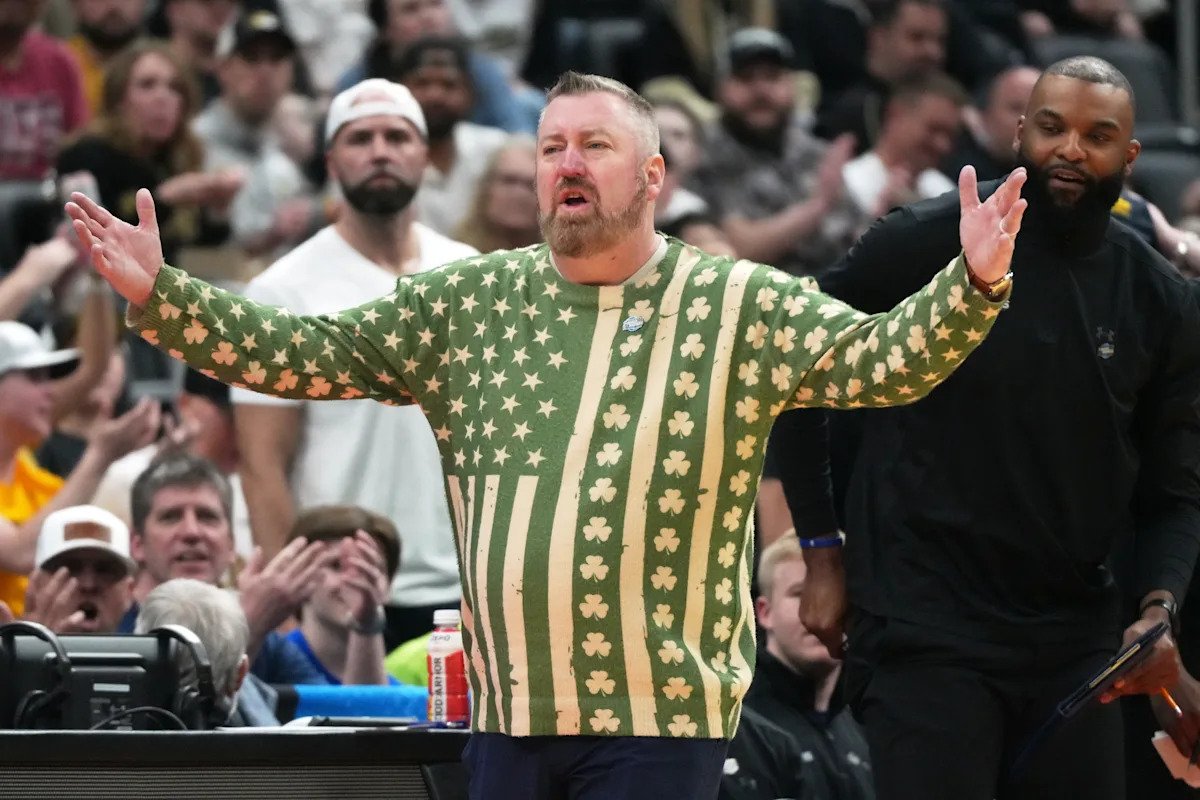
When his team opened conference tournament play earlier this month, Queens University men’s basketball coach Grant Leonard glanced into the stands and was surprised by what he saw.
Sitting courtside, Leonard said, was an SEC assistant coach who was there to get a head start scouting and recruiting a Queens player who had not yet entered the transfer portal. The SEC assistant wore school-branded apparel just like coaches do when trying to make their presence known to high school prospects while attending Peach Jam or other AAU tournaments.
Advertisement
“I don’t think it is the right thing ethically to go to our conference tournament, sit on the floor and try to interact with my player in an elimination game,” Leonard told reporters Thursday on the eve of Queens’ first-round NCAA tournament game against Purdue. “That is my opinion; it is not a fact. Is it permissible? Maybe, maybe not. Is it ethical? In my opinion no.”
Stories like that help illustrate why the Cinderella runs that have long been the lifeblood of the NCAA tournament are rapidly becoming more scarce. The gap between college basketball’s haves and have-nots is rapidly widening because top-tier programs can offer massive NIL payouts to the best available talent and because transfer rules no longer prevent players from switching schools as often as they want without penalty.
The name-brand programs who have advanced in this year’s NCAA tournament have treated mid-major teams like their personal farm system. Their rosters are littered with players who began their college careers at a lower level, from Michigan’s Yaxel Lendeborg, to Louisville’s Ryan Conwell, to UCLA’s Donovan Dent, to Tennessee’s Ja’Kobi Gillepsie.
Those player retention issues have eaten away at the biggest advantage that small-conference programs used to have in March. The Loyola Chicagos, Wichita States and Butlers of the past overcame the talent gap with older players who developed superior cohesiveness through years of playing together. That’s harder to pull off today with wealthier programs sliding into players’ DMs or making life-altering offers through back channels.
Advertisement
The ability to offer NIL payouts well into seven figures has also allowed high-majors to recruit guys who in the past would be playing professional basketball. Teams at the top of this year’s NCAA tournament bracket are loaded with prized freshmen, international prospects and proven veterans who can earn more playing college basketball than they can in overseas pro leagues, the G League or even on an NBA two-way contract. There are teams who are paying six figures to players coming off their bench.
The concentration of talent at the top of college basketball is exemplified by how the past two NCAA tournaments have unfolded.
For the first time since the NCAA tournament expanded to 32 teams in 1975, every team that advanced to last year’s round of 16 hailed from a power conference. Only one plucky double-digit seed managed to crash the party, a John Calipari-coached Arkansas team assembled thanks to one of the sport’s largest NIL war chests.
This year’s NCAA tournament is so far following a similar historically chalky pattern. High Point was the only team seeded 12th or worse to advance out of the round of 64. Siena was the only other team seeded 12th or worse to lose by fewer than nine points. The average margin of victory in the first round was 17.4 points, the highest since the tournament expanded in 1985 per ESPN research.
Advertisement
Two NCAA tournaments may be a small sample size, but regular-season results also reflect the growing chasm between top-tier teams and everyone else. There were 378 matchups this November between high-majors and non-Gonzaga teams from other conferences. The little guy won only 22 of them, according to research by Yahoo Sports.
“In the past, if you did a good job evaluating and a good job recruiting and you found guys who were a notch above your level, they wouldn’t leave because they’d have to sit out some place,” former Fairleigh Dickinson and Iona coach Tobin Anderson told Yahoo Sports in November. “Now with the portal and nonstop free agency, a good low-major or mid-major team for the most part is going to lose its best players every year.”
By the numbers, Duke, Arizona and Michigan entered this year’s NCAA tournament as three of the strongest No. 1 seeds in recent memory. Each boasted KenPom adjusted efficiency margins of at least 37.59, meaning that’s how many points that college basketball statistician Ken Pomeroy would project them to outscore the average Division I opponent by over 100 possessions.
Since the KenPom era began in 1997, only 10 teams have ever finished a season with adjusted efficiency margins higher than 35. Four of those are last year’s No. 1 seeds.
Advertisement
It isn’t just the No. 1 seeds who were unusually formidable this season. A total of 20 teams seeded sixth or higher entered the NCAA tournament with adjusted efficiency margins of plus-25, compared to just four at the end of the 2022-23 college basketball season and nine the year before that.
It’s the opposite story for schools from single-bid leagues, the sorts of programs who populated the seed lines at the bottom of this year’s bracket.
That’s why this has been another NCAA tournament where the giants have swatted aside the giant slayers, where the teams that advance have deep pockets, not glass slippers.

