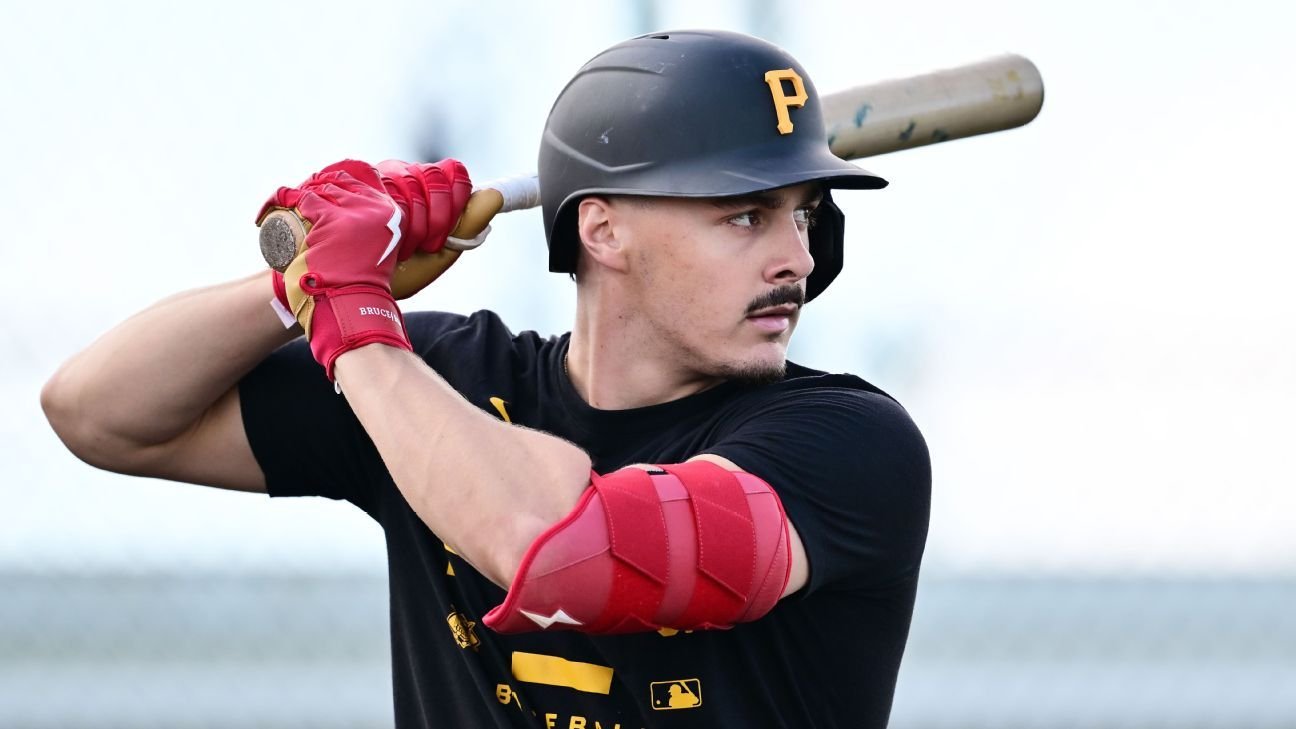
BRADENTON, Fla. — The first time Konnor Griffin visited Maven Baseball Lab in Atlanta, he did something no one there had ever seen. Since opening in 2022, Maven has assessed thousands of baseball players with force plates that use sensors to measure the amount of energy being transferred into the ground during a swing. Griffin was the top-ranked 16-year-old in the country, a 6-foot-4, 200-pound specimen, and the plate was no match for him.
Though the plate was anchored into a portable frame that had withstood swings from perennial major league All-Stars and MVP-caliber players, the force Griffin was creating jarred it loose, cajoling it out of place. Once the awe of onlookers subsided, they scrambled to place 45-pound weights on each side of the plate, hopeful that would suffice in keeping Griffin from wrecking the setup. It did, though those at Maven learned that day what others in the world of Major League Baseball have in the years since: It’s damn near impossible to keep Konnor Griffin — and anything he touches — down.
“You’re looking at a Ferrari,” said Tyler Krieger, the co-owner of Maven and a former Cleveland minor leaguer. “You’re not looking at a little Fiat.”
This spring, the Pittsburgh Pirates are endeavoring to figure out whether they’re ready to take their F40 for a spin. Now 19 years old — and the No. 1 prospect in the game after a tour de force 2025 in which he dominated three levels and was the consensus Minor League Player of the Year — Griffin entered camp with an opportunity to win Pittsburgh’s every-day shortstop job. Regardless of whether he secures an Opening Day roster spot, Griffin will debut at some point this season and join Paul Skenes as the best pair of young players on any team in baseball.
And until the Pirates make that decision, the eyes of the baseball world will be trained on Bradenton. Griffin represents more than a glimmer of hope for a woebegone organization. He is the dream of any franchise: top-of-the-scale power and speed, with a nifty glove and shotgun-blast arm, the kind of work ethic that will make any slacker in his orbit feel like a lout and a demeanor so polite and accommodating that the words “yes” and “sir” might as well be surgically attached to one another.
Now, two years after missing out on earning a first-round draft pick because they kept Skenes in the minor leagues to start the season — after he won the National League Rookie of the Year, they would have been awarded the pick through the prospect promotion incentive program — the Pirates face a similar conundrum with Griffin. It’s not exactly apples to apples. Skenes spent three years in college and was two weeks shy of his 22nd birthday when he arrived in May 2024. Griffin would be the first teenage hitter to debut on Opening Day since Ken Griffey Jr. in 1989.
The Pirates are nonetheless entertaining the possibility — because they have postseason aspirations, sure, but more because Griffin is forcing them to. Inviting him to major league camp last spring just seven months after selecting him in the 2024 MLB draft, then watching him smash an opposite-field home run in his first Grapefruit League game, intimated the Pirates were open to fast-tracking Griffin, but to suggest anyone foresaw what followed — a .333/.415/.527 line with 21 home runs, 65 stolen bases and sterling shortstop defense across Single-A, High-A and Double-A — would be wrong. This, as those at Maven will attest, is something different.
What it breeds is an all-timer of a cost-benefit analysis. Griffin could immediately be a star … and he also could struggle with the truth that baseball excellence is far from linear. He possesses immense and magnificent tools … and has less than 100 plate appearances above Single-A. He could help Pittsburgh this year … and if next season is lost due to a work stoppage and as part of an eventual deal the time to free agency is reduced from six years of service, his tenure as a Pirate could be even shorter-lived.
There are no clear answers, not this early in the spring, not even after Griffin’s two-homer barrage Tuesday against the Boston Red Sox. Time is the ultimate judge. And with Opening Day a month away, Griffin has a finite amount to convince the Pirates that the benefit outweighs the cost.
“I fully trust what the front office and the coaches and everybody have done, how they’re going about it,” Griffin said. “They’ve done a great job so far allowing me to be free in the minor leagues and be able to move and continue to face challenges. But this spring, I’m really trying not to think about it too much. There’s a lot of noise. I’m just trying to treat it just like I did last spring. I knew I had no chance of just making the big league team. And so every day I was just trying to be a sponge and soak up the advice of these great players who’ve been through it. And I’m trying to do the same thing this year. I know there could be a chance I make the big leagues at some point soon and that’s great, but I just want to feel ready.”
In late 2022, Paul Skenes met Konnor Griffin for the first time. After transferring from the Air Force Academy to LSU, Skenes was a few months away from turning in one of the best seasons in college baseball history, capped by a College World Series win and being taken with the No. 1 selection in the amateur draft. Griffin already had reclassified to graduate high school a year early and was LSU’s top recruiting target, a can’t-miss kid the coaching staff knew would likely get poached in the draft before he set foot on campus. Still, the cachet of having a player of Griffin’s talent even committed made the juice worth the squeeze.
Two other recruits accompanied Griffin in Baton Rouge that day — and when they saw Skenes, they went full fanboy, asking for photos. Griffin did not.
“And I had so much respect for that,” Skenes said. “He had the presence. It’s a feel thing. It’s such a small world, and he probably knew at some point he would see me again.”
The two reconnected after Griffin slid to the Pirates with the ninth pick in the 2024 draft, met again last spring and have chatted more during Griffin’s ascent toward the big leagues. Skenes’ opinion of Griffin has only grown brighter. A top pick in the draft, the No. 1 prospect in the game — few understand the deluge of hype, the potholes on the road to success, quite like them. And Skenes, a 23-year-old who carries himself like a 10-year veteran, can’t get past the way Griffin conducts himself as a teenager.
“Goes to church every Sunday, doesn’t cuss, doesn’t do any of that stuff, married at 19,” Skenes said. “It’s not common, but nothing about him is common. Everything screams uncommon. And if you want to be uncommon, you want to do uncommon things, it starts with thinking uncommon — and he does that.”
The uniqueness dates back to before Griffin was a teenager. His father, Kevin, is a longtime coach who had turned the softball team at Belhaven University — a Division III college in Jackson, Mississippi, with an enrollment of around 1,000 undergraduates — into a powerhouse. Konnor, the second of his three sons, was the tallest, strongest and fastest of his peers. Recruiting services pegged him as a future star at 12 years old. Agents chased him around the South, hoping to advise him. He latched on with Excel Sports, whose client Corey Dickerson, an 11-year major leaguer and Mississippi native, invited Griffin to a hitting session when he was 14 and already playing varsity at Jackson Prep as an eighth grader.
“At that point,” said Josh DeMoney, the hitting coach they worked with that day, “Corey’s been in probably seven or eight seasons in the big leagues. And Konnor’s going toe-to-toe with him every swing at 14 years old.”
Griffin found comfort with DeMoney, whose Grit Training facility in Flowood, Mississippi, was a two-minute drive from Jackson Prep. Kevin would accompany his son to hitting sessions and throw batting practice right-handed, and DeMoney countered from the left side. They would crank up a pitching machine to spit out fastballs with velocities that, accounting for the machine sitting 38 feet from the plate, were equivalent to hitting 100- to 105-mph pitches.
“One thing that I look for is how quick a player can make adjustments,” DeMoney said. “You literally could tell Konnor, ‘All right, try this,’ and he would do it the first swing. He is very cerebral and very advanced. Some kids it takes a month or even a whole season to figure something out.”
Baseball came naturally to Griffin. His physicality allowed him to dominate other sports — he was featured on “You Got Mossed” as a freshman in high school after outjumping three defenders to snag a football — but his love of baseball ran deep. The sounds, the smells — even more than that, he said, the constant failures, which made the successes feel that much richer.
Griffin became a regular at DeMoney’s facility, running from midweek road basketball games to hitting sessions that didn’t start until 10 or 11 p.m. Griffin’s reclassification, in which he moved from the Class of 2025 to 2024, forced him to take extra classes and attend summer school. Neither deterred Griffin; if this was the price to reach professional baseball sooner, he would gladly pay it. For years, he spent his weekends traveling around the country playing games and using off-weeks to improve, like his five-hour treks from central Mississippi to Atlanta for maintenance sessions at Maven.
Unable to quibble with his production, evaluators nitpicked Griffin’s swing, wondering aloud about his hit tool. Sometimes he did overstride, his weight crashing forward and making him susceptible to strikeouts. At Maven, Griffin would take 12 swings on a force plate with motion-capture cameras recording his every movement and an algorithm would spit out weaknesses that coaches would devise drills to cure.
Griffin needed to anchor his back leg into the ground to keep from almost leaping forward. He tightened up his swing, allowing his back elbow to guide the movement of his hands and carry his bat through the strike zone. With his hit tool cleaned up, he entered the 2024 draft with no discernible weaknesses. The power was extraterrestrial, the speed blazing enough to steal 87 bases in 88 tries during his final high school season, the glove in center field arguably even better than at shortstop, the arm good enough to pump 97 off the mound and warrant consideration as an early-round pitching prospect, too. Griffin won Gatorade National High School Player of the Year, then heard eight names — all college players — called before his in the draft.
The Pirates haggled with Griffin until the signing deadline, when he agreed to a $6.5 million signing bonus, nearly $300,000 over the assigned slot value. He played all of 2025 at 19 years old — Griffin will turn 20 on April 24 — and ingratiated himself as much with who he is as what he does.
“There’s nothing bad you can say about him,” said Pirates outfielder Jake Mangum, who graduated from Jackson Prep a decade before Griffin. “Genuinely, he is an amazing dude that works really hard and does everything the right way. Mix that together with the talent he has, it’s going to be something special. He works like he has no talent at all, and it’s a really cool combo.”
Few organizations in baseball suffer as many self-inflicted wounds as the Pirates. It’s not just the bad trades of past front office regimes and decades of paltry payrolls, either. It’s the removal of Bucco Bricks and replacing Roberto Clemente’s retired number on the right-field wall with an ad for alcohol-spiked iced tea. More than anything, though, it’s the lack of winning. The Pirates last made the postseason in 2015. Their last NL Central title came in 1992, Barry Bonds’ final season in Pittsburgh.
And for as great as Andrew McCutchen and Brian Giles were, Griffin is the organization’s most talented position player since the all-time home run king. Thirty-five years of pain doesn’t vanish overnight, but a Pirates team that pairs Griffin with offseason lineup additions Brandon Lowe, Ryan O’Hearn and Marcell Ozuna could cause the biggest shock of all: a Pirates fan base that isn’t openly hostile to owner Bob Nutting’s skinflint spending. Complement those bats with a rotation featuring Skenes, Bubba Chandler, Braxton Ashcraft and Mitch Keller, with Jared Jones returning from Tommy John surgery and left-hander Hunter Barco and right-hander Antwone Kelly big league-ready, and the Pirates could find themselves in postseason contention should they take their 26 best players back north. And Griffin, clearly, is among them on merit alone.
“It absolutely says something about what we’re trying to do,” Skenes said. “I mean, we haven’t gone out and gotten a shortstop this offseason. I think they’re going to give him a shot, but he needs to play well enough. And he knows that.
“I say this all the time to guys that are trying to come up: You make the team, and then what? Is that it? I know that’s not how he’s thinking now. There’s a timeline on it for him. So for him, it’s not about playing well and making the team. That doesn’t matter. The only person that knows how good he can be is him. And even I don’t think he knows exactly how good he can be, but there are a lot of expectations and people are saying a lot about him, and I hope he doesn’t see that and read into it and try to fulfill those expectations rather than just be the best Konnor Griffin that Konnor Griffin can be. If he does, then he will learn from that. And the Pirates are going to be in a really good spot.”
The easiest solution to Pittsburgh’s dilemma is to take service time out of the equation. At some point this spring, the Pirates are expected to approach Griffin with a long-term contract extension, sources said. For comparison, Boston Red Sox outfielder Roman Anthony — the No. 1 prospect in baseball entering last year — spent the season’s first two months at Triple-A as a 21-year-old. Less than two months later, he signed an eight-year, $130 million extension.
Griffin’s calculus is different. A debut at 19 would mean free agency at 25. The two most astounding contracts in baseball history were lavished on players who arrived in the majors as teenagers: Alex Rodriguez’s $252 million deal with the Texas Rangers that doubled the previous highest guarantee, and Juan Soto’s $765 million contract with the New York Mets that nearly did the same. The Pirates know that to lock up Griffin — to nullify the years of trauma that have Pittsburgh fans reflexively counting down the days until he’s traded or leaves in free agency — will take a never-before-seen type of deal. The very type the Pirates have never bestowed on a player.
“Konnor looks at himself completely different than people look at him,” DeMoney said. “He’s always thinking that he needs to get better. He’s always trying to improve on something. He doesn’t look at himself as a No. 1 prospect. Obviously, he knows it and it’s all over the place, but his mindset is he is always trying to find ways to get better at the game and develop. You would think that could get to your head as a 19-year-old kid. And it doesn’t even faze him. He doesn’t even think about it. He is still working just as hard as when he was a kid trying to get to that spot.”
Even if a long-term deal that would guarantee Griffin’s place in the middle of the lineup Opening Day doesn’t get done, the Pirates don’t necessarily have to play the service-time game. Though it’s true that keeping him in the minor leagues for at least two weeks to start the season would ensure they control him through 2032 instead of 2031, the desire to win now — to win back a generation of lost fans — and the PPI program are strong enough incentive to warrant him helping raise the Jolly Roger in April.
Either way, Griffin won’t allow a decision that’s ultimately out of his hands to dictate his mood. Nor will he rest on the past successes that have led to the spotlight on his every move as baseball’s next teenage phenom.
“It was wonderful getting all those awards and really just brought the whole year together,” Griffin said, “but what I worked on was kind of closing that yearbook, taking everything I’ve learned and continuing to put in the work to prepare for what’s to come. I haven’t made it to the big leagues yet, and that’s what matters. Awards in the minor leagues are great, but they’re even better when you’re in the big leagues.
“I always tell people my goal is to be in the Hall of Fame, and if I can make the Hall of Fame, then I’ll sit back and be happy and be complacent. But right now I’m just trying to grow.”

