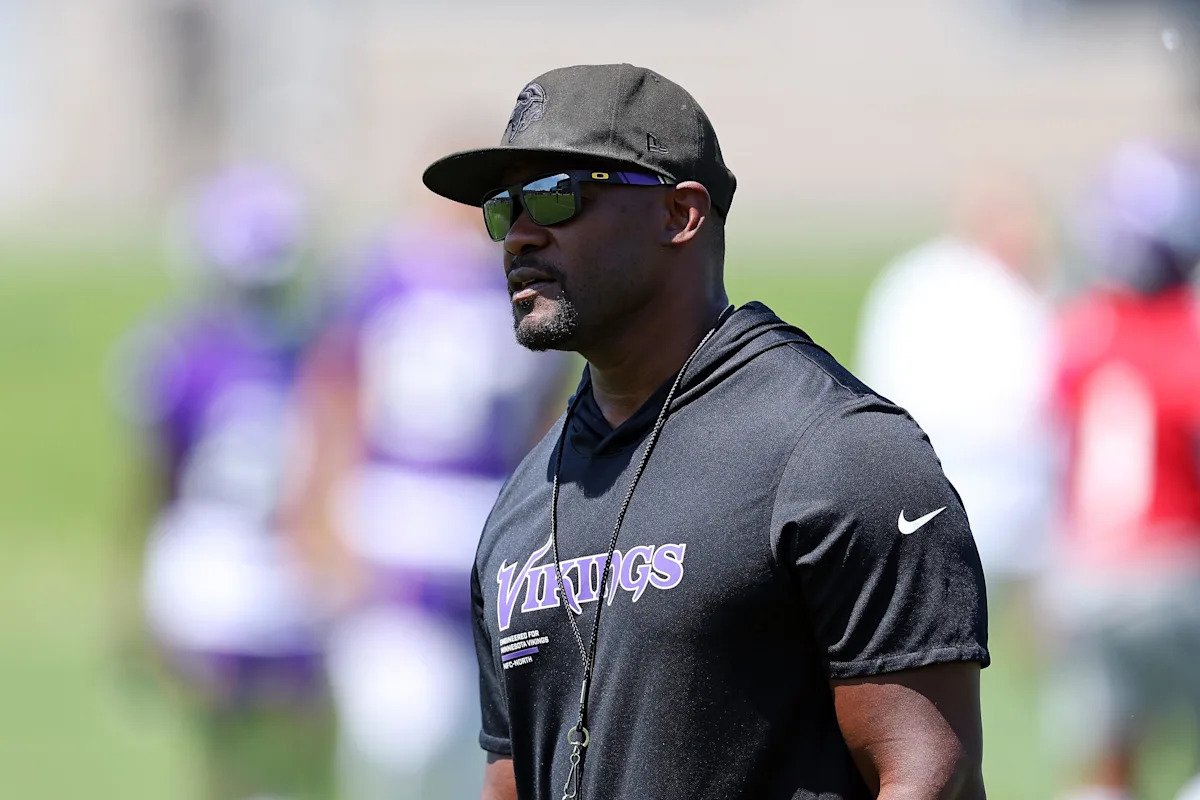
Continuing the Minnesota Vikings roster evaluation and 53-man roster projection with the second half of the series focused on the defensive side and specialists, I break down each position group with some analysis and useful links and information as we move through July and wait for the beginning of training camp at the end of the month.
Part one of the series on offense can be found here.
Advertisement
Defensive Interior Line (6)
The defensive interior line group will be filled with young players, which can be a good and bad thing. Having a young and ascending group could lead to stability and solid play for years to come, but it can also come with growing pains as a pair of rookies learn the scheme and acclimate to the league. Looking at the projected depth chart, the only proven quality starter is Jalen Redmond. The rest have either been average performers or are rookies that haven’t played in the league yet. That is true for the guys I have not making the roster as well. So, there is more uncertainty with this group heading into training camp and the regular season than normal. The Vikings really need their rookies to play well and hopefully get some incremental improvement from the others.
Overall, the first three spots are pretty much locked in, but the last three are less certain- assuming the Vikings keep six defensive tackles again this year (which I think is very likely). There is also a scenario where Tyrion Ingram-Dawkins becomes more of an edge rusher, in which case I’d include him in the edge rusher group instead of Tyler Batty and add one of the cut players here, most likely Jahvaree Ritzie.
Jalen Redmond ➡️
Advertisement
Redmond has been a big success story for the Vikings. He was initially signed by the Panthers as a UDFA in 2023 but didn’t make the roster and played in the XFL in 2024 before the Vikings signed him in June of that year. He played 236 snaps defensively his first season with the Vikings after making the roster and showed he belonged. He had the highest overall PFF defensive grade among defensive tackles, way outperforming the starters that year. A year later, in 2025, with a new set of more expensive veteran defensive tackles, Redmond was still the highest graded. He led the group in quarterback pressures, run stops, forced fumbles, and batted passes.
This season, after the Vikings let Jonathan Allen and Javon Hargrave go, Redmond is now the veteran leading the group at age 27. The question now for Redmond is whether he’s reached his ceiling and could be improve this year? Over his first two seasons his PFF grades have been fairly similar, so maybe there isn’t much more we should expect from Redmond this season. But perhaps after his first full season as a starter he could take another step higher. We’ll see. For now I’m counting on a similar performance as last season, which was pretty good.
Caleb Banks ➡️
All signs point to first-round pick Caleb Banks being full-go for training camp. His foot injury was supposed to be fully healed in early June and it probably was, but the Vikings were still cautious and held him out of practices except for strength and conditioning. He did get on the field a bit toward the end of OTAs in a limited capacity, but the plan was to ramp him up slowly so he’ll be full-go for training camp.
Advertisement
Banks’ ceiling may be sky high given his physical measurables, but he has a lot of work to do to reach that ceiling– and that will take time. The first thing he needs to do is get in shape. He didn’t play much his last season in college and one of the criticisms of his college game is his lack of conditioning showing up on tape. Hopefully he has been working on that over the summer- he was doing so during OTAs- and continuing into training camp. The second thing Banks needs to improve is his technique. He has an excellent first step and has developed some more advanced pass rush moves, but he also plays with high pad level at times and could be quicker getting off blocks in run defense. He can also improve his hand fighting. As a pass rusher, he needs to develop better awareness so he can put himself in a better position to finish. This shows up sometimes in run defense too, where he is in the backfield but isn’t able to make the play. Banks may be helped by not facing as many double-teams as he did in college, but the level of competition will be a big step up too.
Overall, I compare Banks to Jonathan Allen last season. Allen had 34 quarterback pressures and 34 run stops in 809 snaps last season. I don’t expect Banks to play nearly than many snaps, but he could have as many pressures. I’d be surprised if he had as many run stops. As a rookie, Jalen Carter had 50 quarterback pressures and 13 run stops in 599 snaps. It’s reasonable for Banks to have somewhere between Allen and Carter in quarterback pressures this season, but probably closer to Carter in run stops.
Domonique Orange ⬇️
“Big Citrus” is a 6’2”, 322-pound nose tackle the Vikings drafted out of Iowa State in the third round. He’s more of a run-stuffing nose tackle who won’t add as much value as a pass rusher and may likely come off the field on passing downs. His size should help him be more of a run stopper than Levi Drake-Rodriquez last season, but he’s very unlikely to be the pass rusher Javon Hargrave was last season.
Advertisement
Orange wasn’t as dominant at Iowa State as is sometimes written, if you watch his tape. Yes, he is a big man who could man-handle opposing linemen at times, but he was a non-factor for long stretches of games too. He had a good game against drafted center Logan Jones (drafted by the Bears), but against Vikings’ 7th round pick Gavin Gerhardt, he struggled. Overall, he wasn’t as productive as you might think in college- even against the run.
One thing that stands out is that he wasn’t any more productive on 547 snaps last year with the Cyclones than he was his previous season with 367 snaps. In fact, he had more pressures and run stops his junior year on 180 fewer snaps. Last season, in twelve games he had 13 pressures (no sacks) and 20 tackles including 16 run stops. In six of his twelve games, he had either 1 or no tackles. And nearly half of his tackles and half of his run stops for the season occurred in just two games. He also had 7 missed tackles. Overall, his PFF run defense grade (67.4) was only slightly higher than his pass rush grade (62.8), so it wasn’t like he was a dominant against the run.
By contrast, first-round pick Kayden McDonald from Ohio State, also more of a run-stuffing nose tackle, had 15 pressures (4 sacks), 43 tackles and 17 assists including 34 run stops. That was over twice as productive as Orange was on 448 snaps- 99 fewer than Orange.
In Big Citrus’ defense, he was often double-teamed (Iowa State usually went with 3 defensive linemen). The cyclones also played him a lot- maybe too much given his conditioning- which may have caused him to wear out over the course of games and the season.
Advertisement
In his performance against TCU, which was one of his better games from a productivity standpoint last season, he looked gassed almost the whole game. Most pass rush snaps he essentially took off, quickly standing up and trying in vain for a batted pass. He also didn’t show much lateral ability in run defense either.
In the NFL, he’s not likely to be the focus for opposing offenses, but he’ll be double-teamed regularly and he won’t have the size and strength advantage he had over Big-12 offensive linemen. He’ll also be expected to play around half the offensive snaps- which equals close to the 547 he played last season at Iowa State. He’ll also need to be more of a factor in pass defense- at least be able to push the pocket- on a more regular basis.
All that leads me to believe that Big Citrus may need some time to step up to league competition- which is often the case for defensive tackles. Like Caleb Banks, he’ll need to work on his strength and improve his conditioning. He’ll also need to improve his technique like all rookies need to do if they are to make the step up to the NFL. But I’m not expecting a big rookie year for Orange from what I’ve seen of his college tape. My hope is he’ll be decent enough and in good enough shape to at least not be a liability and play enough snaps to keep the other defensive tackles fresh.
Levi Drake-Rodriquez ⬆️
Advertisement
LDR is a 7th round pick from 2024 and a versatile defensive tackle with a high motor who could see more snaps this season with questions about how many snaps both Caleb Banks and Domonique Orange will play. He played 461 snaps defensively last season with roughly average grades except a poor tackling grade with 7 missed tackles. He is a smaller defensive tackle at 6’2”, 300 pounds, and an adequate athlete with a 6.11 RAS. The one question with LDR is how high is his ceiling? He has a motor that won’t stop and is quick off the snap, has a decent swim move, but he can be overpowered at times or lose his contact balance. He is a high effort guy too who could be a good influence in the group, but he still needs to get stronger. Ideally, if he has a lower ceiling, his role should be limited with fewer reps rather than more, and competition is good too, but I wouldn’t be surprised by incremental improvement after his first season of meaningful action on the field. I’m just not sure he’ll be anything more than average overall.
Tyrion Ingram-Dawkins ⬆️
Ingram-Dawkins was drafted in the fifth-round last year and played about 250 snaps on defense. His PFF grades hovered near average. He wasn’t particularly productive from a tackle or run stop or quarterback pressure standpoint, but on plays when his performance was relevant, he was helpful a lot more often than he wasn’t. By that I mean even though he didn’t make the play, he helped someone else to make the play by defending his gap. When he won, he won with his athleticism. When he lost, he lost because he isn’t big or strong enough to hold up against bigger, stronger offensive linemen. He showed enough flashes, however, where he has upside if he can get stronger. That is the case with most rookie defensive linemen and it is particularly the case with Ingram-Dawkins being undersized for a defensive tackle. He also needs to improve his technique and vision of where the ball is, as at times he lost track of the ballcarrier and didn’t flow with the play as a result. But I would expect at least modest improvements from him this season as he’s likely to get stronger after a year in the Vikings’ strength program and some experience under his belt.
The news from the offseason practices was that he is being looked at playing outside, rather than an interior defensive lineman. But looking at his 2025 tape, he played mostly outside the tackle or outside shade of the tackle, though there was still an edge rusher outside him, so this may not be really new for him unless they’re looking at him as a pure edge rusher. We’ll find out in training camp if that’s the case. There could be a role for him to take some snaps as an early-down edge rusher.
Advertisement
Elijah Williams ⬆️
Williams was a UDFA that made the roster last season and at 6’2”, 300 pounds, offers some position versatility along the defensive interior. He’s a good enough athlete, and watching his tape from last season (he played 42 snaps on defense) shows some promise. He had a couple embarrassing reps his first game, but seemed to improve over the course of the season. And he looks like he can hold his own with the big boys. He had some reps holding up at the point of attack and generating push. With an incremental strength improvement, more consistent pad level, better hand usage, and more consistent get off (not even an athletic thing- just a little slow to react on occasion), he could earn a lot more snaps in rotation this season and emerge as at least a quality backup. He could rise above LDR on the depth chart too.
Cut/practice squad: Eric Johnson, Isaiahh Loudermilk, Taki Taimani, Smith Vilbert, Jahvaree Ritzie
Eric Johnson and Isaiahh Loudermilk are a couple of older vets the Vikings signed to provide some experience and a minimum baseline of performance for younger players to exceed if they want to make the roster. Both vets were signed for league minimum with basically no financial commitment if they don’t make the roster.
Advertisement
Taki Taimani was originally signed as a UDFA in 2024 and made the roster that year but was demoted to the practice squad last season. He is a 330-pound run-stuffing nose tackle. He has a shot to make the roster, but Williams has a bit more versatility. And now that the Vikings have Domonique Orange, I doubt they will keep two run-stuffing, nose-tackle-only players on the roster.
Jahvaree Ritzie is a highly athletic defensive tackle with a 9.49 RAS although a bit undersized at 6’4”, 290 pounds. He has decent arm length for a defensive tackle at 33.25.” He started four years at North Carolina and had average PFF grades except his tackling grades were good. He was a UDFA in 2025 signed and released by the Patriots. He was also signed and released by the Steelers in May. His highlight reel definitely shows some pass rush ability (he had a day against Max Brosmer and the Gophers in 2024), but from his draft profile (and watching the Gophers game) he struggles to anchor and can get washed out in the run game. Ritzie has a similar physical profile as Jalen Redmond (and Tyrion Ingram-Dawkins but he’s built more like Redmond) and presumably could be looked at to play primarily 3-tech. He didn’t grade as well as Redmond in college, but he has his upside. If he can show improvement in training camp, he has a chance to make the roster.
Smith Vilbert is another 290-pound defensive tackle out of North Carolina (he also played five years at Penn State, but only one as a starter) who the Vikings signed as a UDFA after rookie minicamp. Unlike Ritzie, Vilbert did not test well athletically, coming in with a 3.3 RAS. He’s got good length though (34” arms) and has a good swim move and initial burst. He is likely another inside-outside defensive line candidate but seems like more of a long-shot to make the roster overall.
Edge Rusher (5)
The loss of Jonathan Greenard hurts the depth of this group, but with Dallas Turner ready to be a starter, it was a bit of a luxury to have a first-round pick and two higher paid edge rushers in the group. But the loss does raise questions about the quality of depth and the possibility of the Vikings acquiring a veteran to bolster the group. Acquiring one of the more high-profile free agents may be a bit tricky as they may not prefer to take a backup role. Jadeveon Clowney might be the best of the available free agents to target if he’s willing to take a backup role for veteran backup money.
Advertisement
I give Van Ginkel an up arrow with the prospect of him not missing as much time as he did last season, when he missed five games and most of a sixth with a neck injury. Van Ginkel was selected the 88th player in the players top 100 rankings last season, the first time he’s made the top 100 in his career despite it not being his best year statistically, in part because of the missed time. But he brings an ability to read plays that is rare for players at his position and the versatility to make plays as a run defender, pass rusher, and in coverage that makes him a unique player as an edge rusher and a key player in Brian Flores’ scheme.
Van Ginkel is in the last year of his contract at age 31, so there is some question about how long he will play. I wouldn’t be surprised if the Vikings extended him, however, as his style of play may lend itself to a longer period as an effective defender.
Dallas Turner ⬆️
Advertisement
Turner showed starting-level ability as the season went on last year but hasn’t approached his ceiling yet as a player. I wouldn’t be surprised to see continued improvement from him this season as well. As he has become more comfortable in the scheme and the league, and as he has gotten stronger, he has become faster and more aggressive on the field. He has Von Miller upside if he continues to work at his craft and refine his technique. But he has shown excellent reps as a pass rusher and run defender, including twisting inside and setting the edge, as shown in the link above. He’s also had a couple nice reps in coverage as well. Here is my breakdown of Dallas Turner after he was drafted.
While I think those who have been watching Turner more closely can see the upside to his game, I wouldn’t be surprised if ‘the emergence of Dallas Turner’ becomes a storyline for the Vikings’ defense this season.
Bo Richter ➡️
Richter is a core special teamer who led the team with 371 special teams snaps last season and one of the higher special teams PFF grades at 76.2 and that is the chief reason for his roster spot here. He had 53 snaps on defense last season, most/all in mop-up situations and did fine. He’s a better run defender and tackler than he is a pass rusher- he doesn’t have the length- although his speed and explosion measurables were elite coming out.
Advertisement
Bo Richter, Chaz Chambliss, and Jake Golday all have similar RAS measurables. They’re all high-end athletes but don’t have the desired arm length for an edge rusher (all have arm length under 32”). Golday is taller at 6’4”, whereas Richter and Chambliss are 6’2” or under.
Richter is a guy that is fine for spot duty off the edge or to take a few reps off of the starters, but probably not as good an option for more extended snaps. He doesn’t make a lot of mistakes that I’ve seen, and is a decent run defender, but he isn’t likely to provide much as a pass rusher.
Chaz Chambliss ⬆️
Chambliss is a UDFA out of Georgia the Vikings signed last year. He had a hamstring and foot injury that kept him from doing some of the athletic drills in the pre-draft process and also kept him out of the offseason program and early part of training camp last year. But the Vikings thought a lot of him as he got a lot of reps in the preseason games and made the roster. He also had 25 snaps on defense in mop-up situations and did fine generally with those. A few of those were as an off-ball linebacker. He had one sack on two pass rush snaps and average grades in run defense. He also played a lot on special teams- 183 snaps- with a 74.8 PFF grade. He would have played more but missed some games with a hamstring injury.
Advertisement
Chambliss is a strong, smart, tough player with a high motor but size limitations. He has some ability to play off-ball linebacker or at least drop in coverage- the Andrew Van Ginkel role- but his size and agility limit his pass rush moves. When he wins as a pass rusher it’s usually on second effort. Like Richter, Chambliss is a guy that can handle spot duty or take some reps off the starters on occasion, but probably not the guy for extended duty from what we’ve seen so far.
But I wouldn’t be surprised if Chambliss showed a little improvement now that he has a healthy offseason and training camp and a season under his belt. That could lead to some more snaps on defense (although still pretty limited) and a continued role as a core special teamer. With the Vikings positioning Jake Golday as an inside linebacker for now, Chambliss is a candidate for the backup ‘Van Ginkel’ role, although Eric Wilson would likely be ahead of him.
Tyler Batty ⬆️
Batty is another UDFA signing from last season who made the roster. He has an odd mix of physical and athletic testing scores, but the main thing for him- like many other rookies- is he needs to get stronger. He had 42 snaps on defense last season- and graded above average overall although individual grades were a mixed bag- good in run defense, not good in tackling, mediocre pass rusher over a small sample size. But he’s not a guy who can hold up against most tackles- at least not in his rookie year. Most of Batty’s snaps defensively came against the Chargers, and this was easily his best PFF graded game. He had two run stops in that game (his only two tackles last season). But that masked how ineffectual he was as a pass rusher in particular- again mostly a size and strength thing. He needs to work on his technique as well. I assume he has been able to get stronger and work on his craft in the offseason which could lead to some incremental improvement.
Advertisement
Batty is also a core special teamer and graded well in that area last season. That is his main claim to a roster spot at this point. But I consider Batty to be a bubble player and if the Vikings acquire an edge rusher he could be cut and relegated to the practice squad. Tyrion Ingram-Dawkins played a similar position as Batty last season (although not as a stand-up edge rusher) but potentially could be used as an edge rusher too, which doesn’t really help Batty’s chances of making the roster as a defensive player.
Cut/practice squad: Cam’Ron Stewart, Arden Walker.
Stewart has the length and body type to be a backup to Dallas Turner and has a 8.16 RAS. He had an elite pass rushing grade at Temple as well, but it looks like a lot of that came against a few bad teams. Still, the Vikings don’t really have a poor man’s version of Dallas Turner and so Stewart could compete for one of the last spots on the depth chart here. He has played some special teams too. But probably a long shot to make the roster.
Walker has a 5.37 RAS based on his pro day results at Colorado and had a decent last two seasons there. He also played some special teams. He earned praise from head coach Deion Sanders for being a ‘dog’ and dependable team leader, high character individual who worked hard in practice. He’s got the length but not really the athleticism as an edge rusher.
Advertisement
If either can show they can be a bona fide edge who can rush the passer, they’ve got a good chance to win a roster spot. But the backend of the depth chart here are solid contributors on special teams and it will be difficult for either of them to win a roster spot that way.
Inside Linebackers (4)
With Blake Cashman turning 30 and Eric Wilson soon to be 32, the hope is that Cashman can have the same longevity as Wilson. We’ll see. Wilson proved to be a great (re)signing last season as he fit in well in Brian Flores’ scheme and one of the best special teamers. But the aging of Cashman and Wilson- and related injury risk- means that the development of Jake Golday cannot come too quickly. Ivan Pace Jr., after a strong all-around rookie season, has become more of a rocket-propelled grenade who remains a good blitzer and run defender when he can make the tackle. But he has become a liability in coverage the last two seasons, and Cashman and Wilson have seen their coverage grade decline notably too. Cashman is also in a contract year and there hasn’t been any reported discussions of an extension. Wilson has (effectively) one more season after this one, and Pace is also in a contract year. So, while drafting Jake Golday was good, there probably needs to be at least one more young guy with starter upside in the pipeline pretty soon. Josh Metellus plays a linebacker/strong safety role around 40% of the time, and has decent run defense, tackling, and pass rush grades, but he has below average coverage grades too.
Blake Cashman ➡️
Advertisement
A lot of what Brian Flores likes to do defensively depends on having a healthy, effective Blake Cashman in the middle. As a run defender, as a blitzer, as a hook zone/hot route cover guy, Cashman serves a lot of functions and is difficult to replace with another player at this point. He is still a good run defender and tackler, but his coverage and blitz grades declined last season. That was the second season his coverage has declined notably. That is worrisome as it has gone from comfortably above average to below average. Particularly as he is the highest graded inside linebacker in coverage on the team.
Cashman also missed four games last season and three the year before, and three in 2023 with Houston, so it’s a good bet he’ll be out a similar number of games this season too.
I’m not expecting improvement from Cashman this year, but I do think he’ll be able to maintain last year’s reduced performance level for another season. Of course there is the chance that in a contract year he has extra motivation to perform, as he did in his last contract year with the Texans in 2023- and that would be a welcome surprise.
Eric Wilson ➡️
Advertisement
Wilson was re-signed by the Vikings after a four-year hiatus which he spent mostly with the Packers. But he returned to the starting role he left in 2020 and had the same number of quarterback pressures last season as he had in his previous seven seasons combined. He also took on Andrew Van Ginkel’s role last season, spending about a third of his snaps as an outside linebacker off the edge. He also racked up 52 defensive stops- a career season high – and more than he had in all his seasons as a non-Viking. And while he was near a season high in tackles, he did have a season high in missed tackles. He was also well below average in coverage. But he also had three forced fumbles- more than doubling his previous career total. And he earned an elite 90.3 PFF grade as a special teamer.
Wilson had a 9.48 RAS coming out back in 2017 (one of three Cincinnati Bearcat linebackers on the roster) and has kept himself in good shape, but at age 32 how long can he maintain at least average overall performance?
Jake Golday ⬆️
Second-round pick Jake Golday should start out as third on the depth chart. The Vikings have said that Golday is practicing with the inside linebackers and will focus on that position this year. Whether he eventually moves to the Andrew Van Ginkel position or stays an inside linebacker remains to be seen, but I’m not holding my breath. Golday may be better suited to replacing Blake Cashman at some point rather than Van Ginkel. And it will take Golday a few years at least to develop Van Ginkel’s instincts and ability to read plays, not to mention his pass rushing skills. I could see Golday being more of an inside linebacker who pass rushes on occasion rather than an edge rusher who drops in coverage on occasion. We’ll see.
Advertisement
I could see Golday getting 400-500 snaps on defense this season, depending on his development, and possibly more- particularly if he proves to be good in coverage. Looking at Golday’s highlight reel, he shows plenty of ability as a blitzer and run defender, but only a few plays in coverage show up. In Brian Flores’ scheme, Golday will be asked to drop in a hook zone over the middle and read/react to the quarterback’s vision. Being able to limit YAC on checkdowns in his zone will be an important measuring stick, along with run defense and blitz ability.
Jacob Roberts ⬆️
I have Roberts replacing Ivan Pace Jr. here at the bottom of the linebacker depth chart primarily for his special teams ability, which is where he’ll see the field most often. But he also has a skillset that works for Brian Flores’ defensive scheme. He can blitz and stop the run but looking at his highlight reel with the Calgary Stampeders, he is good at limiting YAC on checkdowns by following the quarterback’s vision.
Physically, Roberts is of the smaller, “modern” variety at 6’1”, 233 pounds per the Vikings’ website. That’s an inch and a half taller and five pounds heavier than his pro day measurements from 2023. He is a decent athlete with a 7.22 RAS, but not exceptional. His RAS is a bit better than Ivan Pace Jr’s 5.71, while being similar size.
Advertisement
Roberts finished his college career at Wake Forest after playing for North Carolina A&T for three seasons before that. He had above average to good PFF grades- mostly mid-70s- over his college career. He went undrafted and played the last two seasons for the Calgary Stampeders in the CFL. According to the Vikings’ website, he recorded 97 defensive tackles, 19 special teams tackles, 4.0 sacks and forced one fumble over 18 game appearances last season. 19 tackles on special teams was five more than any player on the Vikings had in 17 games last season.
Roberts should fill the Vikings need for a decent special teams linebacker. Last season the Vikings split the defensive reps for inside linebacker between three players and that is likely the plan again this season, with Josh Metellus and perhaps another safety playing linebacker in some subpackages. He offers some potential at linebacker as well, but that remains unproven. I’d still consider Roberts a bubble player, mainly competing against others as a special teamer.
Cut/practice squad: Ivan Pace Jr., Bangally Kamara, Josh Ross, Jacob Roberts, Keli Lawson
Ivan Pace Jr. is the notable name on the cut list here. Pace’s defensive reps last season were less than half of that of his rookie season- a steady decline over the past two seasons. At the same time, his overall PFF season grade has gone from 77.1 his rookie year, to 63.0 in 2024, to 45.1 last season. A steep decline in coverage grade is the chief culprit, but an up and most recently down swing in run defense grade has also contributed. It’s really a strange turn of events given his solid rookie season that looked so promising across every linebacker function. I’m not sure what has caused such a sharp regression- particularly after he showed he could play and play well in the NFL. But here we are. Pace is also a core special teamer now, but his grade declined after his rookie year as well. He was the one responsible for the big return at the end of the second Bears game last year (he didn’t stay in his lane) that likely cost them the game and quite possibly a playoff birth and even the division title. The addition of Jake Golday will likely take the last of the available snaps on defense this season at inside linebacker.
Advertisement
I’d consider it somewhat ominous for Ivan Pace Jr. that most of linebackers the Vikings signed after the draft are primarily special teamers. I suspect the Vikings will give Pace’s reps on defense to Golday, which leaves his reps on special teams to cover if he were to be released. Pace is a $3.5 million cap hit with no dead cap if he were released. I don’t know of any special team-only players on the roster with a salary that high.
Josh Ross was a UDFA back in 2022 and has only played special teams since entering the league. He didn’t play any snaps last season. Seems an unlikely candidate to make the roster.
Keli Lawson is a UDFA out of UCF but played for three seasons for Virginia Tech before that. He had average-to-below average PFF grades overall over his entire career but was one of the higher graded linebackers in this draft class as a special teamer with significant reps.
Bangally Kamara played four seasons with Pittsburgh in Pat Narduzzi’s defense, which is similar to Brian Flores’, with average-ish grades, his strongest being as a blitzer. He played a season at South Carolina and Kansas after that. He didn’t play much at South Carolina but had his best grade as a pass rusher (79) last season with Kansas.
Advertisement
Cornerbacks (4)
An unheralded aspect of the Vikings’ defense last season was cornerback play. The Vikings had the lowest allowed explosive play rate in the league last season at just 3.7% (2nd place was 4.3% – a sizeable gap) and a lot of credit goes to the starting cornerbacks. The two new additions- veteran James Pierre and fifth-round draft pick Charles Demmings- should allow Byron Murphy Jr. to play in the slot more and give the Vikings a promising young player in the pipeline. I have them keeping only four cornerbacks on the roster- which they did last year- all outside cornerbacks except Byron Murphy Jr. who also plays slot- as the safety group has at least a couple players that could play slot cornerback as well.
Byron Murphy Jr. ➡️
Byron Murphy did all you can really ask from a cornerback in the NFL last season. He gave up an average of 25 receiving yards per game. He allowed 3 TDs, had 2 INTs, and 4 PBUs. He was targeted half as much as the previous season (when he was targeted a lot). The longest completion he allowed was 30 yards. The only downside to his performance was his nine penalties, but they say sometimes a cornerback is penalized for doing what he should do- playing tight coverage- and sometimes that gets flagged on bang-bang plays. But he earned his paychecks last season and is actually a smaller cap hit this season before a big $24 million balloon payment next season. He’ll be 29 at that point so that will be part of the equation in whether he is extended or not. Murphy may not be among the top corners in the league, but he’s one of the better ones. And considering coverage is a weakest link proposition, it’s probably better to have two tier two corners than a tier one and a tier three. Here’s a breakdown of some of Murphy’s better plays last season.
Isaiah Rodgers ➡️
Rodgers was a great signing for the Vikings- probably the best free agent signing by the Vikings last year. It was a two-year, $11 million deal- a bargain. He proved to be a solid outside cornerback, with the speed and skills to stay in-phase with any receiver in the league. He gave up an average of just 29 receiving yards per game and did not commit a penalty all season. He had one pick-six, gave up two TDs, and had 3 PBUs. He also had two forced fumbles- one he returned for a touchdown. He also blocked two field goals- returning one for a big gain. He practically single-handedly beat the Bengals in the first half and earned the only perfect game (99.9 grade) PFF has awarded to a player with more than ten snaps in its history. You can see all his big plays in his highlight reel. Again, that’s about all you can ask from a cornerback over the course of a season.
Rodgers is in a contract year and while his value may have gone up based on his performance as a starter, he also turns 29 in January, which should have a negative impact on his next contract value. If Rodgers can produce a similar season this year as last, he is worth extending, even at his age. He is still fast and would be even if he lost a step. It may not be such a bargain as the deal he signed last year, but another two-year deal at a medium price would make sense.
James Pierre ⬆️
As good as Rodgers and Murphy were for the Vikings last season, Pierre was even better with the Steelers. He was a backup called to be a starter due to injury. He had the equivalent of eight starts worth of snaps and gave up an average of 20 receiving yards per game with no penalties all season. He had 9 PBUs and an INT while allowing just one TD. He also returned a fumble for a touchdown. It was an outlier season for Pierre, who was a career backup in Pittsburgh. But he showed he can play at a high level when given the opportunity- even at age 29. He was the highest graded corner in coverage last season.
Pierre had just a 3.69 RAS coming out, but he was able to run with Ja’Marr Chase last season and produce a PBU, and showed his ability to burst from the break to cause several more PBUs on out routes, as you can see from his highlight reel last season. That should serve him well in Brian Flores’ zone coverage scheme. Pierre turns 30 in September and was signed to a 2-year, $8.5 million contract which could prove to be another bargain. He should be an upgrade over Jeff Okudah and Fabian Moreau last season (although Moreau played pretty well).
Charles Demmings ⬆️
Demmings has all the earmarks of being a stud. It may take a little time, but he looks like he’ll get there. Given his production in college (he had one of the highest coverage snaps per reception allowed in all of college football last season and one of the lowest passer ratings when targeted) and his near perfect RAS (he had a poor 3-cone and okay shuttle at his pro day which bring his RAS down to 9.11) including a 4.41” 40 time- 5th best among CBs. He would’ve been a first-round pick if he did all that and played in a Big Four conference. But he didn’t. He played five seasons for Stephen F. Austin. His highlight reel. He was one of only five FCS players selected for the Combine. But he impressed there too, earning the highest athletic grade among cornerbacks. The Vikings picked him in the fifth round.
Moving from FCS to the league is moving up a few steps in competition, not just one, so it may take a year or two for Demmings to be a viable starter for the Vikings. But Demmings has plenty of confidence (which is important for a defensive back or a receiver) and what Brian Flores calls “the want to” in terms of preparation and work ethic to develop into a quality starter. I expect Demmings to get some snaps this season and see how he runs with them. Maybe a hundred snaps, maybe more if he plays well but he also has to be fluent in the scheme and that might take some time along with making the steps to league competition.
The other thing about Demmings that is curious schematically is that Demmings, like Jeff Okudah last year, is more of a press-man corner. He can play off coverage and zone and play them well, but he played a lot of press in college. But the Vikings don’t play much press-man coverage. Maybe there is a hope in Brian Flores that if he can find a shut-down press-man corner, that will allow him to do some other things in coverage to turn the screws on opposing offenses- or at least add more variety.
Cut/practice squad: Dwight McGlothern, Zemaiah Vaughn, Marcus Allen, Tyreek Chappell, Da’Veawn Armstead
Dwight McGlothern was a UDFA who made and stayed on the roster in 2024 but was waived at the end of November last year and placed on the practice squad before being activated just before Christmas. McGlothern had a lot of promise as a very productive cornerback who played in the SEC but doesn’t appear to have taken much of a step forward. And he wasn’t able to stick as a special teamer last year, playing just 20 snaps. Overall, he played just 51 snaps last season, which isn’t enough to justify a roster spot and so he was cut. He’ll be competing for a roster spot as a special teamer this year with a few others and it’s difficult to see him coming out on top after losing his special teams role last year.
Zemaiah Vaughn was also in training camp last year as a UDFA but didn’t make the roster. He had some flashes but didn’t really play special teams- at least not in preseason games as he had only one snap. Maybe he’ll get more of a chance to play special teams this year but he’s unlikely to make the roster as a cornerback.
Marcus Allen, Tyreek Chappell, Da’Veawn Armstead
All three of the above are UDFAs signed this year. Allen out of North Carolina, has average grades as a corner and special teamer- but with significant reps. 7.53 RAS. Chappell is a slot corner out of Texas A&M with average-ish grades over five seasons there. 6.65 RAS. Doesn’t appear to have played special teams. Armstead is out of North Texas, but played initially at TCU, then three seasons at Sam Houston State before North Texas. Average-ish grades again but played a fair amount of special teams. 8.98 RAS. Allen and Armstead will likely compete as special teamers and Chappell as a slot corner but are long shots to make the roster.
Safeties (6)
From Kevin O’Connell’s comments later in the offseason program, it seems like if Harrison Smith decides to come back for another season, it may not be until after the season begins- if he does come back. The Vikings will never fully replace his savvy and know-how, but his physical skillset as he hits his late 30s is replaceable and upgradeable. But between Josh Metellus and Byron Murphy Jr., Andrew Van Ginkel and Blake Cashman, there is plenty of knowledge of Brian Flores’ scheme and a lot of years in the league. Jay Ward and Theo Jackson have also been with the Vikings for all three seasons under Flores.
It’ll be interesting to see how the depth chart here plays out. I’d assume Josh Metellus is top of the depth chart, but I could see Theo Jackson and Jay Ward as starters too. Theo Jackson played almost twice the snaps as Jay Ward last season so he may be the other starting safety. But Jay Ward was the highest PFF-graded safety last season. And third-round pick Jakobe Thomas could challenge for a starting job although it would seem more likely he’ll be a rotational player as a rookie. Tavierre Thomas is primarily a core special teamer and a good one, but he is a decent safety and has some experience at slot corner. Jacob Thomas is an intriguing player with a solid track record at James Madison and has played a lot of special teams, which may be how he makes the roster.
Josh Metellus ➡️
Metellus is the captain and senior guy out there without Harrison Smith. But his role needs to be optimized. His PFF grades have been falling the last three years and overall have fallen to below average due to his declining coverage. He’s played a lot of different spots for years, and I would say that has made him a jack-of-all-trades, master of none type player. After watching his tape in coverage last season, there are a few general observations.
The first half of the year, roughly, he was more/most often tasked with covering a tight end. That was okay if it was not a bigger, more athletic tight end and depending on the route. Metellus is only 5’11” and against more athletic tight ends Metellus can’t keep up with them in coverage. He didn’t always get targeted, but that’s not a matchup that favors the Vikings. Metellus doesn’t really change directions well so he gives up separation on breaks. He can usually do alright if he gets an early jam on the tight end, but if not or if he’s playing off-coverage, that’s not a situation that favors him.
During the second half of the year, Metellus transitioned to be more/mostly a deep safety. Metellus is probably at his best in zone coverage further away from the line of scrimmage where he can see the play develop and not have to react immediately, which isn’t his strong suit. He’s at his best as a tackler running downhill with the ball-carrier in front of him. Deep safety is probably a better position for Metellus in part because he’s less likely to be targeted that way. He doesn’t really play tight coverage as a deep safety, but the pressure up front in Brian Flores’ scheme makes it less likely an opposing offense is going to run a lot of deep routes and have the time to target them. Metellus isn’t going to keep up with the speedier receivers in the league and that leads to bigger cushions and wide-open receivers on digs and out routes. Having good underneath coverage is important to stop those routes, as is pressure up front.
It may be helpful for Metellus this season to have a more simplified role, mostly as a deep safety but charged with covering a tight end if the matchup is okay. Perhaps that will help him develop a better feel for his role over the course of the season. It might also be a good idea to give him fewer snaps. There is also the potential for an awkward situation to develop where Metellus is a captain and vocal leader on defense but is surpassed on the field by others in the group. That may already be the case.
It’s worth noting that while Metellus is under contract for two more years after this season, his cap hit jumps from $6 million to $14 million for each of the final two seasons. Barring a significant turnaround season this year, he isn’t worth keeping for $14 million/year. Perhaps a restructured deal, but if young talent is developed this year, it may be his last with the Vikings.
Theo Jackson ➡️
Jackson played 529 snaps defensively for the Vikings last season (just over half) and would have played more had he not missed three games due to injury. Watching his snaps in coverage last season, he was generally pretty solid- assignment sound, didn’t give up much and wasn’t targeted much. In 302 coverage snaps, he was only targeted ten times and gave up a total of 89 receiving yards. He also didn’t give as much cushion as Metellus did. The only criticism of Jackson based on watching him in coverage last season is his tackling could be a little better and he could take better angles at times to get to those tackles. Neither was terrible, but an area for improvement. Jackson is not a particularly flashy or physical safety, but he does seem to communicate well on the field and gets the job done.
Overall, he looked like a better deep safety than Metellus last season and I would expect Jackson to be a strong contender for a starting job and probably land one.
Jay Ward ➡️
Ward was a rotational safety last season who played more the first three games when Harrison Smith was out and was given a starting job the last three games of the season- which in terms of PFF grades were his best along with week one against the Bears. Overall, Ward was the highest graded safety for the season with over 20 snaps. Ward played 249 snaps defensively 283 on special teams as a core special teamer.
Ward played a strong safety role for the Vikings when he was on the field last season, complementing Jackson’s free safety role. He may not look like it with his longer, skinnier legs, but he was the better, more physical and willing tackler among the safeties currently on the roster who played last season. He played some deep safety, some strong safety often off the edge, and some snaps as a slot corner. He was only targeted twice (once every 45 coverage snaps, third lowest rate among safeties) and one of those he was playing outside cornerback, which is not his usual position and he may or may not have blown his assignment.
It’s interesting that Ward and Jackson were targeted less than have as often (snaps per target) as Josh Metellus and Harrison Smith last season and gave up less than half as many receptions per coverage snap. I would add that neither Ward or Jackson were really tested much in coverage, in part because deep throws were few and far between given the pressure/blitzing up front which led to quarterbacks targeting shallower routes.
In any case, Ward should challenge for the strong safety spot that Harrison Smith has vacated- at least for now- along with Josh Metellus. Ward actually looks like the better candidate based on the tape from last season, but I’m not sure it will play out that way or not.
Jakobe Thomas ⬆️
Thomas was a third-round this year and has a decent, rather than good, athletic profile and a 7.32 RAS. After three seasons at Middle Tennessee State and one at Tennessee with middling PFF grades, he had a breakout fifth year at Miami, largely due to his excellent coverage and pass rush grades. His coverage grades were buoyed by five interceptions and six pass breakups. He also forced two fumbles.
His highlight reel confirms his ball skills and pass rush ability and also reveals more than adequate athleticism. He has more size and physicality than the other Vikings’ safeties and is a willing tackler, if not always a good one- he had 20% missed tackle rate in college, including in Miami. He also has a playmaker mentality in coverage, which can lead to some feast-or-famine results. He played strong safety in Miami and would likely fit in that role with the Vikings.
Thomas brings a good skillset and mentality to the safety position, but he’ll need to refine both his coverage and tackling- not to mention learning Flores’ scheme- before he’ll be ready for more significant snaps and compete for a starting job. It’s unclear how long that will take, but as a rookie he’ll likely be a rotational player and most likely a core special teamer.
Tavierre Thomas ➡️
Tavierre Thomas is mainly a core special teamer who plays on all units and was one of the highest graded special teamers last season. Now age 30, he has plenty of experience at safety and slot cornerback too. But again, he’s on the roster mainly as a special teamer. He was given a two-year, $4.6 million extension in March with $2 million guaranteed.
Jacob Thomas ➡️
Jacob Thomas was a UDFA signing who had a very productive college career at James Madison and boasts a 9.19 RAS. He has similar size and play-style as Jakobe Thomas as a strong safety who can blitz. He can also play a big nickel role and probably a deep safety role as well. But he’ll have a bigger jump in competition, coming from the Sun-Belt conference to the league, and needs to develop, but he also played a lot of special teams in college (over 600 snaps) and could secure a roster spot as a special teamer with upside as a safety. His highlight reel.
Thomas is a former quarterback in high school and was a walk-on to James Madison and had to fight for reps early on there but became one of the top safeties in the Sun-Belt conference. He is described as having a workmanlike mentality and while he is a bubble player, he knows what it’s like to compete for reps and a roster spot. He just turned 22.
Cut/practice squad: Kahlef Hailassie
Hailassie was in training camp last year with the Vikings after spending the 2024 training camp with Cleveland and the 2023 training camp with Kansas City as a UDFA signing that year. He is a converted cornerback and had average PFF grades in preseason last year overall, but poor tackling grades. He had two interceptions in preseason so was the 2025 version of Audie Cole for not making the roster. The big thing with Hailassie last year is he didn’t really stand out enough in any particular way, including special teams. I don’t think it will get any easier for him to make the roster this year.
Specialists
Mostly familiar names returning this year, but with at least one intriguing competition. And the Vikings could end up with current or former All-Pros at all three specialist positions.
Kicker: Will Reichard ➡️
Reichard is unchallenged for the kicker spot and understandably so as he was First-Team All Pro last season. He missed only two field goals all season (one because it hit a wire over the field) and no extra points. He made all his field goal attempts within 50 yards and went 11 for 13 from beyond 50.
One area for improvement is on kickoffs. Reichard was middle of the pack in terms of opponent starting field position after kickoffs and with the rule changes kickers have much more influence on that outcome. Having more kicks that land between the goal line and 20-yard line but bounce into the endzone for a touchback at the 20-yard line is the ideal outcome short of a return that ends short of the 20-yard line.
Punter/Holder: Brett Thorson ➡️
Thorson is not the favorite to win these positions- Johnny Hekker is. The former four-time First-Team All-Pro punter has been an innovator and generational talent as a punter in his prime during the 2010s. He’s also a very good holder, which is important because without a good holder, Will Reichard is not an All-Pro anymore. Hekker was signed as a free agent after Ryan Wright signed a 4-year, $14 million deal with the Saints.
But Hekker is also 36 and past his prime. Last season nearly half of his punts were returned, which was fourth-highest and not a good thing. He also had only 28 of 78 punts inside the opposing 20-yard line which also isn’t a good rate. Overall, his average net yards per punt ranked 26th, which is why he was a free agent.
Thorson was arguably the best punter in college football last season at Georgia. He had 46 punts and 24 were inside the 20-yard line. And only 9% were returned. He had the fourth-highest PFF grade for punters with at least 20 attempts and the highest grade in 2024. His punts had the third-highest hangtime (4.38”) and the fifth-highest net yards (43.4).
The thing with Thorson is he was not the holder at Georgia. That is because Georgia prefers to have the backup quarterback be the holder, rather than the punter. It wasn’t that he wasn’t a good holder or didn’t know how to be a good holder, Georgia just wanted the backup quarterback to do it- presumably to maintain the threat of a fake kick. And that is why Thorson is not the favorite. But I’m betting he will turn out to be a good holder and will punt better than Hekker and win the job.
If Thorson wins the job, that solidifies the punter/holder job with a young and inexpensive player that can provide continuity. I’m sure that is the preferred outcome for the Vikings. If Hekker wins the job, it’ll be a year-to-year thing with more variance and expected decline if they stick with him.
Long snapper: Andrew DePaola ➡️
DePaola has been either first- or second-team All-Pro each of the last four seasons. He is unchallenged for the job. But he turns 39 later this month and I don’t know when age catches up with a long snapper.
Punt and Kick Returner: Myles Price
Price had the most combined kick and punt returns in the league last season with 87 total. He was third in total return yards with 1,765.
Price was 11th in punt return yards last season (295) and 19th in yards per attempt (9.8). The reason for the difference is because he returned more punts than most punt returners (tied for 4th most with 30). When it comes to punt returns, yards per attempt doesn’t include fair catches, which essentially count as a zero-yard punt return and would reduce averages if included. Obviously, discretion is the better part of valor if punt defenders are right there and ready to blow up the play, but some punt returners (like Brandon Powell in 2024) are inclined to fair catch a punt unless he’s got a 10-yard gap between him and the nearest defender whereas Price would return punts with a narrower gap between him and the nearest defender for positive yardage. That may not help his punt return average, but it helps the team’s starting field position. So, I give Price credit for only having 12 fair catches as a punt returner last season out of 42 opportunities.
Overall, Price had decent production as a punt returner and that is likely to help earn him the gig again this year. The downside for Price as a punt returner last year was his two muffs. One wasn’t really a muff per se, but one that he moved away from hoping it would bounce in the end zone for a touchback but instead hit him leading to a gift for the Packers. His mistake was not watching how the ball landed and/or not moving far enough away. The other was a muff recovered by the Falcons. Only six punt returners with at least 20 returns didn’t have a muffed punt last season. His longest punt return was 43-yards against the Bears.
Price also had the third-most kickoff return yards (1,470) but was only 26th in average yards per return. Once again, the reason for the differential is because he returned a lot more kicks than other returners, with 57- third most.
Of course with the kickoff rule change, there aren’t the opportunities to fair catch the ball in the endzone, which leads to starting field position at the 35. Price’s 25.8-yard kickoff return average was in a logjam of 80% of returners with at least 20 attempts who averaged between 27 and 25 yards per return, which makes the ranking less relevant as the vast majority of kickoff returners were very close to average. Price had the ninth-longest kick return at 61-yards. There were only four kickoffs returned for a touchdown last season, which seems like a low. Price had a kick returned for a touchdown called back on a holding penalty against the Lions.
Price is likely to have competition for both returner jobs, including from Demond Claiborne, who was a kickoff returner in college for a couple seasons, but not last season. Other competitors may include Tai Felton, Zavier Scott, and at least a few wide receivers trying to make the roster.
So, there you have it- in almost less than 10,000 words.
Follow me on X/Bluesky @wludford

