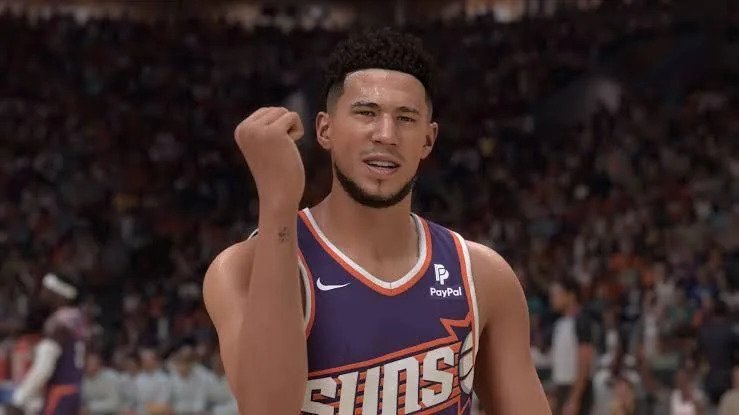
It’s NBA 2K season, which means we have officially reached that wonderful part of the NBA calendar where grown adults argue about numbers assigned to digital versions of basketball players. NBA 2K27 is set to release worldwide on September 4, with the deluxe and ultra editions opening the doors a little earlier on August 28. And as we creep closer to release day, 2K has begun pulling back the curtain on player ratings.
Typically, this is where I’d make the case that while these ratings mean absolutely nothing in the grand scheme of basketball, they still provide an interesting window into perception. How does 2K think a team will function? How do they view certain players? Which skills do they value? Which ones have they apparently watched through a dirty windshield while driving 80 miles per hour through the desert?
Advertisement
Make no mistake about it, the players care. Those little numbers next to specific aspects of their game become locker-room ammunition. They get discussed during shootarounds. They get screenshotted. They get sent to group chats.
If you’re an NBA player and 2K gives you a 48 free-throw rating, your teammates are going to find out about it, and you’re going to hear about it. Does anybody on the Phoenix Suns have a 48 free-throw rating? Oh yeah. Ryan Dunn. Sorry, Ryan.
Anyway, I’m not making my usual case for the importance of 2K ratings this year. I can’t. The entire operation has lost my confidence. Burn the spreadsheets and fire the algorithm into the sun. Somebody clearly left the computer running overnight and came back to find that it had started hallucinating. Whatever collection of numbers, formulas, algorithms, statistics, caffeine, and black magic 2K uses to determine these ratings produced one unforgivable result.
Devin Booker is not among the 10 best midrange shooters in NBA 2K27.
It gets worse. They gave him an 86. An 86! At that point, we are no longer dealing with reasonable basketball analysis. We have entered the realm of statistical malpractice. This is an egregiously narrow view of what Devin Booker does from the midrange, one that immediately calls the credibility of the entire exercise into question.
Advertisement
Therefore, I have reached the only rational conclusion available. None of these ratings can be trusted.
Does it sound like I’m making much ado about nothing? Ultimately, the answer is yes. I fully understand that we are arguing about numbers attached to digital basketball players in a video game that hasn’t even been released yet. Still, when you look at the ratings designated for Devin Booker, they’re ridiculous. It’s as if Visual Concepts, the creator of NBA 2K, has no idea how basketball actually occurs on a basketball court. Which feels like a fairly significant problem when your primary business is creating a basketball video game.
If we’re assuming that last season is serving as the foundation for these ratings, and presumably it is, I have questions. Many questions. The kind of questions that require somebody at Visual Concepts to walk me through the laboratory and show me exactly what the hell they’re cooking in there.
Booker attempted the sixth-most midrange shots in the NBA last season, taking 325 of them. Among the players who attempted at least 300, he ranked sixth in field goal percentage, connecting on 45.8% of those attempts. Volume. Efficiency. An entire season of evidence. And somehow, when 2K unveiled its list of the top 10 midrange shooters in the NBA, Booker wasn’t on it.
Advertisement
Do you know who was? Tre Johnson of the Washington Wizards. I’ll hold while I wait for you to finish filling up your barf bag.
Johnson attempted 111 midrange shots last season. Granted, he made 49.5% of them, which is impressive. The kid can shoot. After one rookie season in Washington, however, NBA 2K has apparently seen enough. Forget sample size, forget volume, and forget the hundreds of additional midrange attempts Booker took and made throughout the course of an NBA season.
Tre Johnson is now the fourth-best midrange shooter in basketball. His rating? 98. Ninety-freaking-eight. Meanwhile, Devin Booker, one of the league’s most prolific midrange shooters for the past decade, a player who attempted nearly three times as many shots from that area of the floor last season, checks in at an 86.
Again, are we making too much out of meaningless video game ratings? Absolutely. But if you’re going to give us numbers to argue about, at least make the numbers make some damn sense.
Advertisement
You want more absurdity? I got you.
Devin Booker made 33% of his three-pointers last season. If I asked you to give him a three-point rating out of 100 based on that performance, where would you put him? Probably somewhere that reflects the reality that he was a below-average three-point shooter last season, right? Let’s do a little poll…
Thank you for voting. Have no fear, we already have our answer.
NBA 2K gave him an 86. The same rating they gave him from the midrange. Laughable. Absolutely laughable. Don’t get me wrong, I would love for Devin Booker to be an 86 from beyond the arc. I would love for him to enter next season as the 30th-best three-point shooter in basketball, which is where NBA 2K apparently believes he belongs. That would be fantastic news for the Phoenix Suns. It also has very little connection to what we watched last season.
Advertisement
Normally, I’m an advocate for NBA 2K. It fills the void during that final month and a half before the season begins, when we’re all wandering through the basketball desert searching for something, anything, that resembles meaningful basketball. You fire up 2K, look through the ratings, complain about a couple of them, start a season, and life moves forward. Generally, you can look at the ratings and understand the logic behind them, even when you disagree with the final number.
I can’t get there with this one. They have completely missed Devin Booker’s shot profile and his effectiveness heading into the 2026-27 season. Somehow, one of the most prolific midrange shooters in basketball has the exact same rating from that area as he does from beyond the arc, where he shot 33% last season.
Or perhaps they’re prophetic. Perhaps the people at Visual Concepts have seen the future, and Devin Booker is going to become less effective in the midrange while becoming one of the better three-point shooters in basketball. Maybe that 86/86 combination is trying to tell us something. Who knows? We’ve reached that point of the NBA calendar where nobody knows anything anyway. Training camp remains somewhere beyond the horizon, the transactions have slowed, and here I am arguing about the numerical shooting attributes assigned to a digital Devin Booker.

