‘The Biggest Bummer:’ NCAA’s Experimental Cut of B Final Met with Widespread Criticism
Thursday night should’ve been a celebration for Chloe Braun, but it ended up looking different than what she had expected.
As a junior in 2025, Braun became the first swimmer from UC San Diego to qualify for the NCAA Women’s Championships, in the first season of eligibility for a program elevating from Division II. She finished 20th in the 100 breaststroke, .13 away from a second swim.
The goal for her senior season was clear. Get back to NCAAs, then get to the night session. The native of Toulouse, France, was within two tenths of her best time in prelims on Thursday. It was good for 16th place, the first NCAA point in Tritons history.
The first night swim in program history, though, will have to wait. The removal of B finals at this year’s edition of the championships deprived UC San Diego – the team qualified three swimmers this year after Braun alone last year – a moment to celebrate their progress under the NCAA state’s brightest lights.
That left Braun with “very mixed” emotions.
“I get to score a point, so it’s amazing,” she said on deck Friday at Georgia Tech. “But at the same time, maybe we could have scored two, I don’t know. It’s a bit sad. I can swim a bit faster in the morning, so I was thinking it was maybe going to be to my advantage. But who knows, maybe I would have been faster.
“So it’s a bit sad. I would have loved to have a second swim, the fireworks, would have been awesome.”
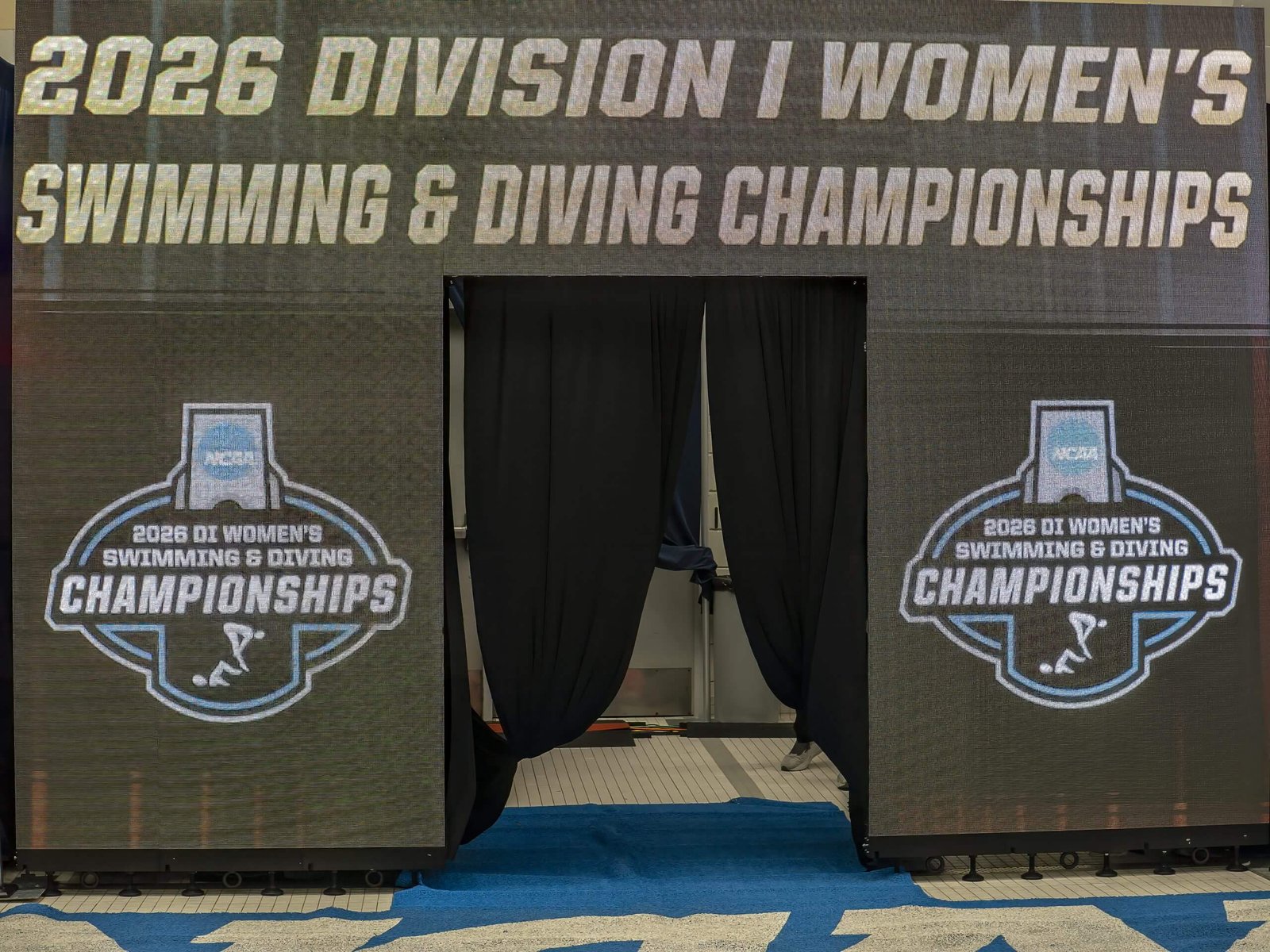
Braun’s is an extreme case. But all over NCAAs at the McAuley Aquatic Center, the women’s field has nearly unanimously panned the new format. Aimed to streamline the night session and optimize it for TV digestion, it has led to diminished crowds and tempered energy at night … at least except until it comes time for chants of “Bring Back Bs” through the gallery and for many swimmers to share their opinions on the format.
Even more startling than the volume of condemnation is from whom it has come: Swimmers of such accomplishment that the difference between finishing eighth and ninth isn’t a real risk. Bella Sims unloaded on it. Torri Huske offered a withering critique on Thursday, then came back Friday for an even more definitive and eloquent takedown drawing on personal experience.
Those swimmers aren’t at risk of losing anything save for a few extra minutes of rest before relays in a padded-out night session. But it’s an acknowledgement of the community: The girls (and next week, guys) losing swims at NCAAs are those comrades in training groups that push A finalists to the speeds they’re able to reach. The disappearance of B finals this week has brought that into sharp focus.
From the top
Huske’s criticism was multi-faceted. The six-time Olympic medalist on Thursday, after winning the 100 butterfly, lamented not just the change but the lack of input from athletes such as herself, who might know a thing or two about how meets are run across the world.
Three times, Huske emphasized how much the change “sucked.”
“I like to focus on my own race, so I’m usually pretty focused on the next step of my process,” she said. “I finished my 100 fly, I have to go change and warm down immediately. I’m very focused on that part. But not having B finals is the biggest bummer.
“Seeing today, I knew it would suck beforehand, but seeing my teammates score points and they’re 11th and 14th or whatever, it sucked not getting to watch them again. It sucked. I don’t know why they did that. I’m honestly still salty about it. You have to take those changes as they go, but I hope they bring them back next year.”
Huske entered the media area on Friday, after she won the 50 freestyle, asking to be asked again about the B-final situation. She had more to say.
“My freshman year, I B finaled in the 100 freestyle,” Huske recounted. “I messed up my start in prelims, and the rest of the race, I was freaking out, and I just didn’t execute my race plan. I didn’t follow it. Everything just kind of went to crap. I was freaking out. And I remember being so devastated by that swim. But I had another chance to prove myself and redeem myself at night, which is what I did. And I think it would have been so hurtful toward me mentally to not be able to get that chance again.”
Huske in 2022 was a disastrous 15th in prelims in the 100 free, going 48.12. She found redemption at night by going 46.98, a time that would’ve been fourth in the A final.
“I don’t really know whose input the CSCAA had when they were making that decision, but I have not talked to a single athlete or coach who has been happy with that decision,” Huske continued. “So I hope that they feel pressured to bring it back next year, because at the end of the day, I think it’s just hurting athletes. I heard when I was in the ready room them chanting, ‘Bring B Back.’ And I just hope that they realize that they messed up and that they can own up to it and make that change again next year.”
The B final bounce
Huske isn’t alone in that kind of experience, even on the Stanford roster. Lucy Bell on Friday swam to her second straight NCAA title in the 200 breaststroke. It’s the fifth time in her storied NCAA career that Bell finished in the top three in an event at NCAAs.
Her first NCAAs swim? As a freshman in 2023, she started the meet by finishing 15th in the 200 individual medley. She credits that night swim with helping her summon the confidence a day later to make the A final in the 400 IM, where she finished seventh.
“I think that swim really helped me get my confidence that I could actually swim fast at a meet like this,” Bell said. “I think especially since the 4-IM was the next day, I think I wasn’t really expecting … a B final swim or any final swim at NCAAs. And so getting to swim that (in the 200 IM) and kind of get my feet in the water and get that high pressure feeling before maybe my better event was really crucial. I think that having the B finals is really important.
“Just in general, at ACCs, before the 4-IM, I saw the C final and I saw the B final and my best friends, they were killing it, and that got me so hyped and excited for my race. And I don’t know if I would have swam as well as I did at ACCs in the 4-IM if I hadn’t seen them and gotten as excited from that. As everyone knows, you need to step up in those high-pressure scenarios. And if you don’t have the opportunity to do that, it’s kind of difficult to do that once maybe once you get into the A final.”
Campbell Stoll was a freshman in 2024 who entered the 200 fly seeded 39th. She dropped more than a second to 1:54.74 in prelims to get into the B final, then another nine tenths at night to finish 12th in 1:53.83.
Two years later, she went 1:50.26 on Saturday night to win the championship.
“I started crying because I was like, I can’t believe I did this,” she said of her freshman experience. “I finally made this final that I’d been dreaming about. … It gave me so much confidence. Just to get a second swim is huge. Coming into this meet as a freshman, you don’t really know a lot of things, and you’re coming in so inexperienced. You’ve been to high-level meets, but nothing compares to this meet. So having that B final really just gained so much confidence for myself, and definitely helped me get to where I am today.”
Back-filling the schedule
Reaction from swimmers have coalesced around both process and product. The College Swimming and Diving Coaches Association in May proposed the new meet schema to “modernize” the format. It said then that the goals were, “to support collegiate swimming and diving by modernizing the championship format to better align with broadcast needs, while expanding institutional access through an updated qualification process.” It’s part of a suite of changes, both in qualification to this meet, event order and arrangement on days, and innovations like the CSCAA Dual Meet Challenge aimed at packaging swimming different.
The aim for the finals sessions at NCAAs was concentrated action: Only A finals, shorter diving breaks, awards presentations at the end of the sessions. The objective was, “a high-stakes, heavyweight experience — where every session matters and every race or dive has the power to shift the standings, elevating both the intensity and visibility of the championship and the sport.”
The result has been something less than those aspirations. The lack of actual swimming hasn’t made sessions shorter. The need for swimmers to rest before relays has required buffer periods, which are no less time-consuming than B finals with less action.
There’s also the attendance effect: Thursday’s session was more sparsely attended because many teams had no one in the session and thus no reason to head to the pool.
“Everyone leaves!,” Michigan’s Sims said Thursday, after her win in the 400 IM. “I’m like, what are you doing, the meet is going on. All the teams leave and I’m like, where is everyone? It’s not as loud. I think that’s another thing. Let’s bring B finals back.”
Part of the appeal of no B finals, on paper, would be to occasion quicker, higher-stakes prelims. But any change in that area has been marginal at best.
“I was hearing some girls talk in the locker room and they were like, oh my god, this year’s so much faster because everyone is going for top eight rather than top 16. And I’m not really sure it’s faster because of that,” Sims said. “I just think swimming gets faster and that’s just how it is. I was talking about this with the coaches – every year, you get to NCAAs and are like, that’s such a fast meet. But that happens every single year. I think swimming is getting faster, and that’s how it should be.”
Swimmers aren’t feeling it from a performance perspective. They are ready to adapt to whatever is thrown at them – “The schedule is what it is,” Virginia’s Claire Curzan said. Most are going to push hard in prelims anyway, and they’ll do what they need to do to rest at night before relays, which many have said is pretty consistent with the past. The shuffle of the days of events is in that category – programs adapt as need be, and for everyone challenging new double created, one double pressure is relieved elsewhere.
But the energy of the night session has been markedly different.
“I definitely wish I could have seen some of my teammates who got in the top 16 swim,” Bell said. “And I think it’s just a little bit, not anticlimactic, but it is like a little bit less hype to have that setup race. There’s more teams, there’s more people. Without that, yeah, having the A finals is great, but I think giving more people a chance to swim, I think would be really great to see.”
The fans in attendance Friday, which was a more robust crowd, mustered the “Bring Back B” chant, which caught on quickly.
“I do think it’s kind of a pulse check on everyone’s general feeling,” Curzan said. “I am really, really happy that people are paying attention to the sport and wanting to change it for the better, because I do think that swimming needs more exposure, and I think more eyes can definitely be on the sport. But I think maybe some more consultation with swimmers and coaches, now that we’ve figured out that this new format is maybe not ideal but could definitely still be built on, I think that would be awesome. And to give more people the opportunity to swim is obviously always better.”
Tales from what used to B
It’s an exceedingly minor point compared to others, but Tatum Wall of Duke and Harriet Rogers of Arkansas both went 21.75 in the 50 free on Friday, tying for 16th. Without a physical B final to swim, they split a point each, instead of a session-capping swim-off. While that wouldn’t have done much for the broadcast product, ask the attendees of U.S. Olympic Trials about the copious thrilling swim-offs they were treated to there.
It’s been a banner year for Pitt swimming. The Panthers’ women’s team recorded its highest-ever finish at ACCs, finishing sixth, with Claire Jansen, its first ACC women’s medalist in a decade. The Panthers, as their recap of Day 3 of ACCs so succinctly put it, “Match 20 years of relay A-Cuts in one night.”
On Wednesday, the 800 freestyle relay of Avery Kudlac, Sydney Gring, Mary Clark and Jansen became the first Pitt relay to score at NCAAs in 39 years, finishing 12th. The 200 free relay was 16th. Gring was 16th in the 100 fly. Gring was 10th in the 200 IM, Jansen fourth in the 200 back on Saturday.
The 2025 meet brought Pitt’s highest NCAAs finish in 29 years, finishing 27th with 21 points. Pitt had more points than that by the end of Friday night, on the way to finishing 16th with 55 points.
Friday had the potential to be a historic night to celebrate that. Jansen made the A final in the 100 back in 50.79 seconds in prelims. Gring finished 11th.
All of which was great. But watching Gring swim in a B final before Jansen moved up to seventh in the A final would’ve been unquestionably better.
“I knew this was a possibility. And I think I prepared myself early enough to know that this could happen,” Gring said. “It does not feel great to not swim again, but I am still able to get points for the team, which automatically is just the goal anyway. There could be things different that I could have done, but I can’t think about that. I’m just glad I got points on the board.
Jansen was 16th in the 100 back last year as a junior. It was an instrumental experience, she said, in vaulting to the A final this time.
“Having that B final experience last year I think was really shaping in my career and kind of propelled me to this moment,” Jansen said. “I think B finals are a great thing, and I think it just builds the atmosphere. Watching Sydney before me swim would have been great.”
Saturday presented a potential strategic benefit of the lack of B finals. Both UCLA’s Rosie Murphy and Virginia’s Tess Howley set daunting doubles for themselves.
Howley entered seeded second in the 200 fly and ninth in the 200 back, which are back-to-back. She finished third in prelims in fly to reach the A final (where she finished fourth for the third straight year) and then 10th in the 200 back. At night, chased points in the 200 fly unfettered by having to save anything in the tank for a B final in the 200 back, where her seven points for Virginia’s title cause were sealed.
Murphy made the A final in the 200 IM in seventh. She was 12th in the 200 back.
When asked if the lack of B finals made it easier, the answer was clear.
“I would always, always be so happy and proud to have another swim, especially for UCLA, and just to be able to swim for my team again,” she said. “It would mean a lot to me. But, it just makes me even more proud that I made an A final in the 2-IM. I would have loved to swim the 2-back again. I would have loved that challenge and to just have another chance to race for my team.”
And if the events were reversed, with the B final first before the A?
“It is an interesting question,” she said, “but I would still like the opportunity to swim it.”

