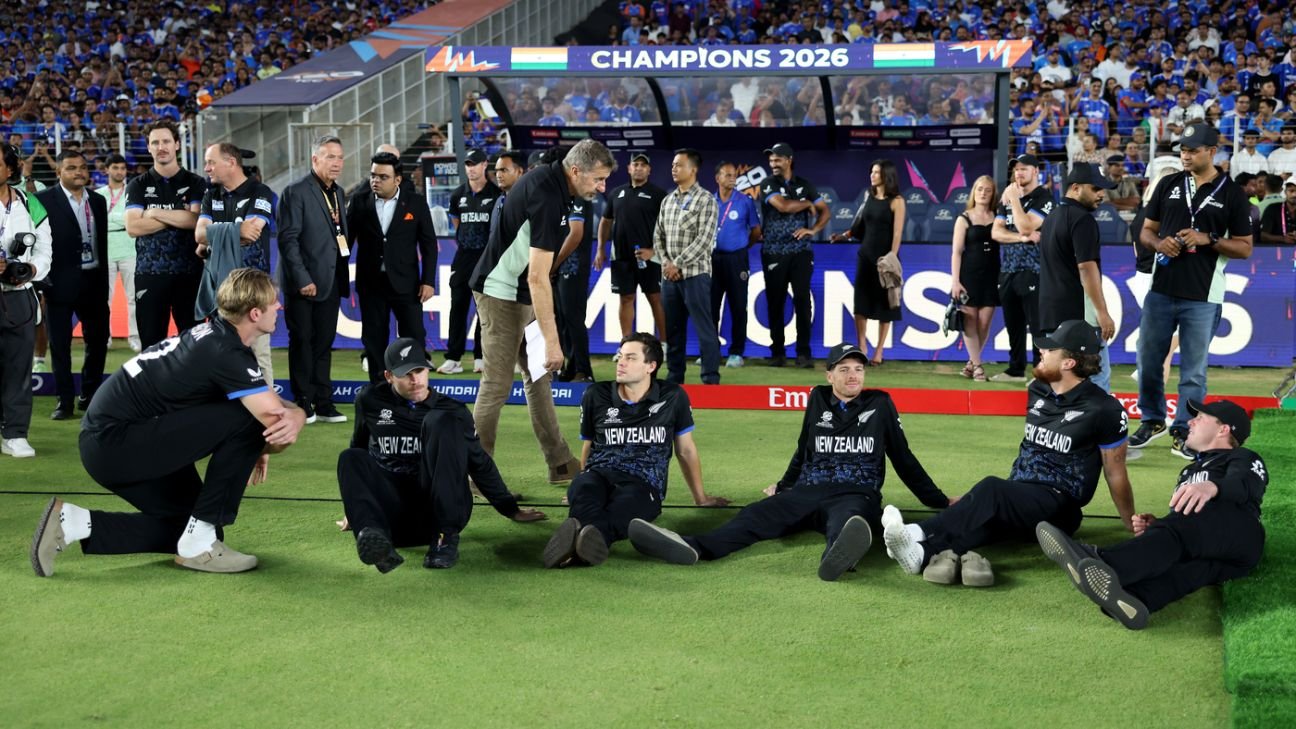
Someone had to Jacques Kallis the heck out of the team talk in the New Zealand dressing room. They’d been hit for the highest total in all T20 World Cup finals and it was only drinks.
Legend goes that in 2006, when Australia became the first team to score 400 in an ODI game, South Africa’s all-time great allrounder saw all his team-mates looking pale as ice and quiet as mice and he didn’t like it at all. “They are 15 short, lads,” he said in that dry rhythmic Cape Town drawl. Tension took leave. Smiles took shape. History was made.
The problem New Zealand will have believing India had left any runs out there after they put up 255 on the board in Ahmedabad is that at one point they had handed them 11% in just wides. There were eight in total after only five overs of play. The Black Caps have never, ever been so wayward. It felt like they were playing hide and seek instead of bat and ball.
They went one-over spells, potentially a learning from the bilateral series they lost earlier to India, except in keeping with that plan they ended up under-bowling the man who delivered one of only four boundary-less overs in the innings. Glenn Phillips had never bowled in the first six overs. Here, he kept Sanju Samson and Abhishek Sharma quiet even as they were itching to go.
New Zealand are usually able to adapt on the go, to trust what was happening in front of their eyes instead of what they vision-boarded the night before. But here they seemed entrenched in their pre-match plans and couldn’t cope when they started to unravel. They had India at 12 for 0 after two overs. Mitchell Santner would want to forget the next four – which fetched 80 runs – in a hurry.
“We know how good both Sanju [Samson], Abhishek [Sharma] and [Ishan] Kishan are at hitting all over the wicket,” he said. “So yeah, I think whichever way you look at it, there’s no perfect plan when guys are going.
“And once they’re going, it’s pretty tough to stop. I think for us, whether it was being braver with yorkers or bouncers, I think we tried a lot of the cutters into the wicket. On wickets that aren’t offering it much, they just kind of go as well.
“We tried the wide stuff. And then we tried the two on the big side. We tried everything.”
Eighty six thousand eight hundred and twenty four India fans had surged through the gates in Ahmedabad early to watch the closing ceremony headlined by Ricky Martin and literal fire bursting out of mechanical contraptions placed all around the ground. Who knew back then that the real heat was still lying in store.
India hit 37 boundaries in their innings – falling shy of the T20 World Cup record by just four – and the noise that greeted every one of them was so wonderfully organic. The fans were replacing the memories from November 19 in live time whenever Samson carted one down the ground or Abhishek belted one over cover or Shivam Dube pulverised several just in the last over.
New Zealand’s plan A was keeping the ball out of the Indian batters’ reach but when they couldn’t executed it properly – going for wide after wide after wide – they just didn’t know what to do. Lockie Ferguson, in particular, bowled two overs for 48 runs and was never seen again. His pace-off deliveries which were working so well earlier in the tournament, just never got any grip here. That convinced him to go pace on which didn’t change things much. The ball just found the fence quicker.
This keeps happening to them in finals. In 2015, they took down a pre-tournament favourite – South Africa – in one of the greatest ODIs ever played and went to the MCG on a huge high only for it all to dissipate the moment Mitchell Starc proved too much for Brendon McCullum. The Proteas might have pictured Hashim Amla playing that ball.
2:06
T20 World Cup final – Should Phillips have bowled more in the powerplay
Faf du Plessis, Anil Kumble and Martin Guptill try and assess where NZ got it wrong in the powerplay
In 2019, they toppled India, denying Rohit Sharma who had scored five centuries in that tournament. Virat Kohli only had five more days as India captain in white-ball world events after that day. And of course, MS Dhoni, so quick between the wickets, has to live with his last act as an international cricket being run-out. That’s when India vs New Zealand really became a rivalry. Now those days might well be at an end.
In 2021, they killed England’s dreams of holding both the T20 World Cup and the ODI World Cup at the same time and then ripped open the wound four days later by making sure Australia would leave the UAE as the new ICC champions. James Neesham was there. And he was here, playing his 100th short-form game and somehow when all his team-mates were struggling he delivered 3-0-22-3, and then he, too, was taken into a dark alley and mugged. His last six balls more than doubled his previous runs tally.
“There was a period of, I think, four overs where they lost four wickets but outside of that it was a free round,” Santner said.
“And, you know, everything kind of has to go well when you’re chasing 250, and, losing the wickets of the power players [Finn Allen, Rachin Ravindra and Phillips in the space of 13 balls] it’s always a challenge. I think that was the tale of the day, was the two powerplays. I think we were three for 40 odd [52 for 3], they were 90-odd for none [92 for 0].”
There was a real buzz back in New Zealand leading up to this final; a sense that finally this might be the year that they add to their one lonesome white-ball world trophy. The #NoSleepTilVictory – a hashtag born in 2019 – was even brought back. Though about 15 overs in when India brought up 200 punters in Wellington and Auckland and Christchurch and Hamilton would have settled in to hate-watch. As you can see, they’ve had a lot of practice.
Matt Henry shooed his team-mates from coming in to celebrate Hardik Pandya’s wicket. Daryl Mitchell lost his temper. Sure, he was provoked by Arshdeep Singh throwing the ball right at him but aren’t these the nice guys? Though in the end they were. Santner threatened to break hearts 24 hours ago. He would leave the ground with the memory of nearly 100,000 smiles.

