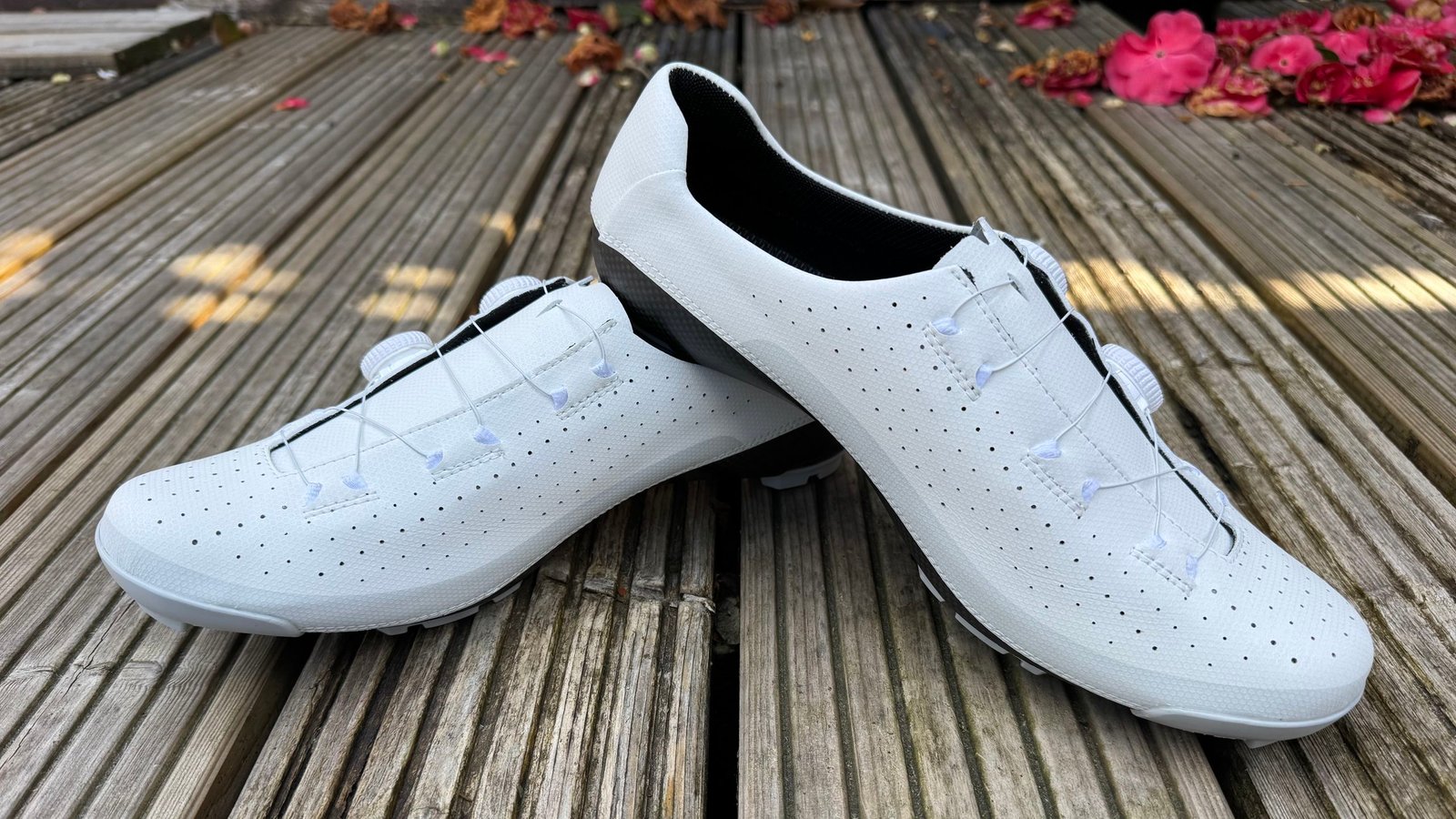
This is actually the second release of the Nimbl Urano shoes. Previously released in the winter of 2024, after testing and feedback from professionals, Nimbl shelved the shoe so that they could fix some issues. Now, it’s back with the Italian brand hoping that the Urano will set the standard for high end gravel race shoes.
Image 1 of 4


Construction
The Urano are built upon the same monocoque carbon fibre sole as the rest of the Nimbl line of shoes. This results in the same incredibly low stack height of around 2mm, with the rear of the sole extending up to create a stiffer heel cup. The main differences are the two-bolt cleat mounting for Shimano SPD cleats, and the inclusion of rubber treads. A TPU toe guard, front and rear treads, and mid-sole protective piece have been added for off-road walking traction and sole protection, a feature you see on many of the best gravel shoes.
As with other Nimbl shoes, retention comes via the two Boa Li2 dials. These allow for micro adjustments for tightening and loosening, with a pull to release system. These are the plastic topped version rather than the metal ones on the Ultimate and Ultimate Glide shoes. A grippy exterior is still included on the dials, in rubber this time, to allow for easy grip and retention adjustments.

On the upper, the structure is the same as the Ultimate shoes, with a conventional tongue design. However, the microfibre upper has been redesigned to be more resilient, and easier to clean given the off-road design of these shoes. For ventilation there are multiple perforations across the sides of the upper material.
A size 43 is quoted as being 254g per shoe, the size 45 on test was 248g per shoe including all the parts and insoles. Sizes range from 39 to 47, with half sizes from 41 up to 47. Black and white colour options are available.

The shoes are a slightly off-white compared to the other white Nimbl shoes
(Image credit: Future – Andy Turner)
The Ride
In terms of performance, I have been mightily impressed by the Nimbl Urano shoes. Using them on the road with Shimano SPD pedals, the power transfer and light weight has meant the setup feels.as good as the usual Speedplay setup I use for road riding. Power transfer for sprints and higher capacity efforts feels planted and direct, while the low weight does feel better at higher cadences when the shoe is moving faster.
To really test these shoes, I used them for the Gralloch UCI gravel race. They clearly didn’t slow me down, after 3.5 hours of racing I had averaged 291 watts and set plenty of power PBs. In essence, they felt like road racing shoes, providing impressive stiffness as a platform to launch watts from.
Comfort wise, these have taken less breaking in time than the Ultimate Air or Glide shoes I’ve tested. The upper is stiff, but not unforgiving and the low entry to the shoes means there is very little chance of any upper material rubbing on ankles. This low entry also does not result in any lack of retention around the heel. The rear of the shoe cups the heel nicely with a fit that is narrow enough on my heel and ankle, but not constricting.
Image 1 of 4


Of course the Boa Li2 dials play a big part in the retention. I personally prefer the tongue-less design of the Ultimate Glide and I find that dial setup does lead to better pressure distribution when really clamping down the dials. However, on the Urano, the two dial setup with tongue can still be tightened down enough to secure the foot well for most high capacity efforts without being overly tight on any section of the foot. The Boa Li2 dials have been praised enough in many shoe reviews I have done, as well as by others, and remain the standard bearer for retention dials on cycling shoes with both the micro-adjustments for tightening and loosening, as well as the pull to release for easy foot release.
After 3.5 hours of racing, the outside of my right foot was aching, due in part to the stiff carbon sole. I have a high arch, so even with arch support I can get a pressure buildup on the outside of my foot, but after this amount of time on rough terrain, there was certainly some aching.
The main difference between the Urano and the rest of the Nimbl lineup is of course the gravel element of them. The sole uses two two bolt attachment points for Shimano SPD cleats rather than the three or four bolt road options. The upper is also more rugged and easier to clean, with dirt wiping easily off them after a day of racing.
On the sole of the shoe there are also more rugged tread elements for walking off-road and maintaining some grip. These are effective, and have proven useful riding on bridleways and requiring a fair bit of walking in some cases, but these are race shoes and these are not as grippy as more adventure focussed gravel shoes.
Image 1 of 2


There is one glaring issue with these shoes though, and that is the quality of the finish. On the front tread section especially, a good amount of it is visibly glued on, and can be lifted quite easily by hand. It’s not the quality I would expect for a pair of shoes that cost more than half a grand. I have seen far better quality of the tread fitting on shoes that are a third of the price. They appear secure enough, with sections that fit into the sole itself on some small openings, but it’s still a little bit tardy in terms of finish quality.
The insoles are the same basic ones that come with all Nimbl shoes, and I am in two minds when it comes to criticism of these. On the one hand, if you spend £550 on cycling shoes, you are likely performance focussed and use custom orthotics. If you don’t, you should, it’s a far greater performance gain. On the other hand, the insoles that come with the QUOC M3 shoes with adjustable arch are fantastic and I use them instead of the custom insoles I have, as with the high arch support they work well for me. Regardless, with the Nimbl Urano you will likely need to buy insoles, or use whatever pair you already use, as the supplied ones don’t offer much support for anyone with any form of arch in their foot.
Value
As with previous Nimbl shoe reviews, value is an area where the price tag does just mean they struggle comparatively. £550 / $649 is a huge amount to pay for cycling shoes, regardless of how good they are. The simple fact is at this price there is certainly a case of diminishing returns on investment.
I have previously been racing in a pair of Specialized S-Works Recon Lace shoes, which retailed for £300 / $325. They are lightweight, fit well, and offer a great level of power transfer, for nearly half the price. Spending my own money, I could not justify spending £250 more on a pair of shoes for what is a small increase in performance based on statistics.
Even the new S-Works Recon Evo, based on the Ares 2 shoe, are £399 /$549, and feature a broader spectrum of sizes. On the face of it some of the finish of those is slightly better than the Urano as well. However, the more convoluted path of the Boa dial lace is ripe for damage from mud and grit ingress over time.
The new Sidi Aeron is another consideration, again £399 / $570 and carbon soled, dual-dialled, and with good levels of tread. The carbon sole is also less exposed for longevity, but this will add weight even if that figure is not disclosed.
But then this is a high-performance race shoe. Compared to most dual-boa-dial equipped shoes the Urano are around half the weight. That’s often around 500g saving which at a higher performance level is not insignificant. The power transfer is also exceptional, so much so that I can happily use these shoes for fast paced road rides on SPD pedals. For those seeking every advantage, there may be value to them in these shoes. For most of us, I’d say you are far better buying in the £250-300 price point for performance gravel shoes. They will be mostly as good, likely feature greater longevity features, and cost far less.
Image 1 of 2


Conclusion
The Nimbl Urano shoes are quintessentially Nimbl. They are extortionately expensive, exceptionally lightweight, wonderfully stiff, secure and comfortable, and lust worthy in their style and desirability. If you want the fastest gravel racing shoe option for SPD cleats, you’ll likely struggle to do better than these. If you want almost all of that performance but for significantly less cash and potentially greater longevity, look elsewhere.

