The onslaughts are truly breathless. They are unrelenting, dizzying in scale, and unmoored now more than ever from what used to be the bedrock of a batting life. Humans are hard-wired by millions of years of evolution to be self-preserving. Batters, on top of this, are taught from the youngest ages to prize their wickets, to hang their worth on the number of runs that appears against their name on a scorecard. When you’re making your way through the game, a fifty might get your name in the local newspaper. A hundred will get you noticed by selectors at whatever level is the next step up. Big runs get player-of-the-match awards.
But India’s T20 batters over the last few years have slashed these ties to tradition. They have baked failure into the philosophy, treating it as a necessary ingredient of excellence, and in doing so found a freedom that is now turning them into a batting juggernaut that – whatever happens in Sunday’s final in Ahmedabad – seems set to redefine the upper limits of T20 batting in the years to come. Leading up to that match, India have crossed 250 twice in three games – first against Zimbabwe in Chennai, before doing it in a knockout against England at the Wankhede.
It is the outright outrageousness of the shots India now play that imprint themselves and live on for weeks in the brain. Sanju Samson was the chief provider of these little ridiculousnesses in the past two matches, smoking a shortish Jofra Archer ball way over midwicket in the powerplay, before to a wider length in the 12th over, he hung on the back foot and sizzled another six over long on, in addition to the five other sixes he struck.
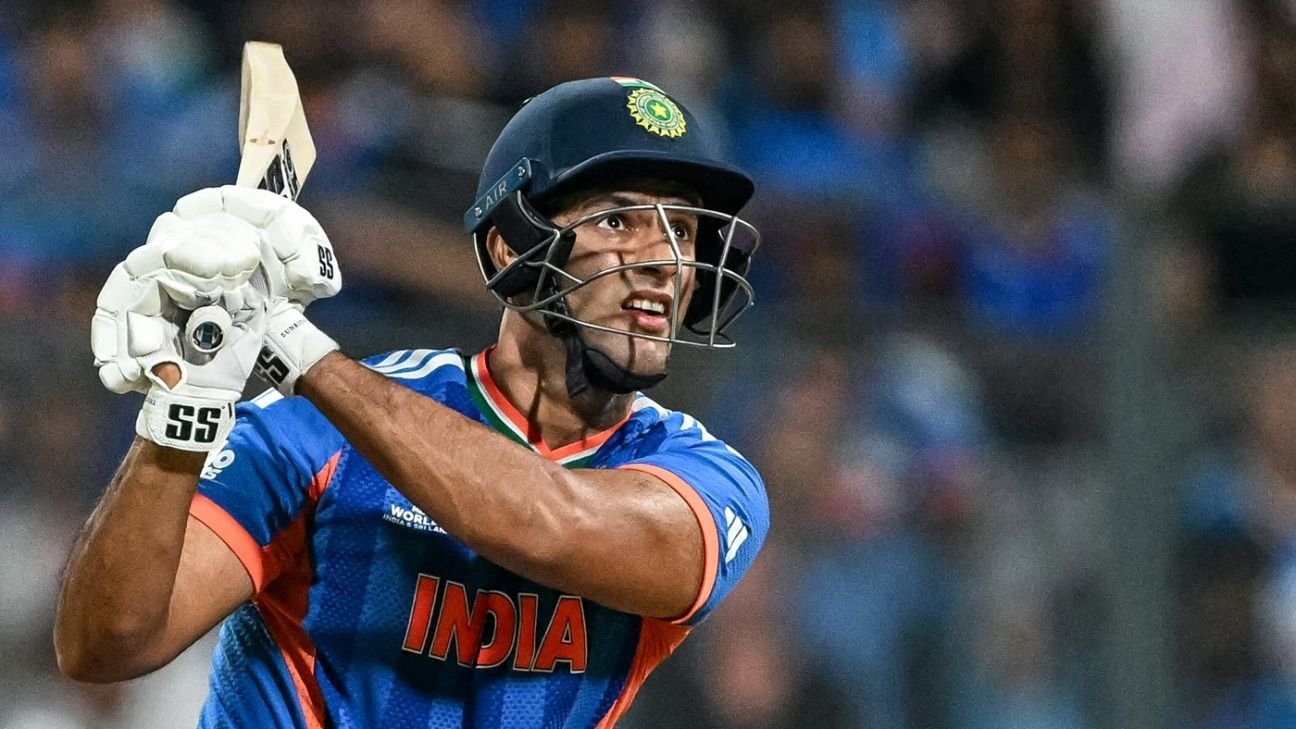
But there is no hint of respite for bowlers from anyone else either. In that semi-final, Shivam Dube was yanked up the order to deliver his own cannonade against spin, the high-risk-high-reward blasting of an England attack utterly overwhelming any joy the opposition may have felt at making a breakthrough.
India’s batters take fewer balls than they ever have to acclimatise to conditions. Having done so, they make bolder plays at a more dazzling frequency than ever before, cutting bowlers’ margins of error to infinitesimal proportions, only pinpoint yorkers a serious safeguard against being blasted. In this tournament Tilak Varma has slipped effortlessly down the order due to a tactical change at the top to keep India running wild. In the semi-final, he played one of the best shots of a heady evening of batting, backing away and slicing a sliiiightly-off length yorker from Archer over deep backward point in an over in which he struck two other sixes that almost seemed almost prosaic in comparison.
When India play at high-scoring venues such as the Wankhede, with a full house reveling rapturously in every big hit, bowlers feel like mere logs to be cast into the white-hot furnace of Indian batting. England’s attack, by the way, had been the most penetrative in the tournament until the semi-final. The great irony of India’s batters putting such a low price on their wickets is that wickets don’t end up meaning that much to the opposition either, one six-hitting powerhouse replaced by another and another all the way down until Axar Patel at No. 8. India have these riches because each of these batters has been primed year after year in the heat of the IPL.
Ahmedabad may not necessarily be the venue for as fearsome ball-striking, given the strip the final is to be played on is a mix of red and black soil, the black soil perhaps lending some slowness to the surface. And yet you look at the average age of this India top eight, and this does not feel like a freight train that will be slowed anytime soon. Since the start of 2024, India have smashed scores of more than 250 on five separate occasions. The next best team is Zimbabwe with three 250+ scores, their opponents having been Seychelles, Gambia, and Botswana. India have done it against Bangladesh, South Africa, New Zealand, Zimbabwe and of course England. Other teams play on flat surfaces with small boundaries too, but they do not have such colossally high ceilings.
When India batters walk to the crease now, they are not there to make big scores, but to hit boundaries and keep hitting boundaries. Samson said as much in post-match press conferences following his two exceptional successive knocks. But you don’t necessarily have to look at the batter who has hit 97 not out and 89 to understand what is happening.
Abhishek Sharma has been having an entirely different sort of tournament, with scores of 0, 15, 10, and 9 among his five most-recent knocks. But each of these had been quick failures, Abhishek using up only 33 balls for those 34 runs, his dismissals uniformly resulting from boundary attempts.
There is also no question that India will retain him for the final. This too unshackles a batting order. Your wicket does not matter. It is only a setting of the stage for the next detonation.

