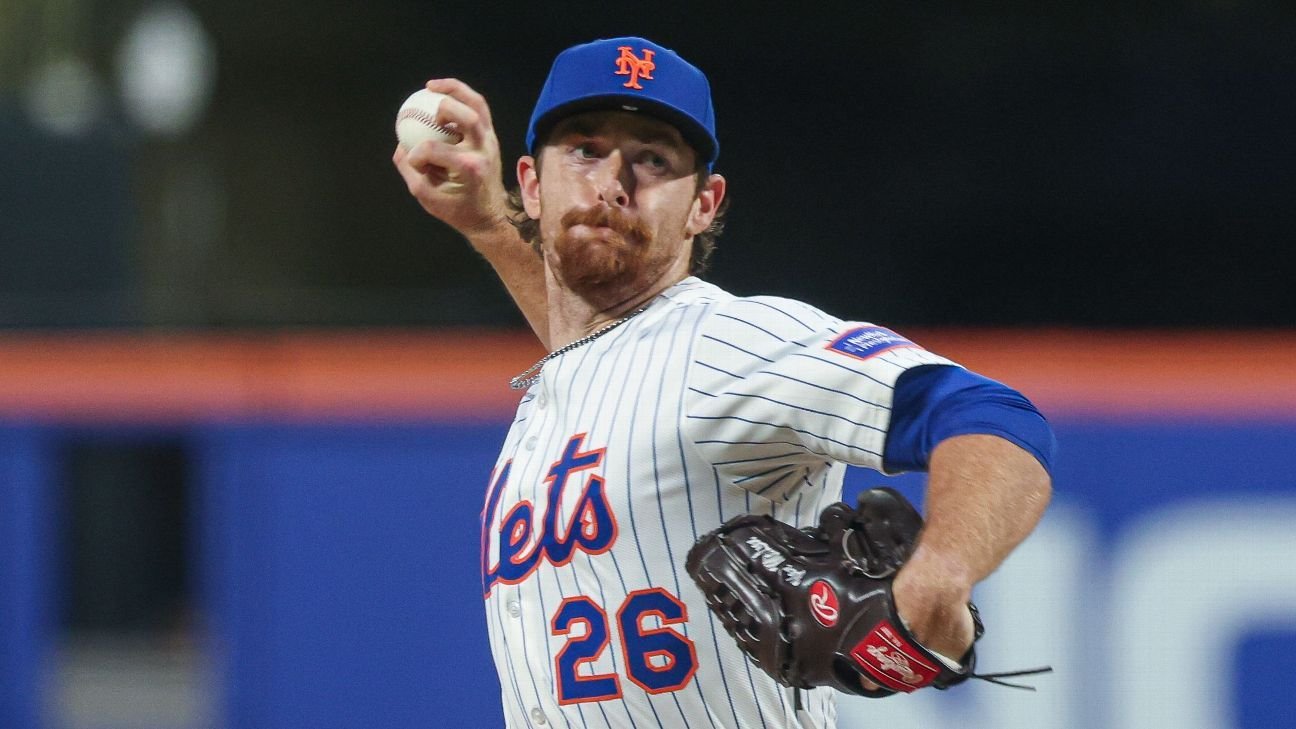
IN THE EARLY days of spring training, Nolan McLean‘s New York Mets teammates couldn’t believe what they were seeing. Here he was, in his first bullpen session of the spring, sitting 97 to 98 mph with his fastball, nearly 2 mph harder than last year. McLean showed up in midseason form for good reason. Even though he has been pitching full time for barely a year and has eight major league starts to his name, the 24-year-old McLean is lined up to start a potential final in the World Baseball Classic for Team USA. Whether it’s the Dominican Republic or Japan that awaits him, every mile per hour matters.
“If I can have a few more clicks on the heater, it never hurts,” he said. “A lot of the guys gave me a hard time throwing pretty hard, pretty soon. When I get on a mound and a guy’s standing in there, something just clicks in my brain where I’ve got to start competing. As soon as the batter stands in there, even if he’s not swinging, I’ve got to throw my best stuff. I think I’m just fascinated and in love with the competition.”
Fascination and love are appropriate descriptors for the Mets’ feelings about McLean — and over the next week, as the WBC reaches its knockout stage and Team USA looks to secure a gold medal for the first time since 2017, the sentiment could spread coast to coast. McLean will make his WBC debut Wednesday at 8 p.m. ET against Italy, following Logan Webb, Tarik Skubal and Paul Skenes in the United States’ devastating rotation. His presence on the staff over more seasoned veterans isn’t just a bet by general manager Michael Hill and manager Mark DeRosa, it’s an acknowledgment that McLean’s success in that initial MLB stint last fall is real enough to make him worthy of the assignment that otherwise would have gone to Skubal.
Ignore the lack of experience and McLean’s presence makes plenty of sense. He might spin the baseball better than anyone in the world, his curveball breaking a major league-best 26 inches and his sweeper running horizontally over the entire 17-inch width of home plate. Pair those offerings with two different-shaped fastballs and a changeup and cutter, and McLean finds himself in rare territory: owner of at least six pitches that grade out on FanGraphs’ Stuff+ model as average or better. The list runs three deep: Skubal, New York Yankees ace Max Fried and McLean.
“We’ve been throwing a lot of catch play together, and it’s not fun. Every time I go, I’m like, ‘Yeah, I’ll throw it with you,'” Mets starter Jonah Tong said with a pronounced sigh. “It’s hard when he’s working on new pitches and I’m just like, nooooo.”
McLean’s rapid ascent, from 2023 third-round pick to the front of the Mets’ 2026 rotation alongside Freddy Peralta and a vital part of the most talented U.S. team ever assembled, is not entirely surprising to those who have borne witness to his athletic feats. At 6-foot-2 and 214 pounds, McLean could have been a star quarterback, and in college was a strong enough power hitter to crush a 472-foot opposite-field home run. He forsook both to focus on pitching, something that at first felt foreign. The more McLean considered it, though, the more he came around to the notion. Like so much in his life, it came naturally.
MIKE GUNDY COULDN’T believe what he was seeing, either. It was the fall of 2020, and a freshman quarterback from Willow Spring, North Carolina, was making the sorts of throws nobody expected, least of all the head coach who had recruited him to Oklahoma State.
“During that time, we could tell,” Gundy said. “Everybody was like, he’s going to be really good. He’s going to be a two- or three-year starter for us. We knew he was going to be a hell of a quarterback. He had the left-brain function. His mental capacity to think fast, react fast, not let things bother you. Very few kids have that. In my opinion, that’s what allows him to be a good pitcher.”
Gundy understood the predicament McLean would face going forward. Because as good as he was at football, he was every bit as talented at baseball — as both a hitter and a pitcher no less. Whatever polish he lacked, it was more that his time was spread so thin than any sort of limitations on his faculties. The inevitability of McLean eventually specializing in one area was palpable, and Gundy just hoped that football would win out.
Emotionally, it was the favorite.
“I loved football before I would say I really, really loved baseball,” McLean said. ” I remember when I was little, I came home crying from my first ever football practice. My dad was like, what’s wrong? I’m like, they want me to play quarterback. He’s like, what’s wrong with that? I was like, I just want to hit people. He’s like, well, quarterback’s a good thing. You probably need to stick with that. You can throw it and not many kids can throw it. So from there, once I bought into that, I fell in love with it.
“The actual part of a football game, playing in football games — best feeling on earth. Something about football with organized chaos that’s going on. It’s similar to baseball where everything’s individual, but it’s with a team aspect as well, and it’s instant. Everybody makes the right block, you’re going to get some yards. If you make the right reads and you make the right throw, you’re going to get some yards. Sometimes in baseball, even if you do everything, you can still get punished for it.”
While McLean bided his time on the scout team in football, he earned plenty of run as a freshman for coach Josh Holliday’s Oklahoma State baseball team. He slugged eight home runs in 137 at-bats and, though he appeared in only two games as a pitcher, McLean’s arm talent revealed itself enough that a friend of Gundy’s in the baseball industry reached out and told him that baseball was McLean’s clearest path to a professional career. Gundy understood.
“If you throw 100 miles an hour,” he said, “you need to stay in baseball.”
McLean left the football team during his sophomore season and trained his energy on baseball. He took over as the full-time third baseman and whacked 19 home runs in 242 at-bats, including that titanic oppo shot against Seton Hall. Holliday leaned on him in a relief role, too, and though McLean’s 4.97 ERA was nothing special, his 39 strikeouts in 25⅓ innings spoke to his ability to blow away hitters with velocity and confound them with spin.
The Baltimore Orioles drafted him in the third round of the 2022 draft but didn’t sign him over medical concerns during his team physical. It was an ill-fated decision — McLean has been the picture of health since — and allowed him to head back to Stillwater, refine his pitching and tantalize big league teams with a ceiling that even most first-round picks could not match. The Mets grabbed McLean with the 91st pick in 2023 and let him spend his first full minor league season in 2024 logging 109⅔ innings and 143 plate appearances. As good as McLean could have been with the bat — “If Adam Dunn didn’t make it, that was me,” he said — his feel for pitching and the mentality that had stood out to Gundy convinced New York it had a gem every bit as good as their two more touted pitching prospects, Tong and Brandon Sproat.
“He just does something with the baseball that I don’t think very many people can do,” Tong said. “He spins it better than anyone I know. And he has that bulldog mentality that is very rare, especially from a pitcher like that. The thing that makes him really successful is not only the fact that he’s an absolute animal on the mound, but he’s an incredible human off it, and he’s so dedicated to his craft that it’s amazing to watch.”
For the first time in his life, McLean dug in on only one discipline. It suited him. And his past experiences prepared him for the success that followed. Pitchers are evermore trying to infiltrate the heads of hitters, to understand what they’re thinking and why. McLean didn’t need to guess. He had lived it. And as lazy as he felt not constantly juggling all of the responsibilities of a two-way player, he realized that the life of a starting pitcher is not dissimilar to another trade he’d spent years playing.
“It’s kind of like a football game,” McLean said. “You get one a week, and it’s a buildup to it. So I think being a starting pitcher definitely helps get back to the football roots where it’s just preparation, preparation, preparation. You go out there, you blow it all out and you recover and restart the process.
“It was weird. I went from constantly being on the move to having a little bit more free time and almost felt like I wasn’t doing enough. Then you realize, OK, recovery is pretty much most important and part of my job other than my start day. So once I started to understand that and implement a routine around my start day, I fully bought in that one day is the most important day of my week and every other day needs to be supplementing that. And things kind of took off from there.”
McLean began the 2025 season in Double-A and spent all of five starts there, giving up four runs in 26⅓ innings. A promotion to Triple-A didn’t slow him down. He posted a 2.78 ERA, his stuff better than ever, his mental game locked in. Beleaguered by injuries, the Mets summoned him for the stretch run and he struck out big leaguers at a higher rate than he had minor leaguers with a 2.06 ERA over 48 innings. It was the best debut by a Mets starter since another two-way player whose arm eventually forced him to stick with pitching full time.
In his first season with the Mets, Jacob deGrom won NL Rookie of the Year. Four years later, he won the NL Cy Young Award. A year after that, he won it again. It’s the sort of path McLean would love to follow. And he isn’t going to sit around and wait for it to happen.
ALMOST EVERY DAY this winter, Nolan McLean would drive about 20 minutes to the fanciest barn in North Carolina and get ready for the 2026 season. A few years back, McLean learned that a family friend named Rick Gilchrist had constructed a 100-by-60-foot facility behind his house for his grandson, Ethan, a top high school prospect in North Carolina. Inside was everything a baseball player could dream of: a batting cage with HitTrax, a pitcher’s mound with a Rapsodo unit, a full weight room, a sauna, Normatech boots. It was heaven for a ballplayer who wanted to train, and when McLean goes to the barn — Gilchrist gave him a key — he emerges the picture of someone who understands the power of toil.
“I see a man on a mission,” Gilchrist said. “He works hard. He’s soaking wet with sweat when he leaves.”
Modern pitching necessitates not only that level of physical exertion but a sort of mental fortitude that McLean inherently demands of himself. He’s at a comfortable place in his life now, getting married to Avery Frechette this winter (their cavapoo, Waffles, made an appearance with a collar of white flowers). The extra time he would have spent in the cage taking swings now allows him to do things like take golf swings on an off night at TGL, where, his agent Tom Hagan said, he carried a drive over 300 yards earlier this spring before Philadelphia star Trea Turner one-upped everyone with a hole-in-one.
Ultimately, McLean knows he’ll be judged by what he does standing 60 feet, 6 inches from home plate. Football is in the past. Hitting is in the past. He’s a pitcher now, and a damn good one. And whether it’s Wednesday night against Italy, in a potential WBC final or during the upcoming season with the Mets, the battle is what McLean craves most.
“Hitters are different,” he said. “You either have a super cerebral hitter who’s actually looking for pitches and trying to pick up what you’re doing, or a guy who just sees ball, hits ball. It’s just a constant cat-and-mouse game. The biggest thing for me is I know I have good pitches. I’ve just got to try to fill every pitch up in the zone and trust the movement and the work and the process I’ve put in on making these pitches nasty just to do their thing. It’s when I get out of the zone and try to make the pitches move instead that I get in trouble.
“Our season’s so long if you just trust the process over that extended period, a good season, hopefully we’re having 30 to 40 starts and that’s a really good season. So over time, if you can just be consistent in everything you do, I think it pays off. It’s really cool where the game’s going. The constant grind is something that I’m obsessed with, and what I love is just the process of trying to find little tricks and nuances to get better.”

