Long before kickoff, this game already had a name.
When Notre Dame boarded a plane for Seattle on September 24, 2005, the storyline had written itself. Tyrone Willingham—dismissed less than a year earlier in South Bend—was now the head coach at Washington, and the matchup was quickly labeled the “Ty Bowl.” It was a week filled with questions, emotions, and an unavoidable sense of unfinished business.
Advertisement
Inside the Gug, Charlie Weis did his best to strip all of that away. No commentary. No looking back. Just football. What unfolded against the Huskies wasn’t fueled by revenge or rhetoric, but by focus—along with a few moments that carried far more weight than the final score would ever show.
The following excerpt is from the 2005 Notre Dame Football Review in the Scholastic Magazine, Vol. 147, written by Michael Kim.
A Ty Bowl Victory
by Michael Kim
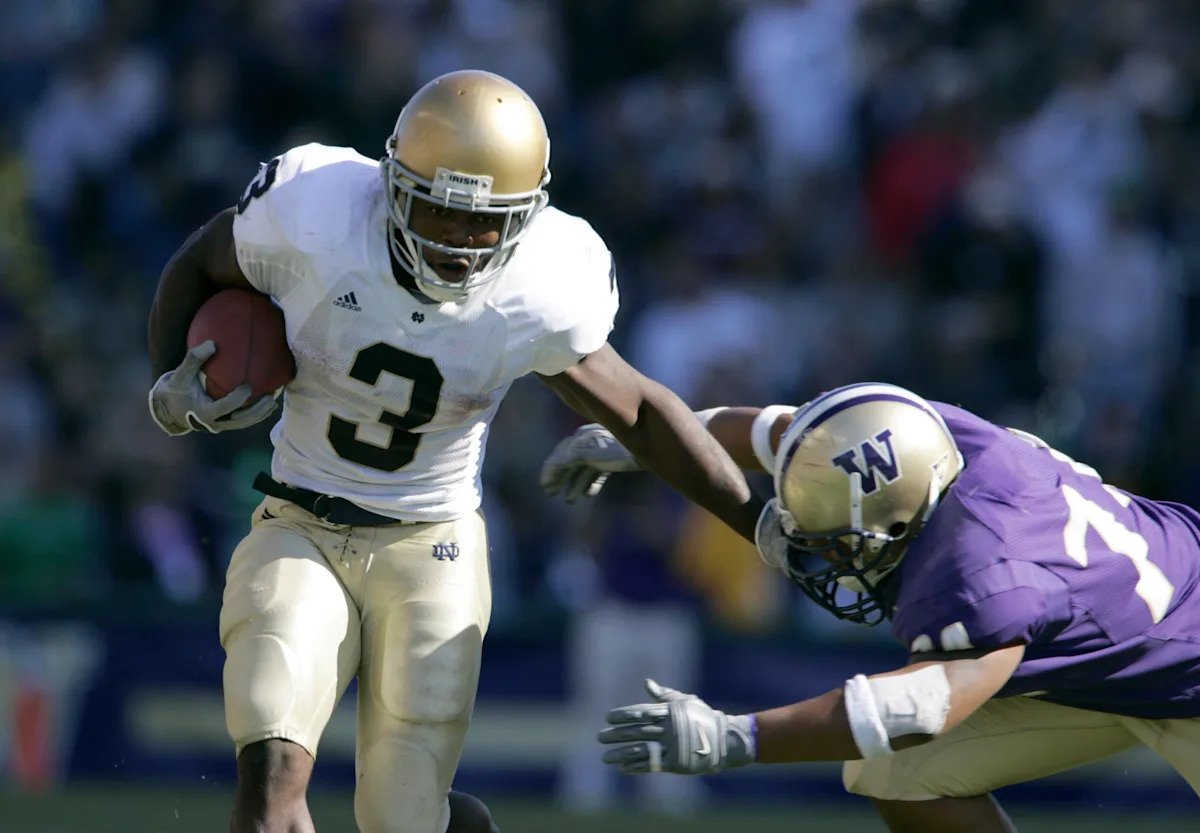
Media members circled Sept. 24, 2005, on their calendars when they heard that former Notre Dame Head Coach Tyrone Willingham was hired by the University of Washington. On that day, Willingham would lead his Huskies against the Irish less than 10 months after his dismissal from Notre Dame as head coach. Head Coach Charlie Weis knew the distraction this presented for his players, who were still dealing with the fallout of Willingham’s controversial firing. Weis refused to comment on Willingham’s firing since the day the former New England Patriots offensive coordinator was hired and continued to do so leading up to the game he coined the “Ty Bowl.” Weis and his team focused solely on football, leaving emotion at home as they headed to Seattle, Wash., to play the struggling Washington Huskies.
Advertisement
Washington came out fast and furious on its opening drive; it was evident that they had the urgency to win one for Willingham. However, their opening drive quickly unraveled when wide receiver Craig Chambers fumbled the ball to the Irish on the Notre Dame 1-yard line. The play foreshadowed the rest of the day for the Huskies, as they committed costly turnovers at inopportune moments.
Although Chambers’ fumble forced the Irish to begin their first offensive drive on their own 1-yard line, on the first offensive play of the game for Notre Dame, quarterback Brady Quinn questionably rolled to the right in his own end zone and connected with tight end Anthony Fasano, who then acrobatically leapt over a Washington defender for a gain of 13 yards and a first down. However, as Irish fans would later discover, Weis’ first call of the game was deliberate; he had promised Montana Mazurkiewicz, a 10-year-old boy who was dying of an inoperable brain tumor, to call the “pass right” play as the first play of the game. Mazurkiewicz sadly died before he could see the play that he asked Weis to call.
Despite the effectiveness of Mazurkiewicz’s “pass right” play, the Notre Dame offense started off sluggishly, and the only bright spot for the Irish in the first half was a 17-yard touchdown run by running back Darius Walker, who would finish the game with 128 rushing yards, making him the first Notre Dame running back to rush for 100 yards in four consecutive games. Kicker D.J. Fitzpatrick added two field goals for the Irish in the first half, and the Irish went into the locker room at halftime ahead 12–3.
Washington had its chance to take control of the game in the third quarter when Huskies quarterback Isaiah Stanback threw a career-long pass of 69 yards to wide receiver Marlon Wood. But the Huskies wasted the effort when, two plays later, Stanback carelessly threw into the end zone and Irish cornerback Ambrose Wooden intercepted the pass.
Advertisement
Notre Dame began to surge late in the third quarter when fullback Rashon Powers-Neal bulldozed his way into the end zone for a 2-yard touchdown run. The Irish put the game out of reach when Quinn threw a 52-yard bomb to wide receiver Jeff Samardzija, who waltzed in for a touchdown, providing his team with a 29–3 lead. Running back Travis Thomas later added an 11-yard run in the fourth quarter for his first touchdown of the season. Despite the two touchdowns scored by Washington in the fourth quarter to make the score closer, ultimately, Notre Dame easily defeated Washington 36–17. There would be no last laugh for Willingham.
As the clock wound down, dozens of photographers raced to the center of the field to get a shot of Weis and Willingham shaking hands. Many of the Notre Dame players that Willingham recruited greeted him warmly, wishing him luck. Weis was relieved that the game was over. “I think, psychologically for the players, this will be a good thing to have behind them and move on to the next game,” he said.
By the time the final seconds ticked away, the result felt almost secondary.
There were handshakes at midfield, quiet moments of closure, and a sense that something heavy had finally been set down. For the players—especially those recruited by Willingham—it was a chance to move forward. For Charlie Weis, it was confirmation that his team had stayed locked in when it mattered most.
Advertisement
The “Ty Bowl” was never going to be just another road game, but Notre Dame made sure it didn’t become anything more than that. They played the game in front of them, honored a promise that transcended football, and left Seattle with a decisive win—and perhaps more importantly, with emotional baggage finally behind them.
Some Saturdays linger because of the drama. Others endure because of the humanity tucked inside the box score. This one managed to be both.
Cheers & GO IRISH!

