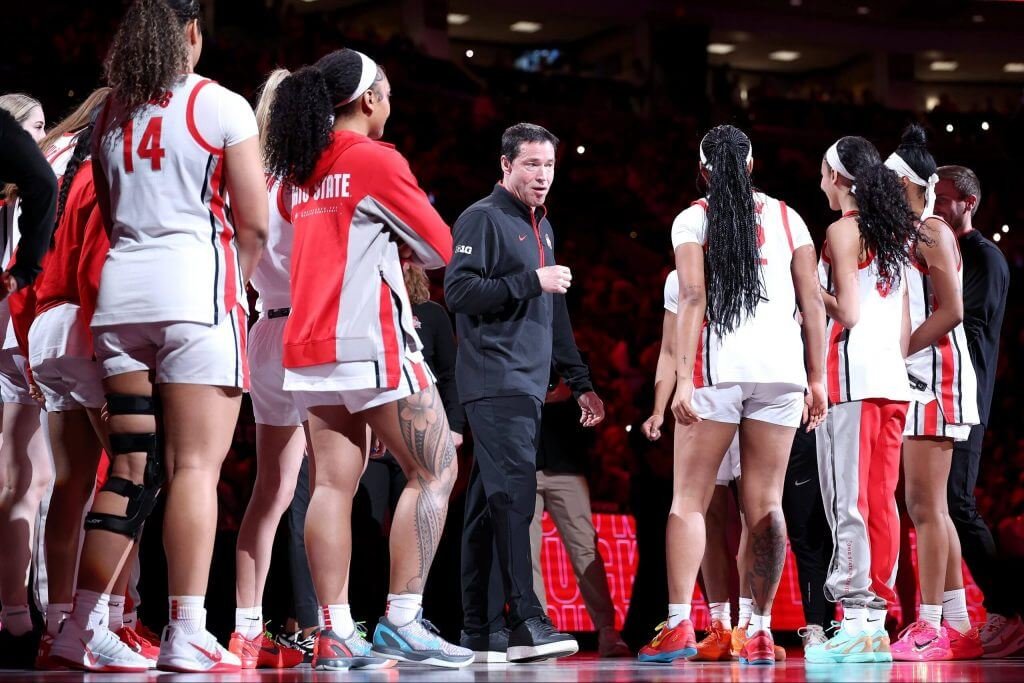
COLUMBUS, Ohio — For Ohio State, it all began sitting around a firepit.
Redshirt junior Kennedy Cambridge is the most experienced player among the Buckeyes, and this offseason, she thought it would be a helpful idea to gather her teammates at her home for a bonfire. Nothing was scripted, no major events were planned, no basketball talk and no coaches invited. It was just a chance for the team, which lost five upperclassmen last season, to spend some time together.
Advertisement
“These are moments you’re never gonna get back,” Kennedy said. “The way the transfer portal is, you’re never going to be in the same room with the same people for so long.”
The next day, the bonfire was the talk of practice, and sophomore guard Ava Watson, who missed it, was getting caught up. “Everybody just told stories about their struggles or what’s hard on us, or what we love, or just kind of digging deep into each other,” she said.
That was important for this season’s Ohio State team, because this season’s roster was so new. Among the losses, four graduated, and standout forward Cotie McMahon entered the transfer portal and wound up at Ole Miss.
Four new players joined the roster, and nobody on the team had played more than a year in McGuff’s system. Who would Ohio State become? How much of a jump could All-America guard Jaloni Cambridge take? How would the Buckeyes get back to an NCAA Tournament hosting position, while playing in a talented Big Ten, with such little experience? And if they got there, how could they ensure they’d avoid another early second-round exit?
Advertisement
The Buckeyes weren’t ranked in the preseason, they weren’t talked about at all during the offseason, and it turned into a bit of an “us against the world” mentality.
It brought players closer together, and through the season, they formed a team that earned the No. 3 seed in the Fort Worth 1 Region and will host No. 6 Notre Dame on Monday afternoon.
It’s been one of coach Kevin McGuff’s best coaching jobs of his career, but it comes with one lingering question over his head.
Can Ohio State finally get out of Columbus, after losing at home to a lower seed the last two seasons of the tournament?
“When it comes down to fighting against another team, you gotta have that trust, and I think that we built that trust when we’re at those bonfires,” Kennedy said.
Advertisement
In his 13 years at Ohio State, McGuff has stuck true to his roster-building blueprint.
At its best, McGuff’s teams are led by a dynamic point guard. He had the program’s all-time leading scorer, Kelsey Mitchell; Jacy Sheldon led the Buckeyes to the Elite Eight; and now Jaloni Cambridge, who is one of the top-10 scorers in the country, is leading the way.
“We’ve been at our best when those particular players have been at their best,” McGuff said. “And I think when you look at this year, when Jaloni has been at her best, it’s certainly been super impactful in our success.”
But he also relies heavily on athletic, energetic guards who can cause havoc in the passing lanes both in his full-court press and in the half court. Though the transfer portal era might tempt coaches to recruit the “best available” player as much as possible, McGuff has been intentional about the players he recruits in high school and in the portal.
Advertisement
This season was no different. Though many saw a roster full of young players and uncertainty, the coaching staff saw versatility.
Katie Smith, who is in her second year as an Ohio State assistant, saw a roster this summer that had just three bigs: Elsa Lemmila, Kylee Kitts and Ella Hobbs. Their post, especially when an opponent has two post players, has been a weakness, but it also opened Smith’s eyes to just how much havoc they could cause on the perimeter.
Bringing back Chance Grey, Jaloni and her sister Kennedy Cambridge and Watson were key to this season’s roster, but adding in senior transfer T’yana Todd and freshman Brynn Martin has provided additional guard depth.
Their potential impact was obvious.
“You’re driving, kicking, you’re ghosting, your bigs set great screens, you can pick-and-roll reads, and then on the other end, yeah, you got to be disruptive, because if you don’t, then people are going to pick you apart,” Smith said. “What we had, though, we were like we can work with it.”
Advertisement
Some seasons, McGuff has relied on athletic and long players, like Taylor Thierry or Celeste Taylor, but this year’s team is built more on its attitude, which began in those summer workouts. “We might be grittier and hang our hat on execution than pure athleticism than what we had in the past,” he said.
Even the Buckeyes didn’t really understand how young they were.
That led McGuff to change his mindset. In previous seasons, when he knew better what his teams would look like during the season, he could push them to be at their best every moment of the day. But this season’s team has been a weekly process.
“I thought we would be good at some point, I didn’t know when, and I didn’t know how long it would take,” McGuff said.
Advertisement
Ohio State had to overcome some curveballs to reach the potential McGuff saw.
Lemmila has grown into one of Ohio State’s most important role players. The 6-foot-6 forward from Finland led the Big Ten in blocks this season and was at her best in Big Ten play, averaging 10 points and 8.4 rebounds. But after an offseason recovering from a stress fracture and a torn meniscus, and undergoing surgery that sidelined her until October, she said she had “zero confidence.”
Her first double-figure game came Dec. 22 against Western Michigan, and Ohio State began to hit its stride. The new pieces began fitting together. Cambridge had ascended into one of the best players in the country.
But then forward Kylee Kitts went down with a shoulder injury during a January win over TCU. Without Kitts, who started the first 19 games of the season, Ohio State had to make do with Lemmila as the lone post player with major experience.
Advertisement
Ohio State won four of five games without Kitts; the lone loss was a 90-71 defeat to Iowa. Iowa forward Hannah Stulke had 18 points and 15 rebounds, but the issue wasn’t the lack of a post player; it was that Ohio State got away from the identity Smith had seen the Buckeyes forming. Smith said the Buckeyes “were just not us,” and Watson said they played “relaxed and nonchalant.”
Ohio State wasn’t a finished product after that stretch; it lost three more games before the end of the regular season, but once it got healthy, it could look back on those times as character-changing moments for the youthful team.
“I think we use that as a stepping stone. We were probably getting too complacent, getting a little too confident,” Grey said. “So, I think we use that as a stepping stone to fix all of our flaws that we needed to tweak before March.”
Ohio State watched the selection show together last week and was annoyed by what it saw.
Advertisement
The Buckeyes were glad to be hosting and had no qualms with a No. 3 seed, but when it came time to have conversations about tournament contenders, Ohio State’s name wasn’t mentioned as much as other teams. “I think all of it kind of just builds up,” Watson said. “We just pride ourselves on who we know we are.”
After spending nearly a year trying to figure out who Ohio State is, the Buckeyes have their identity.
They are a gritty, in-your-face team that uses its youth to its advantage, and when things go wrong, they lean on each other.
Now they are faced with their next challenge: getting out of Columbus. It will take getting by Notre Dame and its experienced veteran guard, Hannah Hidalgo.
Advertisement
“That’s the goal. We haven’t been to the Sweet 16 in three years now, so we’re just going to go back to work and pride ourselves on the next win,” Watson said.
This article originally appeared in The Athletic.
Ohio State Buckeyes, Women’s College Basketball, women’s sports
2026 The Athletic Media Company

