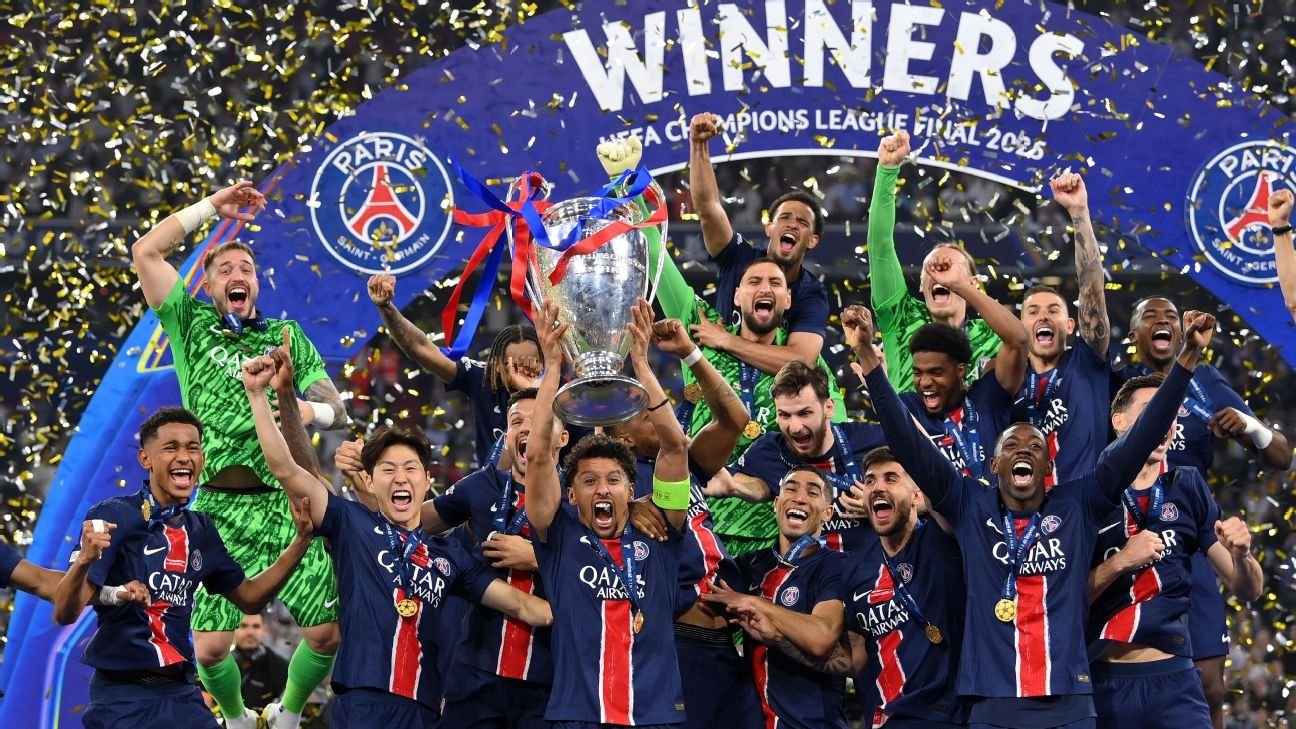
These are the teams that have won the past 10 UEFA Champions League titles: Real Madrid, Liverpool, Bayern Munich, Chelsea, Manchester City and Paris Saint-Germain.
Those teams also comprise six of the eight sides on what UEFA is calling the “Silver Path,” or the top half, of the 2026 Champions League bracket. These teams have combined to win 31 Champions League titles, and they’ve finished second another 15 times. At most, only one of them will reach the final this season.
As for the other side, which we’re officially calling the “Blue Path,” I guess? Their last title came in 2015, and the eight teams on that side have combined for five European Cups and nine more second-place finishes. Apart from Barcelona, no one else on that side of the bracket has a single Champions League trophy.
We got a first-time winner last year, and the way the bracket fell this year has seriously opened up the possibility for it to happen again. Though their odds are still way lower than 50%, Arsenal are sizable betting favorites to win the whole thing.
But will they? Like we do every year, we’re going to look back at all of the past champions for whom we have advanced data, and figure out which of the 16 remaining teams looks the most like a winner.
All data, unless otherwise noted, comes from Opta and Stats Perform.
– Ranked: 10 worst Premier League teams, relative to spending
– The Premier League is boring now — here’s how to fix it
– Summer transfer needs for all 20 Premier League teams
Predictive measurement No. 1: Scoring goals
Rather than leaning only on goals, we’re going to adopt a hybrid of goalscoring and chance creation that I’ve referred to in the past as “adjusted goals.” This, simply, is a blend of 70% expected goals (xG) and 30% actual goals — a better measure of performance than goals alone.
The floor here, as it is in most places, is set by the Chelsea side that won the Champions League despite finishing in sixth place in the Premier League in 2012. Over the whole season, Roberto Di Matteo’s side averaged 1.61 adjusted goals per game — a mark that’s just ever-so-slightly better than what the other Champions League-winning Chelsea side put up nine years later.
Which team doesn’t make the cut this time? We have to say goodbye to three walkers of the blue path and one from the silver, as Atlético Madrid (1.58), Atalanta (1.52), Newcastle (1.52), and Tottenham (1.13) fall below the threshold. We also must remove Sporting Lisbon, Galatasaray, and Bodo/Glimt, based upon the fact that no team outside of Europe’s Big Five top leagues has even reached the final in any of the past 15 seasons.
(If you want some more analytical-like reasons for why they don’t look like winners: Bodo had the fifth-worst xG differential in the league phase among all teams, Galatasaray scored six non-penalty goals in the league phase, and Sporting were outshot 118-87 in the league phase.)
Teams eliminated: Atletico Madrid, Atalanta, Newcastle, Tottenham, Galatasaray, Bodo/Glimt, Sporting Lisbon
Teams remaining: Arsenal, Bayern Munich, Barcelona, Manchester City, Liverpool, PSG, Real Madrid, Chelsea, Bayer Leverkusen
Predictive measurement No. 2: Preventing goals
Defense wins championships — or at least, it used to.
We’ve seen a handful of truly elite defensive teams win the Champions League over the past 15 seasons: Chelsea in 2021, Barcelona in 2011 and 2015, Liverpool in 2019, and Bayern Munich in 2013. They all posted adjusted goals-allowed numbers below 0.85. But most of the recent champions have hovered closer to right around 1.0.
Is it a sign of a shifting tactical balance across Europe? Or is it completely meaningless and random? We shall see.
The worst defense to win it all was the worst attack to win it all: Chelsea in 2012, with their 1.22 adjusted goals allowed per game. Of the remaining sides, the only team with a worse defense this season is, well, Chelsea, at 1.29 adjusted goals allowed per game this season. Just a handful of the 16 teams left allow more shots than Chelsea’s 11 per game, and only Barcelona — the last remaining practitioners of the sell-out-at-all-costs high press — are allowing higher quality shots.
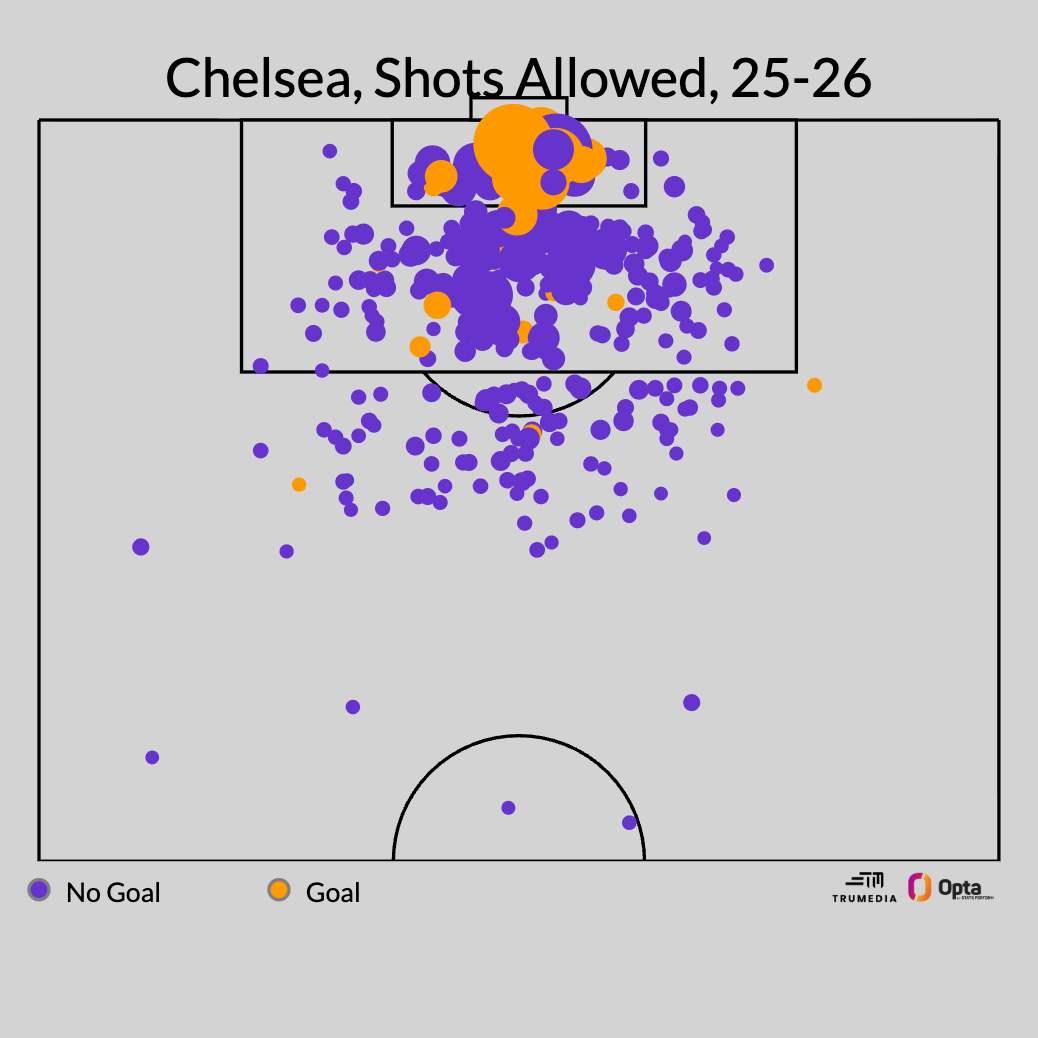
Both Liverpool (1.22) and Barcelona (1.21) snuck in just under the threshold.
Teams eliminated: Chelsea
Teams remaining: Arsenal, Bayern Munich, Barcelona, Manchester City, Liverpool, PSG, Real Madrid, Bayer Leverkusen
Predictive measurement No. 3: Pressing
Some 10 years ago, manager Roger Schmidt was proving with Bayer Leverkusen how effective aggressive, vertical soccer could be. It wasn’t just that they pressed high; they did, but then they’d also try to get a shot off on goal as soon as possible. There really wasn’t any team like them, and I’m not sure there has been any team like them since, either.
The current version of Leverkusen is certainly nothing like them. As measured by passes allowed per defensive action (PPDA), they are the least aggressive pressing team left in the Champions League.
The most aggressive pressers to win the Champions League were Luis Enrique’s Barcelona in 2015, who produced a freakish 6.98 PPDA. This is the same team that rarely ever gave up any goals and had some random dudes named Lionel Messi, Luis Suárez, and Neymar playing up top. They’re the best soccer team I’ve ever seen.
The least aggressive pressers to win the European Cup, unsurprisingly, were Chelsea in 2012. They produced a PPDA of 13.26, which means that we must eliminate Leverkusen and their 13.44 PPDA from contention.
Teams eliminated: Bayer Leverkusen
Teams remaining: Arsenal, Bayern Munich, Barcelona, Manchester City, Liverpool, PSG, Real Madrid
Predictive measurement No. 4: Frequency of crossing the ball
Unlike the other numbers we’ve gone over, this is more of a sweet-spot situation. We’re looking for teams who fall between the highest- and lowest-frequency crossers of the ball.
Why? Crossing is an inefficient method of play on average, but you still need to be able to stretch the defense horizontally and create danger from the flanks. If you never cross the ball, that’s a bad thing. And if you always cross the ball, that’s also a bad thing. A healthy approach doesn’t rely on crossing as its main attacking lever, but it also doesn’t eliminate it altogether.
A Champions League-winning approach has previously fallen somewhere between 8.4% and 19.7% of final-third passes being crosses. The former number is PSG last season and the latter is, again, Chelsea in 2012.
Among this season’s remaining participants, only Spurs fall outside the high end of the threshold, but a number of the current favorites fall below the threshold. Bayern Munich, Barcelona, and PSG — the current second-, third- and sixth-favorites to win the tournament — are crossing the ball less than last season’s winners did. Barcelona are at 8.0%, while Bayern (7.7%) and PSG (7.4%) are even lower.
The question for all three of these teams in the knockout rounds: Will they be able to create quality opportunities if they come up against a big, physical, organized defense?
Teams eliminated: Bayern Munich, Barcelona, PSG
Teams remaining: Arsenal, Manchester City, Liverpool, Real Madrid
Predictive measurement No. 5: Pace of play
It’s pretty much impossible to be in control of every game you play in the Champions League. Not only is the competition level so high and the type of competition so different from what you’re used to in your domestic league, but when you play the same team twice in a couple of weeks, tactical weaknesses are more likely to be exploited.
In other words, if you’re going to win the Champions League, you have to be able to survive — and even thrive — during long stretches when the ball is bouncing back and forth and both teams are running up and down the field.
But once the pandemic hit, the sport changed overnight and we haven’t gone back. In 2019, Liverpool’s matches averaged 99.1 possessions per team — then the highest of any winner in the dataset. That was until Bayern Munich, with 99.8 possessions, broke the record the following year. The five champions since then, though, are now the five winners who averaged the fewest possessions per game.
But the number hasn’t kept dropping after Man City set the lower bound of 78.5 possessions per team in 2023. So, for now, we’re keeping it there. And that means both Arsenal (77.2) and Real Madrid (78.2) get sent packing.
Teams eliminated: Arsenal, Real Madrid
Teams remaining: Manchester City, Liverpool
Predictive measurement No. 6: Defensive shape
There are all kinds of ways to play defense and win trophies.
You can press high and keep the ball away from your box. You can drop deep and make it impossible for your opponent to find space in the attacking third. Or you can slot somewhere in between: play a midblock that frustrates your opponent right around midfield and mucks up every possession. We’ve seen teams suppress goals at a really high level by doing all of the above.
What we haven’t seen before: a successful defense that allows its opponents to get on the ball in the center of the field.
In Europe this season, the average team allows its opponent, on average, to touch the ball 17.52 meters from the center of the field. Every single one of the past 15 Champions League winners kept their opponents even farther away from the center. When Manchester City won their only Champions League in 2023, their opponents got on the ball, on average, 17.58 meters from the center of the field — and that’s the lowest distance-from-the-center for any recent winner.
That’s bad news for Liverpool, who are allowing their opponents to touch the ball 16.76 meters from the center, which is not only closer to the center than any past winner, but it’s closer to the center than all but six other teams in Europe’s Big Five leagues this season.
And so, that leaves us with Manchester City. That feels strange, given that this is one of the three or four worst City teams that Pep Guardiola has managed. But what’s interesting about City is how, well, uninteresting they are. In the past, Guardiola’s teams would always exist on some kind of extremes — for how they controlled possession or pressed or moved the ball forward. Now, they just kind of look like all of the other good teams do, without too many distinctive stylistic features.
That doesn’t work as well when you’re trying to maximize your points haul over a 38-game domestic season, hence Man City being behind Arsenal in the Premier League title race — but maybe it’s a better fit for four rounds of knockout soccer against all of the best teams in the world.
Winner: Manchester City

