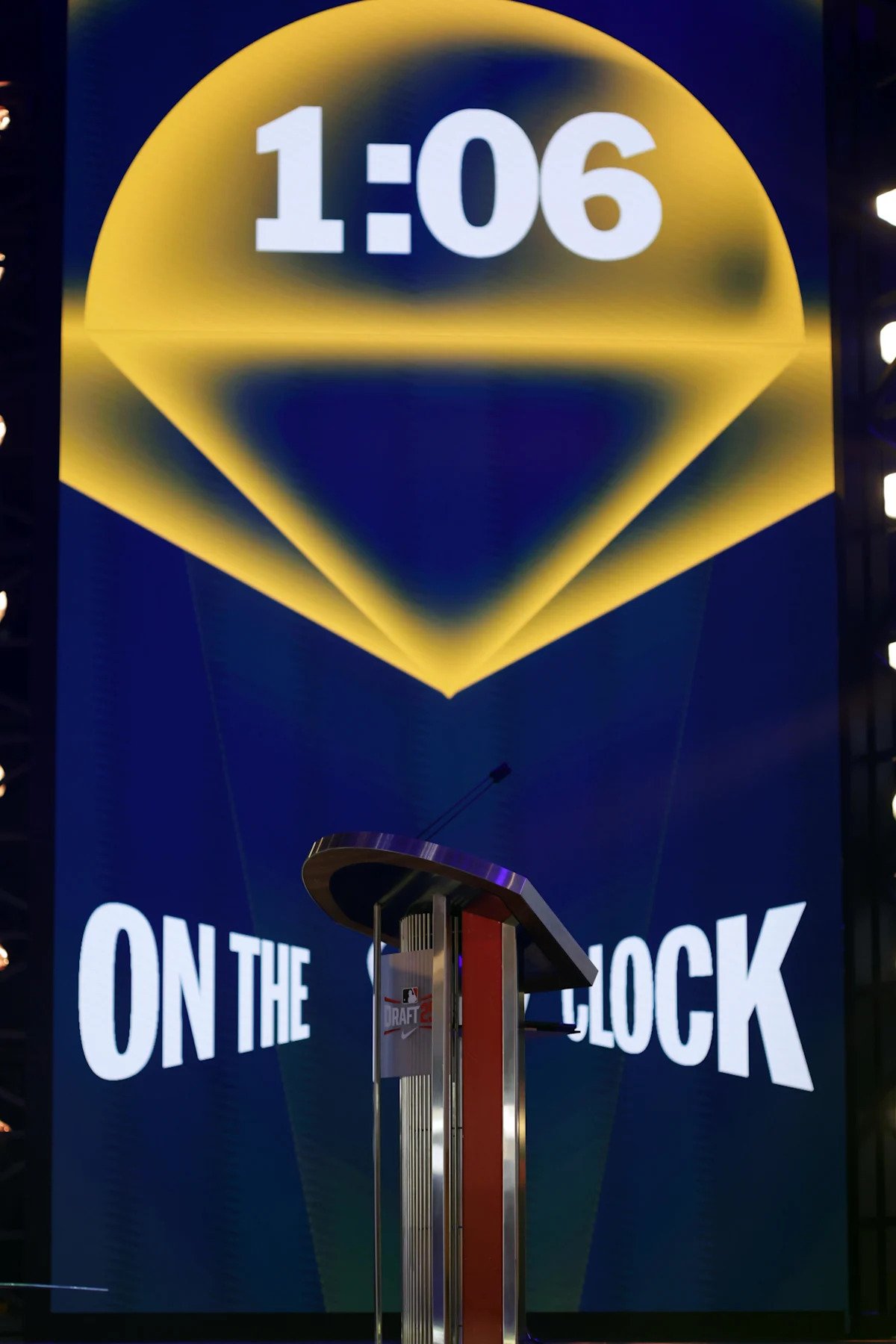
Chicago’s future will be decided this weekend in a conference room in Philadelphia, at approximately 12 p.m. CT. Although I only partially mean it facetiously, that’s how the front office has seen the first pick of the 2026 MLB draft since the Winter Meetings that revealed its lottery win.
For the last seven months, Chicago’s baseball operations, scouting, player development and coaches have debated who should be the face of the franchise by 2030: Roch Cholowsky, Grady Emerson or Vahn Lackey. National and local scouting reports, podcasts, and analysts have done their fair share of speculation, but let’s shift the conversation and read between the lines and assess what these picks say about the organization’s belief in itself.
Advertisement
Scouting department reflection
If the pick is Cholowsky: Seeing would be believing that Cholowsky’s last three college years were the real deal. The 21 year-old slugger peaked last year with a .353/.480/.710 and 23 HRs and 74 RBIs, regressing only slightly in his 2026 campaign. Picking the UCLA Bruin signals that the scouting department believes these numbers aren’t flukes, and that GM Chris Getz has full trust in the scouts’ eyes.
Emerson: If Getz’s confidence is a 10 out of 10 for Cholowsky, it would be a 12/10 for Emerson in the scouting department. Taking a high-schooler is always riskier than a college player, but banking on a player who slashed .398/.515/.648, had 13 home runs and a 19.7% walk rate in 223 games in the Perfect Game Tournament, one of the most elite travel ball programs in the country, would indicate that the scouts believe Emerson isn’t even close to his ceiling, and that Getz believes so, too.
Lackey: A catcher hasn’t been taken with the first pick of the MLB draft since Adley Rutschman in 2019. For Lackey to be in the discussion means the scouts see something truly special in him, and so does Getz. His rapid acceleration from slashing .214/.330/.381 in his freshman year at Georgia Tech to .397/.519/.772 two years later is forgivable because his glove and arm steal scouts’ eyes. This is a bold pick, but the upside and trust are there.
Development department reflection
If the pick is Cholowsky: Chicago is relying on Cholowsky to come in mostly-baked, because they’re more confident in their talent development in fine-tuning a prospect than early pipeline stages. Only two of the Sox’s last 11 first-round picks (since 2016) came from high school. Chicago is relying on Cholowsky’s college maturation, noted by a 2.5% strikeout rate drop and 2% walk rate increase from freshman to junior year, to compensate for its hit-or-miss development skills, primarily with position players.
Advertisement
Emerson: Confidence is sky-high with player development. Paul Janish is the new sheriff in town, and he’s ready to turn the tables on the Sox’s poor PD track record. This doesn’t mean that Emerson doesn’t lay plenty of groundwork. His natural, powerful swing, plus arm and decent speed make him a dream pick in many eyes. But he’s only 18 years old, even if he’s more developed than many college players.
Lackey: Like Cholowsky, Lackey is close to a finished product. Having Walker McKinven, former Brewers catching and strategy and run prevention coach, as the bench coach instills a lot of confidence in the Sox’s ability to translate Lackey’s 55-grade fielding and 50-grade arm into a reliable, daily catcher. Going with a guy whose profile isn’t far off from Cholowsky’s alludes to a high degree of confidence in the coaching staff’s ability to raise Lackey’s ceiling and floor.
Baseball operations reflection
If the pick is Cholowsky: Although a crowded infield seems like a problem, the Sox embrace it because they know Will Venable can put together a decent lineup. Getz’s trust and confidence in Venable has grown exponentially this year, even if the dramatic home and road splits call his management into question. If Venable is finding a way to win without the first overall draft pick in his arsenal, let’s see what he does when he has the most highly-anticipated shortstop Troy Tulowitzki.
Emerson: Adding Montgomery as the No. 22 overall pick in the 2021 draft was the tip of the high school prospect iceberg. Seeing Montgomery’s transformation from a struggling Triple-A hitter riddled with injuries to a cumulative 5.3 WAR player in essentially a year’s worth of games was a sign that the research, player development and scouting departments figured out the right recipe for above-average talent at a cost-effective price. Now, it’s time to rinse and repeat the formula. It’s time to go back to drafting players with 50-grade fielding and speed and smooth lefty swings.
Advertisement
Lackey: The Sox aren’t happy with their backstops of today or tomorrow, and Lackey could earn the starting job quickly. There’s little faith that Kyle Teel or Edgar Quero, or anyone else in the minors, can be every pitcher’s favorite catcher and provide elite defense. Making the unorthodox choice to snag a catcher with the top pick in the draft also hints at the front office’s preference for a slow-burn player who can provide more defensive value in the long run at a lower price point than a flashy, versatile shortstop.

