Is there any major managerial job that won’t be open at some point soon?
The averages, of course, say no. The average manager in England lasts just under a season and a half on the sideline. Put another way: any head coach in England that survives two full seasons has bested the odds.
That number, though, is pulling from everyone — and almost everyone in England exists in a state of financial precarity. With nearly the entire professional pyramid at risk of getting relegated or promoted in any given season, “panic” tends to be the default state of mind. And when you’re worried about your team’s performance costing you tens or hundreds of millions of dollars in revenue, valuation or both, then the easiest thing to do is fire the guy you hired to coach the team.
Except, there are a select few teams across Europe that don’t have to worry about any of this: massive clubs that are going to make lots of money even if they have a couple of down years. So, you might think these teams are a little less aggressive than all the others — but they’re not, or at least they’re not going to be.
In England, Chelsea hire a new coach every couple of months, Tottenham Hotspur‘s Thomas Frank is on ice so thin you can see the fish swimming beneath it, and Manchester United are currently being managed by a guy (Michael Carrick) who is only signed through May. Pep Guardiola is likely to leave Manchester City at some point in the next couple of seasons. Arne Slot isn’t safe despite winning Liverpool‘s second-ever Premier League title in his first season with the club less than a year ago. And while Mikel Arteta has it made at Arsenal, with the Gunners chasing a possible quadruple, he’s not going to stay there forever … right?
Outside of England, Real Madrid still won’t say if Álvaro Arbeloa is sticking around after this season, Luis Enrique’s contract with Paris Saint-Germain is up after next season, Barcelona manager Hansi Flick hasn’t lasted longer than a couple of seasons in any of his prior jobs, Diego Simeone suddenly has new private-equity bosses at Atlético Madrid, Bayern Munich‘s board is never happy, and Italian clubs essentially fire coaches as a collective ritual to mark the passing of time.
There’s enough pending volatility before we’ve even mentioned that the World Cup is this summer, which means a number of the world’s most famous coaches — Thomas Tuchel, Julian Nagelsmann, Carlo Ancelotti and Mauricio Pochettino, to name a few — might be looking for new gigs in a couple of months, too. And it also means that a bunch of the richest national teams might be looking for new coaches.
So, ahead of what feels like a coming sea change at the top of the managerial ladder, we’ve put together the 25 biggest club and country jobs in the world — and then we’ve ranked them from most to least desirable.
How we ranked ’em
As usual, simple is better for ranking methodologies. So, this list has three inputs, all weighted equally: (1) How much does the coach get paid? (2) How stable is the job? And (3) How talented is the team?
For the first, I dug around for reports of various managerial earnings and then made estimates where I had to. This is based on whatever the current coach is getting paid. It’s not perfect, but that’s why it’s rated equally with the other two variables. Otherwise, I’d weigh the potential salary as the highest factor.
For stability, I just looked at how many different managers have coached at least 10 games for the team this decade. And for talent, the market valuations from Transfermarkt will be our proxy.
And to pick the 25 teams that deserved to make the cut: I’ve included the “Big Six” in the Premier League, the “Big Three” in Spain, Bayern Munich and Borussia Dortmund in Germany, the two Milan clubs in Italy, and Paris Saint-Germain in France. For national teams, I went with the “traditional” top nine of Argentina, Brazil, Spain, France, England, Germany, Portugal, Italy, and the Netherlands. And then, because I know my audience, I added in Mexico and the United States.
Pep Guardiola has been the manager for nearly 10 years, he makes a ton of money, and he has one of the deepest and most talented squads in the world.
Man City have the backing of essentially unlimited sovereign wealth, and that money is spent using a massive, professionalized global infrastructure — not at the whims of some disgruntled prince. For a club that could afford to make rash, emotional decisions, City rarely seem to do it.
What these rankings can’t account for: the next coach won’t be given the power or patience Pep was given, you’re getting paid by a group with a detailed entry on Amnesty International’s website, and the club’s 115 financial charges for allegedly breaching the Premier League’s financial rules will still be hanging over the new coach’s head.
This is a similar situation to the City job — minus the quandaries that come with getting paid by a sovereign nation. You don’t get the same money for yourself or your team, but you also get to live in London. And I think Arsenal have a squad better suited for the near future.
Much like with City, though, the next Arsenal manager after Mikel Arteta probably won’t get the same patience and power as Arteta. Still, broadly this is a rich team that’s willing to spend, has now proved it knows how to spend, and it won’t fire you at the first run of bad results.
If I were creating tiers, this would be the end of the top tier, and I think that speaks to how unique Guardiola, Arteta and Diego Simeone are in the modern game. They’re, by most estimates, the three highest-paid coaches in the sport — with Simeone at No. 1. And they’re the three longest-tenured coaches at the Champions League level — with Simeone leading the way, now into his 14th year.
Zoom out far enough and Atletico Madrid looks like the perfect job: You get paid more than anyone in the world to be the coach, you get to live in a major city that easily attracts players, and you don’t have to deal with the absurdly high expectations of managing Real Madrid. If we zoom in, then it looks even better: Simeone might be the sport’s last true manager. He influences what happens at Atletico Madrid more than any “head coach” at any other big club.
The question, though, is for how much longer? Apollo Global Capital, a private-equity firm with around $900 billion in assets, bought Atletico Madrid in November. Do you really think they’re going to let the coach keep making all of the club’s major decisions?
These are the two most talented national teams in the world, and it’s hard to see that changing any time soon. Didier Deschamps has been the France coach since 2012, while Gareth Southgate lasted nearly a decade before being replaced by Thomas Tuchel, who immediately became one of the highest-paid national team managers.
You’re not going to make what you could make at one of Europe’s top clubs and you won’t be able to develop talent or install any complex principles as you can in a club-team environment. But you get to coach players who are just as good as at any club, it’s way less stressful, and you actually get to spend some time with your family.
Do you want to get paid a ton of money to coach the best players in the world, but also get fired just because those players decide they don’t like you or someone in a suit doesn’t realize how random the Champions League knockout rounds really are?
Then these are the two jobs for you.
I’d probably bump this one up if these were subjective rankings because Liverpool showed they were willing to pay a manager tons of money in Jürgen Klopp, and they make the most measured decisions of any club on this list. Plus, there’s a pretty good track record of their organizational structure working.
But I don’t think they want to pay their manager as much as they paid Klopp because they don’t want a manager — they want a head coach, which is what Arne Slot is. And then there are still a bunch of question marks about Richard Hughes, the club’s sporting director since 2024. This was the first summer in about 10 years where you could look at what Liverpool did and say, “Yeah, I’m not really sure I understand the plan here.”
Spain paid Luis Enrique more than they’re paying current manager Luis de la Fuente, so a bigger name could still make good money coaching La Roja. And you’re hitching your wagon to Lamine Yamal, so you’ve got potentially 15 more years (?) of elite play from your do-it-all superstar.
But I still think England and France are less likely to have a talent drop-off in any given generation than Spain are.
Coaching Lionel Messi with Argentina seems like the surest thing in sports. Despite no track record of top-level managing, Lionel Scaloni got to do it, and now he has won three straight major trophies, is the defending World Cup champ, and has been the coach since 2018.
But if we look back past 2018? No major trophies, lots of psychological drama, and three managers in the three years prior. I wonder how stable and close-to-automatically successful this job will look once Messi finally retires.
Having to manage Cristiano Ronaldo right now would be a nightmare: You basically have to find a way to convince one of the most famous and powerful athletes to ever live that he needs to come off the bench or that he can’t play 90 minutes every game. And if you can’t do that, which you won’t, you have to find a way to build your team around a mostly immobile 41-year-old striker who still takes bad shots and does zero defending.
That said, the Portuguese federation has had only five full-time managers since the 2002 World Cup, and there is still a ton of talent waiting to be unleashed in the post-Ronaldo generation.
This is purely a coincidence, but Germany and Bayern Munich earned the exact same score from the three different inputs. Yet, I’m not sure they could be much different gigs.
The German federation overhauled the domestic landscape in 2004 and are just generally one of the more forward-thinking governing bodies in the sport. Unlike the bruising, dour teams of the past, the modern version of Germany seems to want to play the kind of aggressive, creative, possession soccer that we see — er, used to see — at the highest levels of the club game. There have been three Germany managers since 2006.
At Bayern, you get paid a lot and your team is awesome, but no one really cares if you win the Bundesliga anymore — that’s what happens when you’ve won 12 of the past 13 titles. Plus, the club’s board is filled with people who constantly whine to the media about whatever they’re unhappy about.
This is one of the few national team jobs that can rival some of the top club jobs in potential salary. Plus, Brazil has a massive, mostly soccer-playing population that is always going to produce a ton of talent.
But the expectations are pretty much impossible: You’re supposed to match the past success of a country that’s no longer the talent center of world soccer, while also maintaining the free-flowing, joyful style of play that everyone associates with the country. If there’s anyone who could pull that off, though, it’s probably current manager Carlo Ancelotti.
While they have stabilized under Hansi Flick, we don’t have to look too far back to remember an era where Barcelona were pulling levers to sign Robert Lewandowski and attempting to publicly shame Frenkie de Jong into taking a pay cut.
Luis Enrique won everything with Barcelona, and yet fans hated him at the beginning: He lasted only two seasons after winning the Champions League. It’s also unclear if they can pay top-of-the-market salaries for their managers anymore. I’m getting stressed out just thinking about managing Barcelona.
The club paid a lot of money to simply bring Thomas Frank over from Brentford, which suggests a willingness to invest money in the manager. And although they’ve had five coaches since 2020, I’d say that has more to do with the kinds of choices they’ve made rather than a quick trigger finger.
Plus, the decision-makers have changed over the past half-decade, and Thomas Frank has the team near the relegation zone. I think he would’ve been fired at a bunch of other clubs on this list already.
I’d say this is more of a “it can’t get any worse”-type of gig.
Italy haven’t won a World Cup game since they won the World Cup final in 2006. Regression to the mean suggests that if you take this job, you’re likely to improve on that just by sheer dumb luck. The talent level, though, seems significantly lower than all of the already mentioned countries, and I’m not sure it’s getting better any time soon.
The highest-paid coach in the world is former Inter Milan manager Simone Inzaghi, who is reportedly making close to $30 million a year with Al Ahli in Saudi Arabia. Meanwhile, current Inter Milan manager Cristian Chivu might be the lowest-paid coach on this list.
And yet, Inter are still humming along and look like they’re easily the best team in Serie A this year. The past decade of success has established Inter as the clear No. 1 club in Italy.
A lot of American fans think this is a great job, and it finally became one when a couple hedge-fund billionaires decided to pool enough money together to pay the U.S. men’s national team manager $6 million a year to potentially coach only three meaningful games in two years.
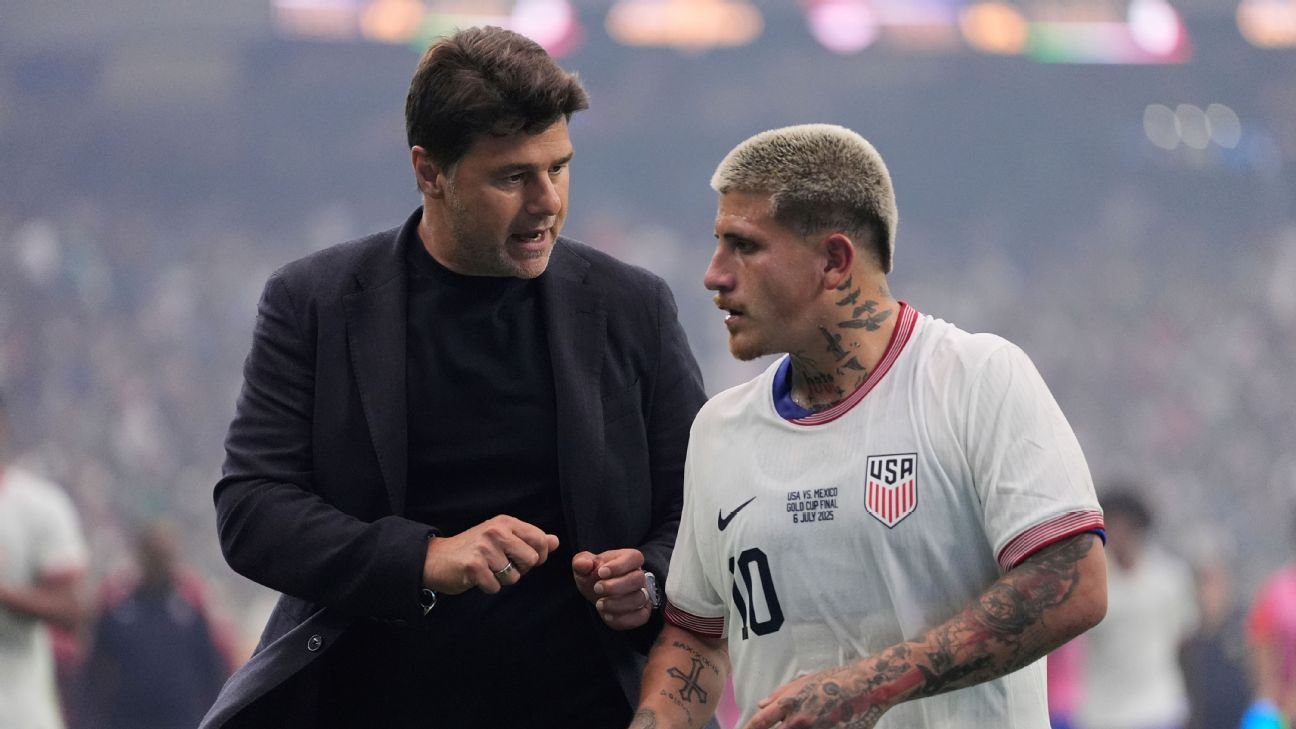
Think about that for a second: Mauricio Pochettino might end up coaching only three matches with real stakes when the World Cup rolls around. The Gold Cup didn’t feature his A-list roster, the Nations League is still whatever you make of it, and there were no World Cup qualifiers. A successful cycle from Pochettino might mean that he gets out of the group stage this summer and then wins a game, so that’d bring him to a whopping five total competitive matches as USMNT manager.
This, of course, is an anomaly: He took over after the Copa America in 2024, so he missed the one major continental tournament of this cycle, and then as hosts, the U.S. didn’t have to qualify for the World Cup. But I do wonder if national team jobs won’t become even more popular with high-profile coaches, now that most clubs are moving toward structures designed to minimize the manager’s impact.
As a national team coach, you barely get to train, the soccer you have to play is more rudimentary, and you’re limited by arbitrary borders and citizenship laws — but you get to pick your players and you’re the guy at the federation.
If the U.S. continues to pay its managers as much as they’re paying Pochettino, coupled with the low relative expectations for the USMNT in the world stage, this will continue to be a pretty good gig.
It’s funny how many of these connected jobs seem to bunch together: England and France, Germany and Bayern, Inter and Italy, and the USMNT and Milan.
While you’ll get paid less to manage Christian Pulisic for his country instead of his club, you’re way less likely to lose your job.
Why is this job behind the USMNT job?
Yes, you’re way more likely to win the World Cup with Netherlands because they have way better players than the U.S. does, you’re also more likely to get fired after a couple of bad results and you’re not likely to get paid as much as Pochettino currently is.
Impossible expectations? Front office chaos? A job that everyone has failed at over the past decade and a half? More diminished financial power than anyone realizes because of how bad things have been? So … why is this not last on the list?
Well, the upside to the gig is apparent in what we’re seeing happen right now: Michael Carrick has won four games as the manager, and he already has people thinking he’s a savior. Plus, the pay is pretty damn good, and the potential for it to get even better is certainly there. On top of that, United’s five managers since 2020 don’t even represent the most turnover on this list …
Nope, that distinction would belong to Chelsea and their seven coaches since the pandemic began. And while things are very different under ownership group BlueCo than they were under Roman Abramovich, this is the one area where the new owners have maintained club traditions. In fact, they might’ve even stepped it up to a new level.
Across Abramovich’s past four seasons as owner, Chelsea had four different managers: Thomas Tuchel, Frank Lampard, Maurizio Sarri and Antonio Conte. Across BlueCo’s first four seasons, they’re already up to No. 6: Tuchel, Graham Potter, Lampard, Pochettino, Enzo Maresca, and now Liam Rosenior.
Between Jürgen Klopp and Thomas Tuchel, Dortmund had two managers across nine seasons. In the nine years since, they’ve had nine different full-time managers, including Edin Terzic, who got two separate spins of the wheel.
No longer a club with a clear identity or devotion to player development, the only real remaining perk of managing Dortmund is a decent salary.
Can I interest you in a job where the expectations are even more unrealistic than at Manchester United, but where your players aren’t as good, your salary is probably half the size (if not even smaller), and you’re just as likely to get fired after a couple of bad matches?
Please mail your résumés to the Mexican Football Federation in Toluca.

