European Championships, Day Three Finals: Sarah Sjöström Wins 18th Gold a Year After Becoming a Mum
Sarah Sjöström won her sixth 50 fly title and 18th overall gold a year after becoming a first-time mum at the European Championships in Paris.
The Swede returned to the top of the podium at the first attempt, 12 months after the arrival of son Adrian, as she claimed her 18th European title and 29th overall medal.
David Popovici won his third straight 100 free title but was pushed all the way by Egor Kornev with the Olympic champion leading home three men inside 47secs in a championship record of 46.56.
Johannes Liebmann took down his own European 800 free record: read more here .
Angharad Evans, Hubert Kos, Ellen Walshe and the Dutch women’s 4×100 free squad all clinched European titles on a thrilling, raucous night at the Olympic Aquatic Centre.
Great Britain top the medal table after three days of action with four golds, a silver and a bronze followed by Italy (two golds, two silvers, four bronzes0 and the Neutral Athletes B (two golds, two silvers, three bronzes).
Men’s 200m Backstroke
Hubert Kós was just 0.38 off Aaron Peirsol’s world record in semis when he went 1:52.30. The Hungarian fell shy of the super-suited standard that has stood for 17 years since the 2009 World Championships and such was the intensity of his effort that he was nauseous following the race and forced to sit and recover.
He returned on Wednesday to turn his attention to clinching his first European backstroke medal. The Olympic champion was the model of stability and had more than a body-length lead at halfway.
He extended his lead down the third 50 and although the field ate into the deficit in the final 25, Kós was never threatened as he added the European crown to his Olympic and world titles in 1:53.08.
Apostolos Siskos of Greece was second in 1:53.81 with Thomas Ceccon third in 1:53.96 with the pair setting respective Greek and Italian records.
Kós is the first Hungarian winner of the event since Sándor Wladár at Split 1981, a year after he won the Olympic title at Moscow 1980. that followed Zoltán Verrasztó’s title at Jönköping 1977.
Women’s 50 Butterfly
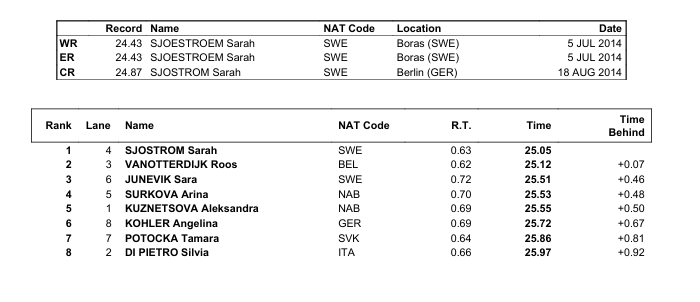
Sarah Sjöström began her golden odyssey in the one-length fly at Debrecen 2012 aged 18 and won the next three editions in Berlin, London and Glasgow.
The Swede didn’t compete in Budapest in May 2021 while still recovering from an elbow injury she sustained in February of that year before getting back atop the podium in Rome in 2022.
Sara Junevik kept the title in Swedish hands last year and she also lined up for the final.
There was a huge ovation for Sjöström when she was introduced to the crowd and she rolled to the title in 25.05. Roos Vanotterdijk was second in 25.12 with Juvenik making it a Sweden 1-3 in 25.51.
Sjöström claimed her sixth 50 fly title at 32, 18 years after her maiden European crown in the 100 fly when she was 14 at Eindhoven 2008. The three-time Olympic champion is the most decorated swimmer in European Championship history and expanded her collection to 29 medals of which 18 are gold, seven silver and four bronzes.
She moved level with Franziska van Almsick for the most European golds although the German has far more relay titles. Sjöström has the 50 free to come where she could become the outright record-holder.
“It’s great to be back at this level, I never thought it was possible a few months ago,” Sjöström said. “I’m glad I took the chance, and I’m glad my body is still working. It’s nothing I take for granted, so I’m happy with that.”
Women’s 100m Breaststroke
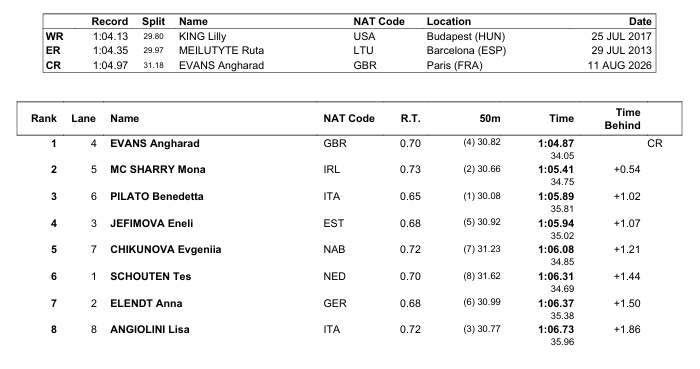
Benedetta Pilato went out hard and reached the turn first ahead of Mona McSharry and Lisa Angiolini with Angharad Evans – who set a 1:04.97 CR in the semis – in fourth.
Evans came through on the second 50, drawing on to her rivals’ shoulders with her momentum taking her clear in the final 25m. The University of Stirling swimmer came through in 1:04.87, a new championship standard and British record with Evans taking 0.09 off her own standard of 1:04.96 from the national championships in April. Evans – coached by Ben Higson at the University of Stirling – set a new championship record in each round.
McSharry was second in 1:05.41 with Pilato third in 1:05.89 with reigning champion Eneli Jefimova 0.05 off the podium in 1:05.94.
Evans was surprised to learn she was the first British woman to have won the title, beaming: “I didn’t even realise that. I feel like I’m not very caught up with swimming history and records. I didn’t really know in the heats that I got the record until they read it out. But that’s absolutely amazing. I hope to inspire the next generation of breaststrokers and they look at that and know that that’s just on their doorstep.”
She’s only the fourth British woman in all to have won a medal in the event following Suki Brownsdon (silver, Split 1981), Kirsty Balfour (silver, Budapest 2006) and Chloe Tutton (bronze, London 2016).
Evans continues the fine British breaststroke tradition which has been synonymous with Adam Ramsay-Peaty since 2014.
Evans doesn’t want to be known as the female answer to the three-time Olympic champion Adam Ramsay-Peaty although she’s proud of such comparisons.
“Obviously that’s a compliment,” she said. “But presumably you just want to be the first ever! People compare me to Adam Peaty and it’s such an honour. He’s someone I looked up to all of my younger swimming years, but I also do want to make a name for myself.
“When he was breaking world records, I had stepped back from the sport. So, if you look at the two journeys, yes, we’re swimming the same stroke but in completely different ways, and we’ve been through completely different things.
“He’s had a lot of downs and a lot of ups, but I had very different hills than him. And he says to me he’s always there for me to lean on with nerves and navigating.”
McSharry won bronze a few miles away at La Defense Arena two years ago at the Olympics. “I was definitely nervous going into it,” she said. “But I was really happy with yesterday’s race, and I think the goal was maybe first 25m the same, kind of build a little bit more into the wall, and then try and focus on really racing the second 50m. When I turned, I could see Pilato right there beside me, and she was a bit ahead, so I was like, right, I gotta go here, I don’t know what’s happening behind me, so I was just pushing and yeah, really happy with that.”
Women’s 400 IM
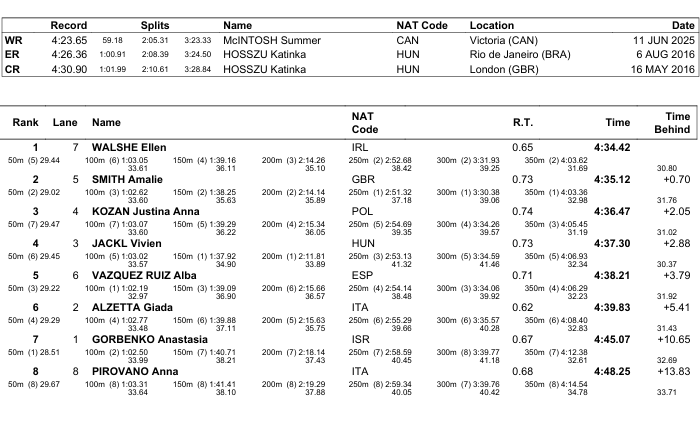
A superb final turn saw Ellen Walshe move on to the shoulder of leader Amalie Smith before moving ahead to take the title in 4:34.42, lowering her own Irish record in the process.
Sixteen-year-old Smith was second in 4:35.12 with Justina Kozan third in 4:36.47, a Polish record.
Sixth after the fly leg, Walshe moved up to third at halfway and second after the breaststroke to split 31.69/30.80 on the free and come home for the first major international title of her career.
“It hasn’t really hit,” said Walshe. “It’s been probably a bit of a runaround to the medal, it was very quick turnaround, I can’t really think about it right now. I’m still really hurting from the race my calfs are cramping, hopefully when I swim down, I can enjoy the moment for myself.
“I think the nice thing about the 4IM is everyone races their own race and everyone has strengths and weaknesses in the event, there’s always that kind of side of it that I should get out a little bit quicker, but it might hurt the back end. But I was delighted to stick to my own plan today and it worked out in the end.”
Smith won the European junior title in early July before taking silver at the Commonwealth Games which she then matched in Paris, all in the space of five weeks.
“I’ve enjoyed every single meet and I’ve really enjoyed this one so far,” she said. “To come away with a medal, I’m super excited. Coming into the summer, I would have loved to get a medal at every single meet, so the fact that I’ve been able to achieve that, I’m so, so happy.”
The teen – who is coached by Karen Bradbury at RTW Monson club in Tonbridge Wells – admitted she felt overwhelmed coming into Wednesday’s event.
“I was just quite nervous in general, I wasn’t sure what I was going to do,” she said. “I didn’t know whether I could back up the swims I’ve already done this summer. I think all the coaches have been really helpful, all the sports staff, they’ve just been reassuring. They’ve not been telling me I’m going to do this, they’ve just been like, you’ve got this, just keep calm and do your own race.”
She described the crowd at the Olympic Aquatic Centre as “crazy,” saying: “I knew after watching the Olympics this crowd was mental, but the fact it’s still mental is just really cool.
Next up for Smith is the 200IM in which she won bronze at the Commonwealth Games before a well-earned rest and some 17th birthday celebrations later in August.
Women’s 4x100m Freestyle
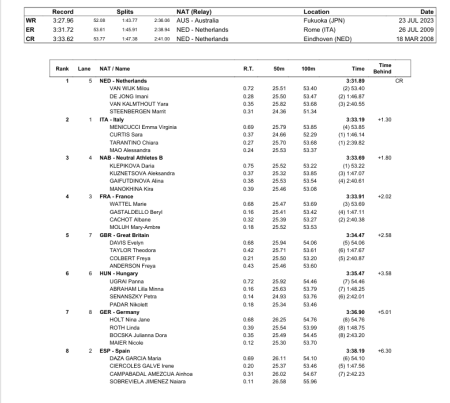
The Netherlands quartet – with Marrit Steenbergen on anchor – came through to take the title. Steenbergen took over in third before blazing a 51.34 split to steer them to gold in 3:31.89. With that they lowered the championship record of 3:33.62 by 1.73secs that had stood to a Dutch quartet – including Ranomi Kromowidjojo and Femke Heemskerk – since Eindhoven 2008.
It was a second gold for Steenbergen following her 100 free title and third medal overall with silver in the mixed medley relay in which she split an historic 50.87.
Italy led at the 300m mark following a 52.29 second-leg split from Sara Curtis, fresh from her 50 back WR, and finished second in 3:33.19 with the NAB third in 3:33.69.