With every transfer window that passes by, the food chain in the football transfer market becomes more defined: Smaller clubs feed the top flight, and the elite clubs take their pick from there.
It is the elite clubs’ fix for all manner of problems. Unable to sign a dominant center back? Need proven quality in midfield? Can’t ever seem to find a goal-scoring striker? There are places you can go. There are certain clubs across world football — the likes of Brighton & Hove Albion, Eintracht Frankfurt, Sturm Graz, Woifsburg and more — who have become masters of recruitment in specific positions.
These clubs are the best-in-class at identifying and recruiting talent in certain areas and flipping them for a profit. They’re where all of Europe’s top teams should be searching.
So, if your club has a positional need to fix, where should they look, and how do those clubs do it? Here is your cheat sheet.
Before we begin, a quick note: Goalkeeper is the only position not covered here. Several ESPN sources consulted for this piece warned against it. Simply put, no club is particularly expert at signing them. It’s an individualist and (oftentimes) chaotic area of the market.
– Connelly: Premier League’s 50 worst transfers of all time
– Olley: Why the Tottenham job proved too big for Frank
– 5.4 million meters covered: The insane stats behind Milner’s PL career
CENTER BACKS
 AFC Bournemouth
NOTABLE PLAYERS: Marcos Senesi, Illia Zabarnyi, Dean Huijsen
Despite heavy player turnover in the last few seasons, Bournemouth have been able to continually reload and achieve great results in the Premier League. That’s only possible if you nail your recruitment.
The Cherries are the headline side in one of modern football’s most effective multi-club organizations, benefitting from the shared pool of knowledge the sister clubs — such as Lorient (French Ligue 1) and Moreirense (Portuguese Primeira Liga) — bring, and they boast a clear strategy when it comes to making signings.
They have particularly excelled at recruiting center backs. With a clear playing style cemented by manager Andoni Iraola, they are able to focus on players with traits that suit his tactical system: they must be comfortable defending high up as the team presses and strong in one-on-one duels.
The club are also attentive to the demands of the Premier League as a whole, with one scout suggesting they all-but require a minimum height of 185cm (6-foot-1).
It is a strategy that has paid consistent dividends. Last summer, their first-choice center back partnership was poached by reigning European champions Paris Saint-Germain (Zabarnyi) and continental titans Real Madrid (Huijsen) for over £100 million combined. Senesi’s contract is set to expire this summer and he will no doubt entertain some big offers for a free transfer.
 Wolfsburg
NOTABLE PLAYERS: Maxence Lacroix, Micky van de Ven, Konstantinos Koulierakis
Like Bournemouth, Wolfsburg are on a superb run of center backs, supplying the Premier League with two of their best in recent years, and they have another gem in the ranks, too.
Their strategy is to pick out physically exceptional players — super fast, super strong, or both — from weaker leagues, then platform them in the Bundesliga. The German top flight produces end-to-end games of football, meaning those attributes are immediately on show.
For example, Lacroix and Van de Ven were plucked from second-tier clubs in France and the Netherlands, respectively. They cost Wolfsburg less than €10 million between them and excelled in the Bundesliga — each posted top speeds of over 34.5 km/h, per Gradient Sports — and moved on to the Premier League for huge profits.
Their current star center back, Koulierakis, has a slightly lower top speed — he hit 33.12 km/h against Union Berlin in December — but his acceleration is remarkable, and his overwhelming strength has earned him the nickname “The Hammer.” Consequently, he has been linked with a move to Liverpool.
Wolfsburg won’t be too concerned if Koulierakis does leave; they’ve always got their eye on another potential star. The club spent January trying (and failing) to sign Toulouse‘s Charlie Cresswell, who came through Leeds United‘s academy. He could be next.
FULLBACKS
 Bayer Leverkusen
NOTABLE PLAYERS: Jeremie Frimpong, Piero Hincapié, Alejandro Grimaldo, Arthur
Finding promising full backs is a tricky task for most clubs, but Bayer Leverkusen appear to have it all figured out. The club’s sporting director, Simon Rolfes, heads up their scouting operation that is designed to cut through the noise and look in the right places.
Leverkusen focus heavily on younger players, who can move on for profit at a later date. It is why the vast majority of their signings are aged 22 or younger. They use data to identify outliers, such as the ludicrously quick Frimpong, before turning to more traditional scouting methods to check on a player’s character and personality.
The club’s scouting department has an arm that focuses specifically on South America. It has been very effective, bringing in a series of quality players in all sorts of positions, and has been a major driver of their success in the full-back area.
Hincapié was signed for just over €6 million from Argentine side Talleres and is now fighting for a Premier League title with Arsenal. Arthur cost a similar fee from América Mineiro in Brazil and now raids up and down Leverkusen’s right flank opposite Grimaldo — signed on a free transfer from Benfica in 2023 — who now ranks as one of the world’s best left-backs.
CENTER MIDFIELDERS
 Brighton & Hove Albion
NOTABLE PLAYERS: Moisés Caicedo, Carlos Baleba, Yasin Ayari
Brighton were one of the first Premier League clubs to lean into modern scouting, utilising data better than most and willing to scour the entire globe to find talent worth honing.
The Seagulls also employ position-specific scouts, whose responsibility is to recruit for particular areas of the pitch. That’s a rarity in football, and only a handful of Premier League clubs do it. Manchester City are another example.
Clearly, whoever is in charge of finding center midfielders for Brighton is doing an incredible job. Caicedo cost them just £4 million from Ecuadorian outfit Independiente del Valle in 2021; two-and-a-half years later, he joined Chelsea in a then-British record £115 million deal.
They reinvested that money in a host of prospects, most notably Baleba. He signed from Lille for €27 million in 2023 and is frequently linked with a big-money move to Manchester United.
But what is it that Brighton look for? The club often prioritise physical traits when scouting for midfielders and pore through data to find athletic outliers. When Baleba was at Lille he registered in the 100th percentile for a series of sprint metrics. So did Malick Yalcouyé, a player the Seagulls signed for £6 million in 2024, when he was on loan at Sturm Graz.
WINGERS
 STADE RENNAIS
NOTABLE PLAYERS: Ismaïla Sarr, Raphinha, Jérémy Doku, Martin Terrier
Stade Rennais is a hotbed for wingers in more ways than one. Before discussing their recruitment successes, it is worth noting that both Ousmane Dembélé and Désiré Doué came through the academy there, roughly seven years apart, and linked up at Paris Saint-Germain to win last season’s Champions League.
Rennes weren’t able to hold onto either of those for long, but they have still kept the fans entertained with a steady stream of excellent wingers coming through the door. Raphinha and Doku were the highlight names, the former finishing fifth in the 2025 Ballon d’Or stakes, the latter going on to sign for Manchester City in a €65 million deal.
Through this run of wingers, Rennes dealt in fairly known quantities rather than took punts. Raphinha and Terrier were in their early 20s with several professional seasons under their belts, while Doku and Sarr were well-known prospects with one full campaign in a top-tier league.
Where Rennes excel, quite simply, is taking good wingers and making them even better before sending them on their way to great things.
 Borussia Dortmund
NOTABLE PLAYERS: Ousmane Dembélé, Jadon Sancho, Christian Pulisic, Karim Adeyemi, Jamie Gittens
Borussia Dortmund carved out perhaps the ultimate niche over a 10-year period: They recruited some of the world’s best young wingers, platformed them in a high-scoring Bundesliga landscape, then made huge money on their departures.
That streak started with the eye-popping flip of Dembélé to Barcelona, then took on a life of its own as it began to raid English academies for its best talent. They posed Sancho, Jude Bellingham and Gittens the same question: Would you like to skip to the front of the queue, play top-level football immediately, and see your careers take off?
STRIKERS
Before we dig into the specific clubs that excel at recruiting strikers, it is worth discussing the common theme that runs through their approaches: most of them utilise strike partnerships on the pitch.
One head of recruitment at a European club told ESPN it is much easier for a striker to shine while playing in a duo, as it halves the amount of “tough work” to do (holding the ball up, occupying defenders, running the channels) and gives that player someone to easily link with.
In turn, doing less of the hard yards can conceivably keep strikers fresher for when the big chance arrives.
 Eintracht Frankfurt
NOTABLE PLAYERS: Sébastien Haller, Luka Jovic, Randal Kolo Muani, Omar Marmoush, Hugo Ekitike
This is some run of forwards. It began in 2017 with the partnership of Jovic and Haller, who fetched over £100 million between them when they moved on to Real Madrid and West Ham United, respectively, and has continued to hit remarkable heights.
Three of the players listed were taken on by Eintracht when their stock was at an all-time low. That is one of the club’s key skills: Identifying obviously good strikers whose careers have taken a downward turn, restoring them, then profiting. Jovic flopped at Benfica, Marmoush ran out of steam at Wolfsburg and Ekitike failed at PSG — but Frankfurt turned them all into £60 million-plus players.
 Villarreal
NOTABLE PLAYERS: Nicolas Jackson, Alexander Sørloth, Thierno Barry, Tani Oluwaseyi
Villarreal are willing to look in places others perhaps won’t. Their scouting scope is massive, resulting in them bringing in players from all over the world.
Jackson, now of Chelsea and Bayern Munich, was plucked from Senegalese football. Barry, now with Everton, came from Swiss club Basel. Oluwaseyi made the move from Minnesota United in MLS, while Sørloth floated across Europe unsuccessfully before finally firing with Villarreal.
It would be hard to know where they could turn next. Reports in January suggested they were tracking Jalal Abdullai, who plays for Swedish side Elfsborg. That they continue to look for striker talent in a league well outside Europe’s elite isn’t the least bit surprising.
 Sturm Graz
NOTABLE PLAYERS: Rasmus Højlund, Kelvin Yeboah, Emmanuel Emegha, Mika Biereth
Sturm Graz play a direct style of football, getting the ball from defence to attack fast, and recruit strikers that suit such an approach. They index heavily on sprinting and top speed data to achieve that, and their recent run of forwards has generated huge profits.
Højlund, formerly of Manchester United, and Emegha, soon to join Chelsea, have both eclipsed 35 km/h this season for their clubs, while Yeboah exceeded 33 km/h for Minnesota in 2025. Biereth is an outlier in this regard, although he showed enough quality in this system to earn a €13 million move to Monaco last year.
 Brentford
NOTABLE PLAYERS: Ollie Watkins, Ivan Toney, Bryan Mbeumo, Yoane Wissa, Igor Thiago
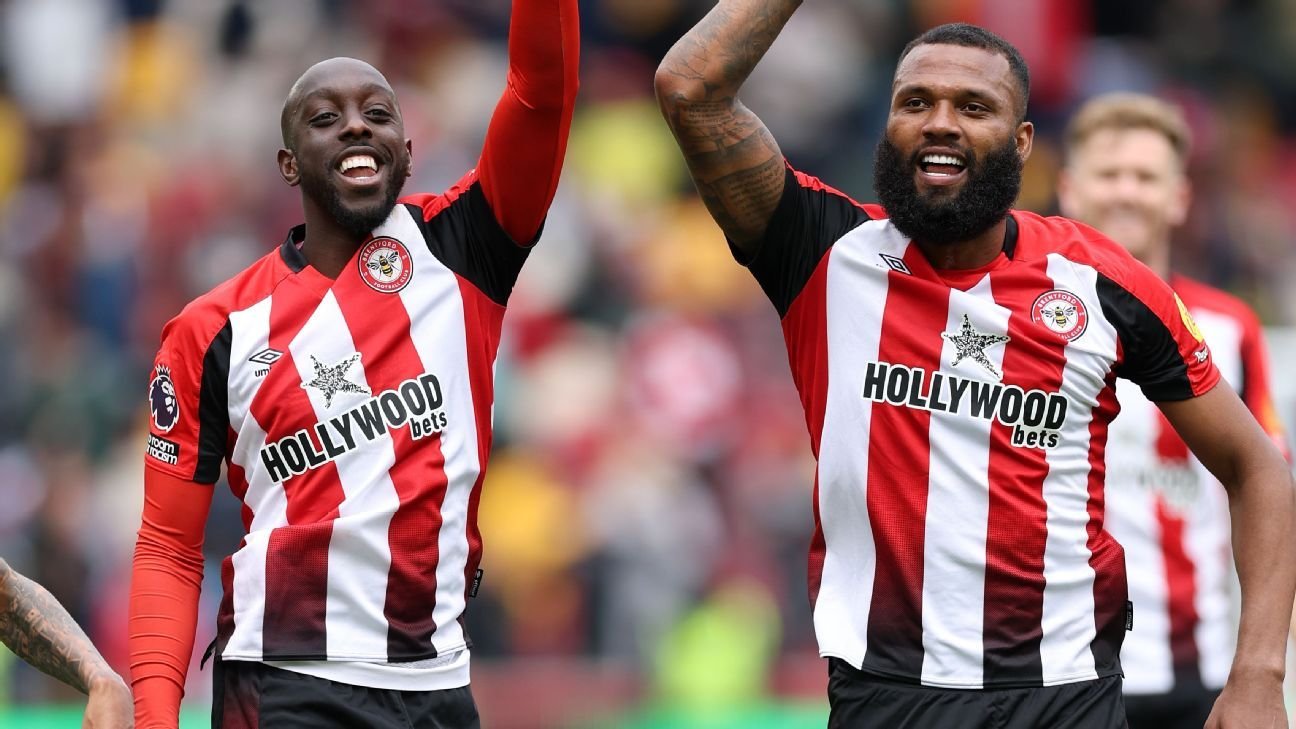
All hits, no misses. Brentford‘s recent record of recruiting strikers has been second to none. Starting with Watkins almost a decade ago, several players that Brentford have fielded as a No. 9 have proven to be not only Premier League quality, but Champions League quality, too.
The club uses a heavily data-driven approach to scouting and is happy to take small gambles on players that pop up on their radar as outliers. An example of that is winger Kevin Schade, who had barely eclipsed 1,000 minutes for Freiburg when the Bees signed him for a club-record fee of £20 million. Why? He nearly broke the speed metrics on SkillCorner, a platform professional clubs use extensively to gauge physical data.
Brentford are also happy to search high and low for players. Mbeumo came from the French second tier, Toney the English third tier and Watkins the fourth tier.
Many of these clubs have cemented their roles as top-tier recruiters and developers because they can point to previous cases. It’s a snowball effect.
Sancho’s success at Dortmund would have made it so much easier for the club to coax Bellingham and Gittens to Germany. Center backs are jumping at the chance to join Bournemouth and Wolfsburg because they know it could easily lead to a huge move a couple of years later. Any down-on-their-luck striker should be desperate for Eintracht Frankfurt to call, because the odds are they will be a superstar in the near future.
As one ESPN source in scouting and recruitment put it: “The early stories lay the foundations for the later ones. Clubs can say to players ‘we have a history of brilliant players in your position; come and be the next one.'”
Another thing that became clear while speaking with sources is that while this is not an exhaustive list of clubs doing great work in the market, there aren’t that many more who are nailing their processes.
Transfers are difficult, fraught with potential downsides as well as upsides. Many struggle to get it right, while some others sidestep the process almost completely, relying instead on the clubs that specialise in it.

