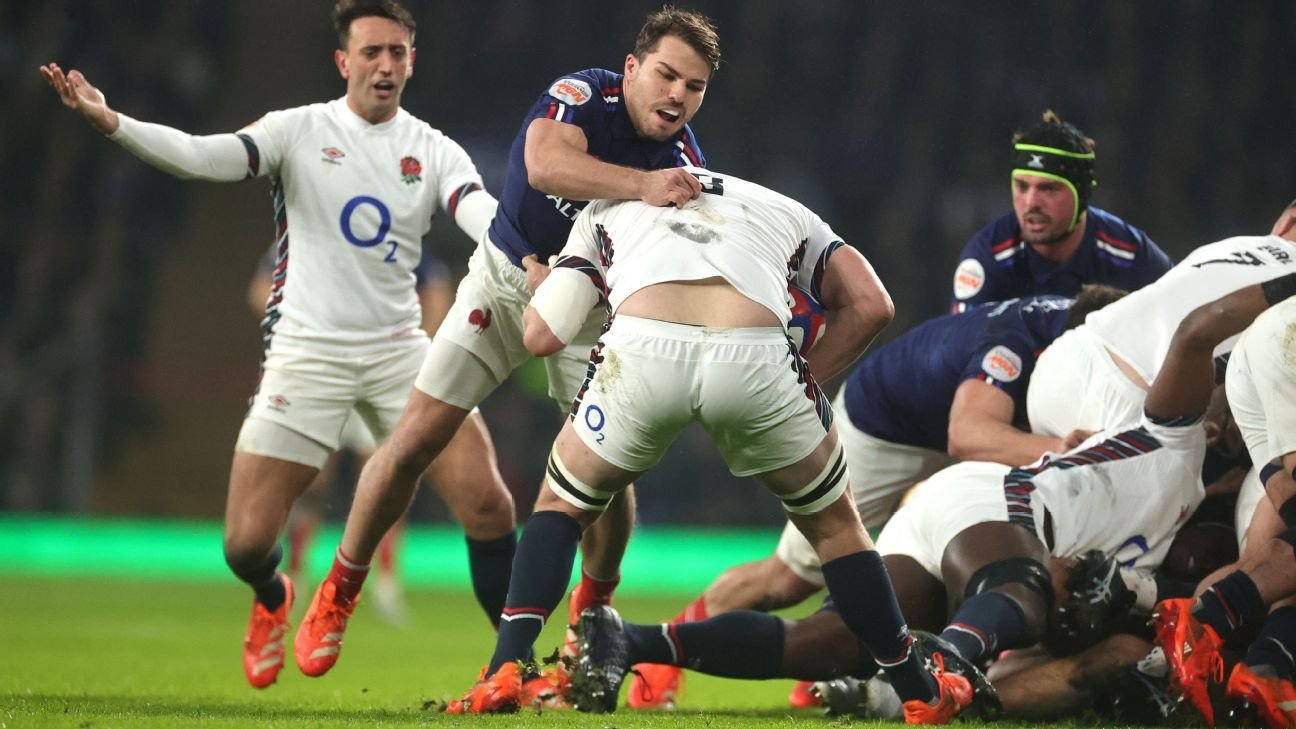
PARIS, France — You hope both France and England know how William Shakespeare’s Romeo and Juliet ends. Both teams have turned to the play in one form or other for inspiration this week. After three defeats on the bounce, England have been in Verona, complete with its famous balcony. France visited Paris’ Opera Garnier on Thursday to watch a ballet rehearsal of Rudolf Noureev’s interpretation of the tragic tale.
Both approaches offer differing methods of cajoling out one last performance in this wonderful Six Nations, but heed the Bard’s warnings: Saturday night’s match in Paris will offer violent delights and violent ends to a championship that promised much. For one team, it will be a tale of woe.
England must feel like they’ve had a plague on their house this championship as they head towards their worst ever Six Nations. Judging by the numbers boarding the Eurostar on Friday morning, Steve Borthwick got half of his pre-tournament wish.
There were plenty of England fans making the trip across the Channel — a pilgrimage Borthwick talked up back in February. He wanted them travelling over in their thousands, ready for a title showdown, but instead in St Pancras, this was no party mood. It felt more routine — “It’ll be a nice weekend, anyway,” type of vibe. The bleary-eyed fans were not anticipating a Grand Slam-decider, but instead, travelling in blind hope.
Just about every pundit and former England player has had their say on the team’s campaign this year. Support and sympathy are in short supply. Their leadership, gameplan and coaching staff have all been questioned. Even the kit choices for this Saturday’s match are being queried — France in their majestic light blue celebratory number, and England in traditional white, prompting fears of a colour clash.
But England are defiant, having regrouped in fair Verona. Any need to mix up the gameplan which saw them fall to Scotland, Ireland and that historic first defeat to Italy? “We’ve seen results from it so I don’t think we need to change too much,” Ben Spencer said.
Are there issues with the leadership, especially considering Maro Itoje’s on-field disagreement with Fin Smith last weekend? “There’s no crack between us,” Itoje said. (For what it’s worth, would you prefer Itoje to be diminutive? Itoje should be talked up here, not silenced.) And what about Borthwick? “The boys back him, I definitely back him,” Tom Roebuck said.
Everywhere you look, there are different diagnoses for England’s slump. Borthwick’s view is that the weight of the shirt has impacted their campaign, but after nine changes ahead of Italy, Borthwick has refrained from stirring the pot further.
England have made one change for Saturday with Ollie Chessum starting. Borthwick has named an unchanged backline, giving them another chance after a stuttering start on Saturday. But time is not a commodity which Borthwick can enjoy — England know a defeat on Saturday in Paris would condemn this as their worst ever campaign.
Borthwick’s job is safe, for the time being, at least. The RFU statement last Sunday morning gives Borthwick Paris, and the three Nations Championship matches (complete with 25,000 miles of travel) to turn this ship around.
That 12-match winning streak which carried them to Murrayfield feels like it’s from another lifetime, let alone a mere month. Borthwick this week called on his senior players to “step forward”. Challenge laid down. But who would have predicted that meek surrender in Rome would be their third alarming defeat in a row? That’s the violent beauty of this championship.
France are overwhelming favourites for Le Crunch in Paris, but are wary of England, with Pierre-Louis Barassi labelling them a “wounded animal.” “A former coach once told me that an injured player can cause more damage than a fit one,” France forwards coach William Servat added.
Shakespeare loved his pathetic fallacy, and it’s meant to be a chilly, drenching evening in Paris on Saturday, yet amid the downpour will be a sight of France’s one-off kit. France will be wearing a beautiful number to commemorate 120 years of Le Crunch. It could be their outfit for a coronation as they are still favourites to win the whole thing.
But the Grand Slam has gone. Scotland put paid to that last weekend with a wonderfully bonkers 50-40 win. That result has also seen Fabien Galthie weather criticism this week; Jean-Baptiste Elissalde said the start of the second-half was the “worst 22 minutes” of Galthie’s reign.
As the team ventured into Paris on Thursday night, Galthie hoped his team would be inspired by the ballet and the beauty of the venue, welcoming new scenery after nearly two months at their base in Marcoussis. It’s been a championship where we saw France obliterate Ireland and Wales, battle past Italy and then go through just about every emotion possible in Scotland.
– England’s worst ever Six Nations? What’s gone wrong, why, and what’s next after Italy defeat
– Six Nations power rankings: Scotland soar, England woes worsen
– Six Nations 2026: Schedule, results, table, squads, news, TV info, more
They looked ordinary at times, perhaps over-confident. Sitting alongside the lingering pain of that defeat is a four-match ban for flanker Oscar Jegou meaning France will turn to yet another gem in their bottomless treasure trove of talent to hand a debut to Temo Matiu.
We’ll see another centre combination in Barassi and Yoram Moefana, the reintroduction of Emmanuel Meafou — adding four stone to the pack — and then on the bench there’s the familiar name of Joshua Brennan, son of Toulouse and Ireland enforcer Trevor.
Then there are the famous protagonists: Louis Bielle-Bierrey, Mathieu Jalibert and Antoine Dupont. But even the transcendent scrum-half hasn’t been saved from the odd bit of criticism this week. “We are human beings,” Galthie said in defence of Dupont. “He’s an exceptional player. Sometimes there can be difficult moments, but it’s nothing serious. It’s all part of the journey leading up to Saturday’s match.”
By the time France and England head out to a wall of red, white and blue Tricolore in Paris, France will know what they have to do to secure their third championship in five years. Ireland and Scotland are the other challengers, and they meet in Dublin in the opening game of the day with the Triple Crown on the line.
There are myriad permutations (explained here by James Regan) but simply put, France’s destiny is in their own hands, but if they slip, then the trophy may be heading into Irish or Scottish hands.
Ireland have been on their own journey this tournament: from the depths of the defeat in Paris and suggestions of decline, to edging past Italy in Round 2 and then swiping aside England for a record win at Twickenham a week later. They got the job done against an ever-improving Wales side last weekend to give themselves a championship chance. Farrell has made four changes for Saturday with Tommy O’Brien, Dan Sheehan, Joe McCarthy and Josh van der Flier recalled. Bundee Aki is back on the bench.
Scotland’s Darcy Graham said earlier in the week Ireland are “there for the taking”. Farrell was measured in his response. “He’s entitled to his opinion first and foremost,” Farrell said. “Scotland were outstanding last week against France and we’ve been preparing for another Scottish performance like that. We know that we’ll have to be at our best to beat them as they’re a side that we’ve always respected.”
Scotland’s Six Nations has also been a turbulent one. Gregor Townsend was on the precipice after their opening round defeat to Italy, but players rallied to defend their coach with that 31-20 victory over England, an impressive fightback in Wales, and culminating in their brilliant win over France last time out.
Instead of “faith turning to despair”, it’s a campaign which has morphed into true beauty. They head to Dublin seeking their first win there since 2010, and a chance of lifting the overall title. “Winning something for Scotland, especially the Six Nations, would be definitely the peak of my career,” Finn Russell said.
“When you start playing for Scotland, you always want to win it, obviously, and we’ve never put ourselves in a position where we can. So now we’re in that position, it’s all to play for this weekend.”
But Townsend is trying to keep a lid on expectation and hype. “It’s out of our hands, really,” he said. “We can only do a certain amount. It’s a game for us to play against an opponent that’s had the upper hand on us for years.” This is no time for nosebleeds this close to the summit.
Over in Cardiff, Steve Tandy is close to stemming the bleeding in Welsh rugby. Though a first Six Nations win since 2023 remains elusive, they are evolving. They were desperate against England, a distant second-best against France, but showed resilience against Scotland and again against Ireland. Their defence is looking firmer, and the team is playing with more familiarity. And then there’s their ever-improving work rate, exemplified by Alex Mann’s 32 tackles against Ireland last time out.
“We can’t control the outcome,” Tandy said. “You see in games, the bounce of the ball might not always go your way, but where we have to be is consistent. We have to consistently get better and have consistent performances.
Because the closer you get, like against Scotland and Ireland and you’re in games, the results will follow. You can get a win, but actually are you still growing? They should go hand in hand. We want to produce a performance that replicates what we did over the last few weeks, but also makes it better.”
Wales hope to avoid the ignominy of their third straight wooden spoon against Italy.
Wonderful Italy. For so long they were used as the crash test dummy to talk up introducing the crunch of Six Nations promotion-relegation. But no longer. A win in Cardiff on Saturday would be their third this tournament — their best return.
That victory over England last weekend came at the 33rd attempt but was no fluke. It was down to the work done behind the scenes to improve their talent pathway, aided by great coaching and achieved through on-field brilliance and resolve.
Tommaso Menoncello should be regarded as one of the finest players in world rugby, but this is no longer a team consisting of a couple of generational superstars like Sergio Parisse and a few willing support acts, they are far more than that now. Italy are without Simone Ferrari, Andrea Zambonin and Alessandro Garbisi, but they head to Cardiff as favourites, looking for their third successive victory on Welsh soil.
The denouement of this year’s tournament will be in Paris. It’s been a memorable championship, arguably one of the greatest we’ve seen. Teams have teetered on the abyss, only to fight back.
Others have promised much and flittered away. Titles are to be won, history to be written, while jobs hinge on these types of occasions. We’re going to miss it. “Parting is such sweet sorrow”, Juliet said, but there’s still room for final plot twists. Sport offers a thin line between triumph and tragedy, and we wait to see which teams rise, and who gets the kiss of death.

