Dublin — “COME ON ENGLAND” yelled the Irish fans inside the Silken Thomas bar in Kildare, 30 minutes west of Dublin. You really had to be there to believe it. I was, and it is still surreal writing these words having heard those words repeatedly while we watched the action unfold in Paris.
The live music was due to start at 10 p.m. But with England leading France 27-24 at half-time in the evening kick-off, the local four-piece folk band was put on hold. Just in case England held on for a most unlikely victory in Paris, resulting in Ireland being crowned Six Nations champions.
“Do we still get paid our full agreed amount?” the bandleader asked the bar manager.
Meanwhile, over in Paris, the second half went something like this: France called the tune. England called the tune … And so on. Tommy Freeman scored under the posts in Paris in the final minutes and the patrons inside the Silken Thomas lost their minds. But then, with the game clock showing 82:55, French fullback Thomas Ramos converted a pressure penalty with the last kick of the last game to break Irish hearts.
The punters in the Kildare pub just sat there, hands on heads, numb, unable to comprehend what they had just seen.
Irish hopes were sunk. Then the band played.
Even the ticket scalpers outside Aviva Stadium on Lansdowne Road were struggling to make themselves heard half an hour before the game, with a mix of traditional Irish anthems and “Flower of Scotland” belted out with gusto by the masses surrounding them.
€500 spending money should be enough for a weekend in Dublin — you might even get some change after buying a round of overpriced drinks in Temple Bar — but on this occasion it wasn’t enough to get your hands on the hottest ticket in town.
“How much?” asked Oisín from Galway, having travelled across the country by train to Dublin Heuston earlier in the day in the hope of getting a gold dust brief at the last minute. The wad of notes in his hand courtesy of a lumpy bet on Cheltenham Gold Cup winner Gaelic Warrior the day before, the Willie Mullins-trained horse being roared home from Oisín’s regular pew at Hughes Bar in the Woodquay area of his city.
“Seven-fifty”
That was too much for our lad from the west coast, who had been prepared to spend up to €500 but wasn’t willing to go much higher. If this particular Galway Guy did manage to eventually get a ticket for a lesser amount I just hope he made his way to his seat with haste, otherwise he would have missed the opening score of the game.
The acrid scent from the pre-game fireworks had not yet dissipated when Ireland found themselves ahead with less than three minutes on the clock.
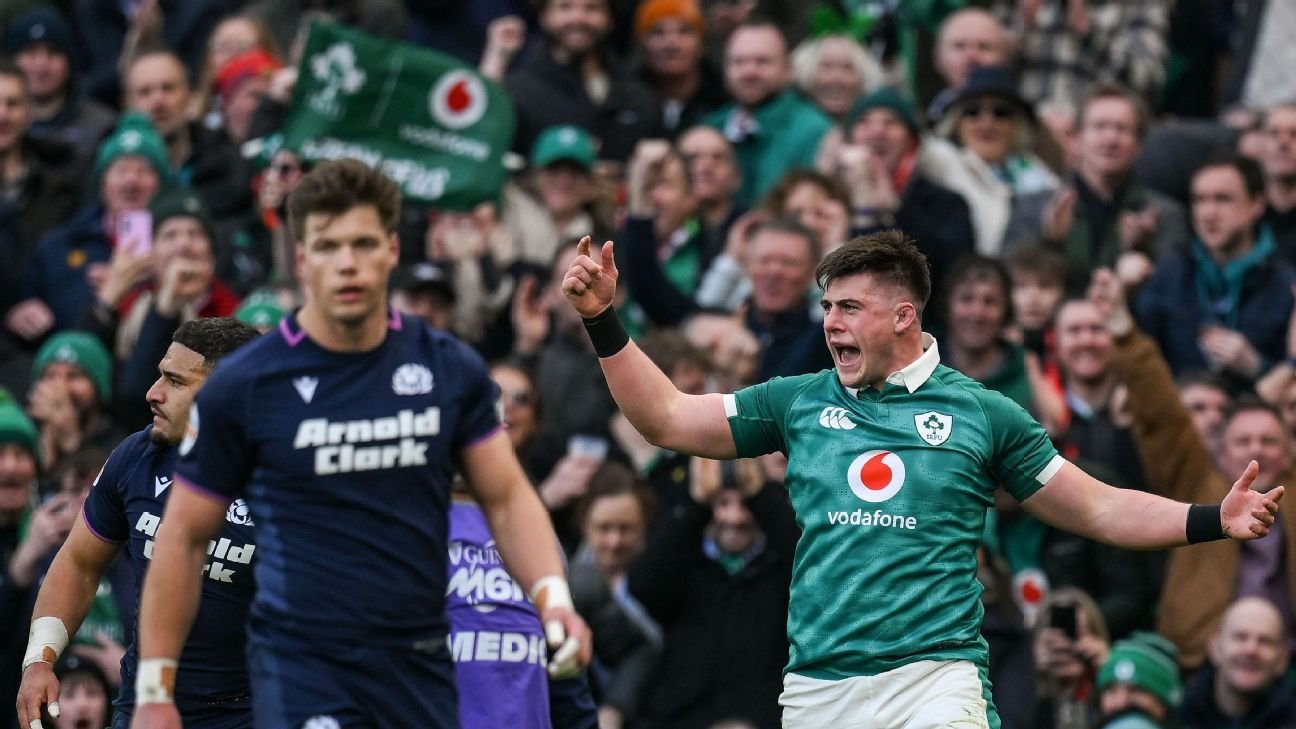
From a Scotland put-in, the Ireland scrum — which came under fire during this year’s tournament — came out on top and won a penalty from which Jamie Osborne touched down. The clock on the stadium scoreboard showing two minutes and 54 seconds.
Just four minutes later Scotland were level as Darcy Graham scored in the corner following a lovely Scottish move, which was both patient and free-flowing.
“Utter precision in all 19 phases and Scotland looking very comfortable on the ball,” Scott Hastings said on ITV.
The frantic start to the match continued, and Scotland thought they had contained the Irish maul, but Dan Sheehan broke away five metres out and touched down as Ireland restored their advantage with just 10 minutes on the clock. Three tries already: this was a fast-paced track meet in the making.
The most important moment of the match, certainly from a Scottish perspective, came shortly after when, with the Scots five metres out and pressing to level the scores, a huge tackle on Finn Russell by Stuart McCloskey forced the turnover. As an Irish journalist sitting beside me remarked, “that hit from McCloskey carried an extra bag of potatoes!” Physicality over panache won this particular encounter.
Ireland started to dominate physically and were clear winners of the breakdown contest in the first half, providing them with the platform to play on the front foot and put pressure on the Scot, specifically on Russell, who they had clearly targeted.
Winger Rob Baloucoune was next to go over for the Irish, who extended their lead to 12 points, although Jack Crowley missed the conversion, the only blemish on a day he was successful with his other six kicks at goal.
With less than 20 minutes on the clock Ireland already needed just one more try for the all-important bonus point.
Mistakes were starting to creep into Scotland’s game — Finn Russell’s kick was charged down by McCloskey then Gregor Townsend was seen with his hands on his head following a Scotland line-out as Ireland turned it over and won the scrum.
The Scots continued to try the flicks and the tricks but Ireland were far better at the ugly side of the game. Not the size of the dog in the fight but the size of the fight in the dog.
“Finn Russell is probably the most important player on the pitch if Scotland are going to turn this deficit around. When he finds his note the Scottish players respond to him,” former Ireland centre Gordon D’Arcy said at half-time on ITV.
Mr D’Arcy, better known for attending a ball rather than owning one of the crystal variety, still managed to predict the future because just over ten minutes into the second half the mercurial Russell touched down in the corner after twelve phases of play. Scotland’s patience and accuracy was rewarded as the try scorer’s conversion narrowed the deficit to just five points, with the Scots now trailing 19-14.
Irish replacement Darragh Murray scored a try on his home debut to extend Ireland’s lead once again to twelve points, then the tit-for-tat nature of the match continued when Rory Darge touched down for the visitors on the hour mark. Finn Russell’s conversion saw him become just the fourth player to reach 500 points for Scotland.
But that was as close as they got for the rest of the game.
With the Scots visibly tiring, having put so much effort into the win against France last weekend and playing on a day’s less rest than their opponents, Ireland turned the screw. Two converted tries from Tommy O’Brien and a Jack Crowley penalty saw the hosts pull away and clinch Ireland’s fourth Triple Crown in the last five seasons. Scotland, incidentally, fell short of their fourth Triple Crown since 1938…
The final score of 43-21 was perhaps slightly harsh on Gregor Townsend’s men, but this was a much-deserved victory for Ireland; they won the battles that needed to be won, summed up by the fact their starting eight made 147 tackles. Physicality and greater ability triumphed over panache on this particular day.
The result against Scotland was enough for Ireland to clinch the Triple Crown. The result in Paris, however, meant that was the only thing the Irish won on a Super Saturday for some and a Saturday of super sadness for others, especially the Ireland squad inside an AVIVA Stadium suite watching France snatch it at the death.
Rugby can be a cruel mistress at times. Mon Dieu.

