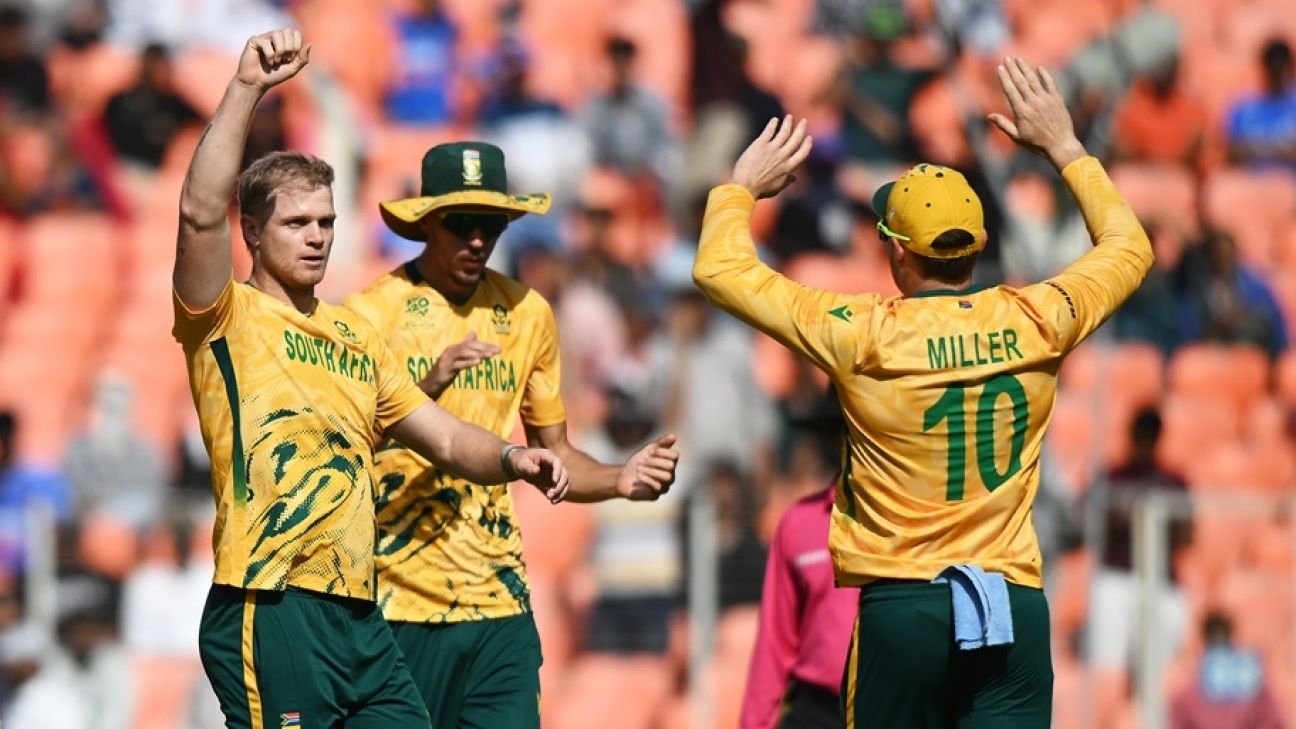
And so, South Africa are the last unbeaten team standing at this T20 World Cup.
With only one game left in the Super Eights, they have collected six wins from their six matches – including against India, the favourites, and West Indies, the only other undefeated side before Thursday. Many are suggesting they’re odds on for the trophy, and you can see why.
The double Super Over game against Afghanistan aside, South Africa are a side that looks in total control of their campaign, especially with ball in hand. They’ve adapted to different surfaces, albeit mostly at the same venue, almost perfectly, and had in their ranks players with the skill sets to make best use of conditions.
In their pace battery of six seamers in the squad and four in every XI, South Africa have been able to take advantage of any swing or bounce on offer, to even operate in the absence of either of those two, and to deal with “tackiness” (which Aiden Markram saw in the pitch against West Indies in Ahmedabad).
West Indies captain Shai Hope was much more frank in his assessment, and said the red-soil Ahmedabad surface was “South African”, and reminded him of some of the pitches West Indies played on just a month ago on the Highveld. Hope went as far to say West Indies’ total of 176 was as much as “maybe 40, 50, even 60 runs short”, and that’s because of how effective the South African attack was.
This was the pitch with the best bounce and carry they have played on so far, and Kagiso Rabada made use of that straightaway, as Markram knew he would. “Because it was hard, it would hold in the wicket and either nip or have a bit of extra bounce, and with our boys, you need to try and use that as much as you can when it’s on offer,” Markram said.
Rabada’s two wickets in his opening over ended what had been a quiet tournament so far. The noise of that final over against Afghanistan aside, he only took two wickets in the five matches preceding this one. But what the numbers didn’t say is that Rabada also had three catches dropped off his bowling. His performances against New Zealand (4-0-27-0) and India (4-0-32-0) built the pressure that created opportunities at the other end. Against West Indies, Rabada took the first wicket, and laid the template for the rest to use.
Lungi Ngidi, who had used the slower ball to great effect throughout South Africa’s time in Ahmedabad, flipped the script. He went pace on with hard length, and was rewarded. Ngidi also got two wickets in his opening over as both Brandon King and Roston Chase were forced back in the crease, and then to play at deliveries that they ended up mis-hitting. Just in case anyone has forgotten, Ngidi can still crank it up.
South Africa’s third prong was Corbin Bosch, who built his reputation on an ability to bowl fast, and unfurl a mean bouncer. The surface in Ahmedabad was tailor-made for him, and he came on after the powerplay, bowled two good-length balls – the second was hit for six by Sherfane Rutherford – then banged it in short and got a top edge. Rutherford was surprised by both pace and bounce, had no room to muscle it away, and sent the ball high for Quinton de Kock to catch.
But it wasn’t long after that South Africa had to change tack as the ball got older, and the surface seemed to settle.
“It got a bit tricky at some stage, and we had to balance whether we continued with that (pace on),” Markram said. “To a lot of us it looked like the wicket kept getting better and better, and it was thinking about if it’s a really flat one, how would we approach it from there? So that’s pretty much why the plan’s changed today.”
3:11
Has Ngidi been the bowler of the T20 World Cup so far?
Faf du Plessis and Anil Kumble tackle the big questions from South Africa’s win
By the 11th over, Bosch had the offcutter out, and Matthew Forde sent it to deep-backward square leg. When South Africa tried pace on against Jason Holder and Romario Shepherd, who Markram said are “obviously two massive humans, and their mis-hits go for six”, they travelled.
The pair put on 89 for the eighth wicket, and on 163 for 7 after 18 overs, South Africa reached a crucial stage. Although they believed batting was becoming easier, Markram thought “to get 180, you still need to bat well”, and he suspected West Indies could get many more. “West Indies is always a team that can make 60 in three overs, and it’ll feel like it’s normal.”
Enter Ngidi. His final over was in the same signature style which he has made his own at this tournament, with all slow balls that dipped on Shepherd as he swung in vain. Shepherd got one off the outside edge away for four, and there were four dot balls in the over, which underlined why Ngidi is one of this event’s greats.
“He just nails it, to be honest,” Markram said. “The deception of pace is obviously massive, and he bowls a really good yorker in between to keep you on your toes. But he lands it exactly where it’s meant to land.”
The final over was given to Bosch, who went yorker length and didn’t miss. West Indies could only manage four singles before closing out the innings with a boundary, also off the edge. The consistency with which Bosch finds the right length is no fluke. “He trains smartly, he trains hard, and he doesn’t give himself too many options,” Markram said. “He just tries to get really good at the things that he backs.”
All told, South Africa conceded 13 runs in the last two overs, a stunning effort in strangulation, and have now got two death-bowling go-tos. Ngidi is the obvious choice, and Bosch has become as valuable. Of bowlers who have delivered more than 15 overs in this tournament, Bosch has the third-lowest economy rate after Jasprit Bumrah and Forde.
That statistic will only sting West Indies more after Forde opened the bowling in defence of what was a slightly under-par score, and conceded 30 runs in his three overs. They now go into their game against India under must-win pressure, while South Africa will consider all their bases covered.
Perhaps the only one is what happens when South Africa move out of Ahmedabad? Ah, they’re only headed as far as Delhi, and they’ve already been there in this tournament, where they put on another skilled display to keep UAE to 122 for 6.
South Africa’s problems are for later on, when they wait for their semi-final venue, and that could remain unknown until the last minute. Wherever it is, they have not been to either of the three potential venues: Mumbai, Colombo or Kolkata. But they’re “locked in”, as Markram puts it, and satisfied with how things have gone so far.
“It doesn’t feel easy, to be honest. Every game, every meeting we have, the guys are fully locked in,” he said. “We’ve been on good and bad sides at World Cups, and it’s definitely not something this group would take for granted. The guys have a lot of pride, and are really on a mission to try to achieve something.”
Their quest continues against Zimbabwe on Sunday.

