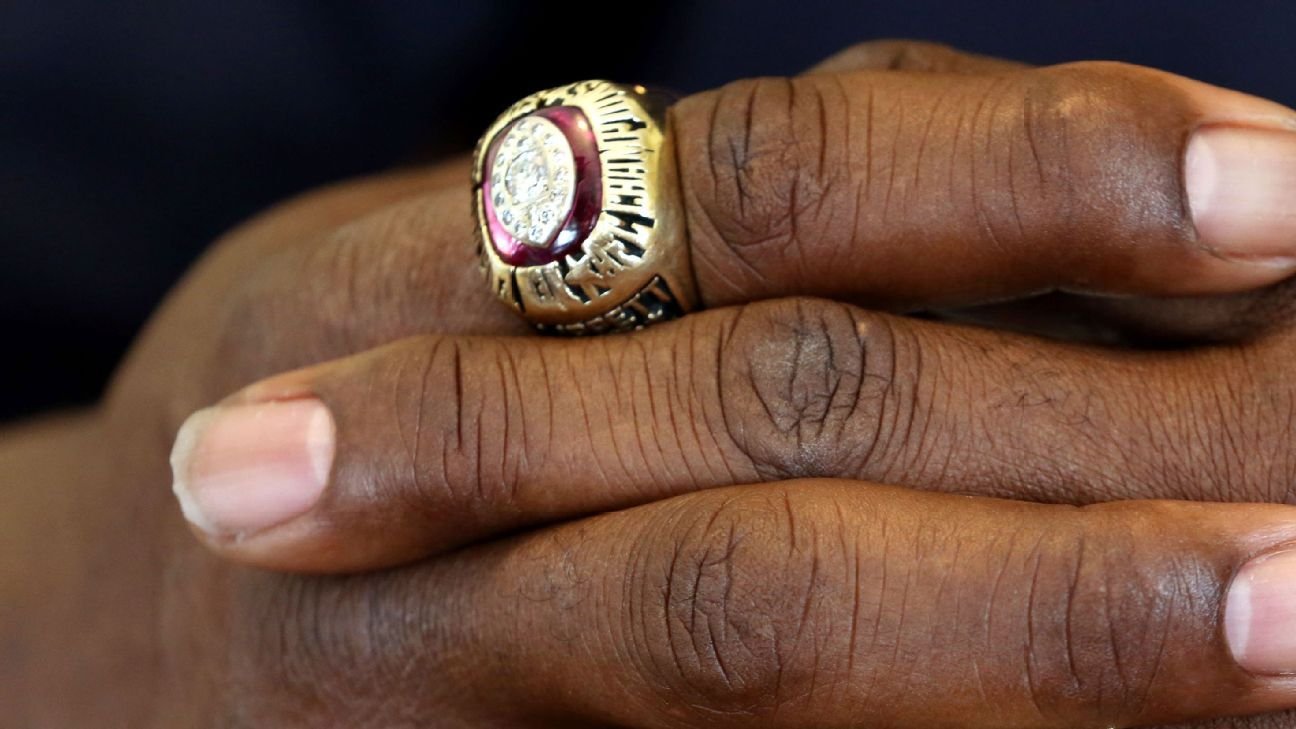
FOUR MONTHS AFTER the Philadelphia Eagles lost Super Bowl LVII, Cam Jurgens glanced at the team schedule and came upon something that stopped him.
“Ring Ceremony.”
It was June 2023, and Philadelphia still wasn’t over its 38-35 loss to the Kansas City Chiefs. “What the hell is the ring ceremony for?” Jurgens, then a second-year offensive lineman, muttered. “We lost.”
But it was supposed to be a nice thing. The team gathered in a meeting room and watched a highlight video of the 2022 season, and boy, were there some lovely highs — the 13-1 start, the 70 sacks. The reel ended, and the Eagles were directed to a table in the cafeteria, which held a heap of boxes of personalized conference championship rings. The reward for finishing second.
Jurgens grabbed a box with his name on it and stuffed it on a shelf in his closet.
“Honestly, I wasn’t so thrilled about getting a ring that felt like a participation trophy that I had to pay taxes on,” Jurgens said.
“Like, it’s second place. You know, you made it to the Super Bowl; you participated. So here’s a beautiful, nice-sized ring as a token, or a reminder of you losing the Super Bowl. … It’s not necessarily just a participation trophy, but it’s a reminder that, hey, you made it all the way to the mountaintop and failed.”
The NFL game operations manual says that the team that loses the Super Bowl “will receive awards” for winning its conference championship. That prize traditionally has been a ring.
But word of the “other” piece of jewelry doesn’t seem to make the rounds. In more than a dozen ESPN interviews last week with players and coaches in Sunday’s Super Bowl, only two knew they’d eventually be walking away with something, win or lose. It’s not as if second place isn’t rewarded in other sports. The Olympics have the silver medal, Wimbledon has a silver platter for the men’s singles runner-up, and Major League Baseball hands out rings to the pennant winner that falls short in the World Series.
There is, however, no pea-green jacket for the Masters.
Jurgens can’t remember if he ever tried on his NFC championship ring, which is gathering dust. It became particularly irrelevant last year, when his team beat the Chiefs in Super Bowl LIX.
“I’m a lot more proud of that,” he said.
“Yeah, I’ve worn that [ring]. I feel like it weighs my whole arm down, but I’ve worn it.”
THE CHAMPIONSHIP RING business is competitive, and as the final seconds tick away on Super Bowl Sunday nights, Jason Arasheben is busy constructing an email to the winners. “Congratulations on an epic win,” the note might start.
Arasheben is the CEO of Jason of Beverly Hills and has designed championship rings for the NFL, NBA, MLB, NHL and WNBA. His pitch to the Eagles landed last year, and Arasheben was the mastermind behind their Super Bowl championship ring, a 140-gram monstrosity of diamonds, white gold, a sapphire and a push button that pops out two eagle wings. Each ring reportedly cost $40,000.
Pitches to the losing team require a little more patience.
“It’s a completely different mood,” Arasheben said. “You don’t want to reach out to them the very next day because the last thing they want to hear is like, ‘Congratulations, you lost your game.’ Now here’s your second-place ring they don’t want because obviously they’re upset. So you have to tread softly with something like that.
“Typically we take a little longer before we reach out. Let the loss settle in and let them have an opportunity to reflect on the season and reflect on some of the good things that happened. The fact that they did make it far in the playoffs, the fact that they did win their conference and make it to the championship game. And then at that point when everything’s kind of calmed down — we’ll slowly and gently approach them and say, ‘Hey, you know, congratulations on winning the NFC or AFC championship.'”
Some teams are active participants in the design process. Arasheben said he has had MLB owners who’ve come to the realization that they don’t know when their next chance at a World Series will come, and they want to celebrate the journey of the season. They want something they can look back at 20 years later, with a clearer perspective.
Others want very little to do with the process.
In 2024, the San Francisco 49ers enlisted Jason of Beverly Hills to make their runner-up rings, albeit half-heartedly. The 49ers are a storied franchise that has won five Super Bowls and had just lost in overtime to the Chiefs — the team that also beat them in the Super Bowl four years earlier.
“One thing I’ve noticed is that when you’re dealing with teams that have a history of championships,” Arasheben said, “they’re even less inclined to do this ring than the teams that have never won before.
“So for them, they were like, ‘Ugh, we’re going to do it for the players. We want to give them something special. But what we really want to be designing here is a championship ring.'”
That sentiment isn’t entirely foreign to Arasheben.
“Is the goal, the No. 1 prize, to get the championship ring? Of course it is,” he said. “Even though in the moment I might not be as happy as I would be if I was getting the Super Bowl ring, I feel like it’s equally as important because it’s just another relationship.”
The 49ers’ NFC championship ring has an appraised retail value of $10,000, Arasheben said. It has 1.70 carats of white diamonds set onto white gold, and is showcased in a lighted box with a rotating platform to give the recipients “the same special feeling,” as if they’d won the Super Bowl.
IN THE SPRING of 1991, Buffalo Bills general manager Bill Polian informed the team of a “shindig” scheduled for the Super Bowl runners-up at a country club in Orchard Park, New York. Former Bills receiver Don Beebe said the players wore their best clothes, ate a big dinner and received their AFC championship rings.
When they lost 20-19 to the New York Giants on a field goal attempt that sailed wide right in the closing seconds in January, Beebe figured that quashed any future celebrations.
“You know the way you get a ring, you’ve got to win it,” he said.
But the Bills eventually embraced the accomplishment, and Beebe appreciated the keepsake. He believes that making it to the Super Bowl is a big deal, and that a winner is defined by “who you are and what you’re trying to accomplish.” He said that’s what Buffalo coach Marv Levy stressed.
And for three straight years after that, after three more Super Bowl losses, the Bills gathered to collect their AFC championship rings. Beebe said they all look the same; former Bills receiver Steve Tasker said each one is kind of unique.
“It’s weird,” Tasker said, “to get a piece of jewelry that’s that cool and that disappointing all at once.”
Tasker said the final weeks of the 1991 season were the most stressful work environment he’d ever experienced. Players practiced with the flu and through injuries because they were “hell-bent,” he said, to make it back to the Super Bowl and atone for the game that slipped away.
The pressure was palpable in the locker room, and the Bills lost to Washington 37-24. Then Dallas crushed their hopes for a title the following two seasons. Still, the rings, at least for Tasker and Beebe, aren’t sad reminders of what was lost. They represent the accomplishments of the only team in NFL history to make it to four straight Super Bowls. They bind the 22 players who were part of all four teams.
Three decades later, they take trips together and call each other to catch up. Beebe said quarterback Jim Kelly recently sent a bunch of the old teammates a picture of a buck he shot during a hunting trip.
“I think losing brings guys close together,” Beebe said. “It really does.
“Everybody wants to win it. However, everybody would love to have been on that team. What we did and accomplished as that group gave us tremendous memories and things that have impacted the rest of our lives.”
Beebe did eventually get his Super Bowl ring, in Green Bay. It came in his first season with the Packers, in Super Bowl XXXI in January 1997. The next season, they made it back to the Super Bowl but lost to Denver. Another runner-up ring for Beebe.
He cannot wear any of the rings because of a high-velocity Brett Favre throw that blew out the ring finger on his right hand, leaving it eternally swollen and crooked. Beebe keeps all six rings in a box in his basement. The only time he opens that box is when he’s doing a speaking appearance or visiting a school.
He puts all six of them in his pocket.
THE WIDE-EYED and hopeful week leading up to the Super Bowl is probably the worst time to ask about the other ring.
It’s kind of like propping up spinach at a barbecue; nobody is thinking about something that comes with a bitter taste.
New England Patriots linebacker Jahlani Tavai said his team is “here for one thing” — a Super Bowl ring. If that didn’t happen, he said, he’d probably give the conference championship ring away to his mom or dad.
“I couldn’t care less about getting the runner-up ring,” Seattle Seahawks safety Ty Okada said Wednesday in a ballroom at the San Jose Convention Center. “It’s interesting that they do it. That’s about all I have to say about that.”
After Seattle’s 29-13 win over New England in Super Bowl LX, Okada doesn’t have to say anything more.
He has a cache of state wrestling medals and other awards at his parents’ house in Minnesota. Every player for the Seahawks and Patriots has old, stored-away trinkets that at one time meant everything.
But Coby Bryant, a fellow safety who was sitting across the table from Okada, said this is different. Bryant won conference championship rings in his last two college seasons at Cincinnati, and up to this season in Seattle those were the biggest awards he’d ever received. He gave one ring to his dad and the other to his grandfather. They were part of his journey, he said.
“Super Bowl ring, I’m keeping it forever,” Bryant said. “That’s something I’ll always have. Especially for my kids, when I do have kids.
“I would keep [the NFC championship ring] too. But my mind is on having the biggest ring.”
The recipients of recent conference championship rings have shared similar sentiments.
In 2024, days before San Francisco played the Chiefs in the Super Bowl, 49ers captain Fred Warner shook his head and laughed in a news conference when a reporter asked him about his thoughts on his 2019 NFC championship ring.
“I don’t know where that ring is,” he said. “But I remember we got one. I was like, ‘Oh, this is cute.'”
Warner is still chasing that larger, elusive ring.
This past summer, after another set of conference championship ring boxes arrived for another Super Bowl runner-up, three-time Super Bowl winner Patrick Mahomes described his emotions on the ring to reporters in Kansas City.
“I appreciate it,” Mahomes said, “because I know at the end of my career I’ll look back and remember those times with that team …
“But it’s a reminder for you to go out there and be better. I put it this way — I put those in my safe and I put the other ones on top of my safe. I keep those, but some of them I showcase a little more.”
Chiefs tight end Travis Kelce was more than a bit less bullish. “I’m only interested in Super Bowl rings,” said Kelce, whose 2020 AFC championship ring sold through Goldin Auctions for a staggering $34,404.
Auction houses regularly oversee ownership changes for conference championship rings. Some change hands for a few thousand dollars, but others are far pricier.
This past weekend, John Riggins’ 1983 NFC championship ring fetched $22,325 in the Super Bowl LX Live Auction in San Francisco, according to Hunt Auctions. (A portion of the proceeds benefits NFL Auction-related charities.) David Hunt, president of Hunt Auctions, said estimating the value of championship rings can be tricky.
“You can have a really significant player where it’s their conference championship ring and it brings the same as the world championship ring would bring for a front office person,” Hunt said. “There is not a cut-and-dried formula for value.”
The NFL game operations manual includes specs for the Super Bowl consolation prize: “the award will be a piece of jewelry such as a ring, a watch, a medal, etc., which in no event may cost more than one-half the established price set for the Super Bowl ring to the winning team.” The league reportedly kicks in between $5,000 and $7,000 per ring, up to 150, for the Super Bowl champion. The team takes on any cost above that. The Super Bowl champions don’t also receive a conference championship ring. Those are reserved for the players not heading to a victory parade.
In the days leading up to Super Bowl LX, Seahawks guard Anthony Bradford — who won a national championship with LSU — wasn’t thinking about an NFC championship ring. He expected to be on the stage with his teammates Sunday night.
But Bradford didn’t dismiss the relevance of the runner-up award. What’s wrong with having something to show for a year’s, a lifetime’s worth of work?
“That’s pretty cool,” Bradford said about the prospect of everyone walking away with something.
“This is the end of the row right here. It’s very hard to get here. Top of the top, best of the best.”

