The Suunto Vertical titanium solar model, as tested, is priced at £625 and is marketed as an “Adventure watch for outdoor expeditions and training.” It is part of an extensive collection designed to meet the needs of various outdoor enthusiasts, whether you’re cycling and need to track your time or require something more specialised for activities like scuba diving or mountaineering. Many people choose a smarthwatch over some of the best bike computers or headunits, and I personally find their permanent presence on my wrist much more useful for cycling and general activity tracking.
Looking at the range and pricing, the Vertical seems to sit in the amateur adventurer base camp, with plenty of mountain pro style vibes and lots of features.
If you’re not familiar with Suunto, they’re a Finnish brand that has been in existence for some 80 years. Its founder was credited with creating the first water-filled compass, delivering superior stability for the needle over the wobblier, fresh-air enclosed systems of the time. It also claims, rather brilliantly, that in 1939, a Finnish soldier was shot at, but the bullet hit the Suunto M-311 field compass in his pocket, allowing him to fight his way home unscathed.
With all that compass inventing, mountaineering cred, you’d think that Suunto knows a thing or two about both navigation and how to make outdoor kit that doesn’t break. My experience of the Suunto Vertical confirms at least one of those characteristics to be incontrovertible. The navigation on this watch is impeccable.
The map is easy to read and packed with more information than I’ll ever need, but somehow, it is still clear and a pleasure to look at in use. The GPS seems to map my movements like a Nepalese sherpa tracks the weather. The watch employs a dual-band GPS/GNSS system to communicate with all five major satellite systems, which means it really could pinpoint a truffle quicker than an Umbrian pig, and lead you back to it after you’ve finished your half-marathon. Waymarking tech makes this easy.
The AMOLED screen is bright and engaging, and the navigation and detail on the map is unsurprisingly brilliant. You do need to input and plan your routes in advance via the app. This level of control will suit people heading off on a hike, but it’s less useful for cycling. And it doesn’t name street names in the way that Garmin does. Perhaps that’s just clutter if you’re hiking up a mountain, but it’s handy if you’re riding around French villages on a bike.
With navigation out of the way, on the second question, is it tough enough, it is best imagined best through the tale of the soldier. Through that lens, I’d rate the Suunto’s ability to make kit that won’t break as ‘pretty good’ in the case of the Vertical, but I wouldn’t trust it to stop a bullet. There’s fewer edges and gaps in the titanium casing than an equivalent Garmin, which adds to the sturdy feel, but the strap feels less connected to the main body of the watch. I pulled it off a couple of times on doorways. My Garmin, in contrast, shares the 22mm wide strap dimensions, but a taper in the rubber from the hinge to the strap adds some welcome bulk where it feels like it’s needed. I’ve never bothered a Garmin strap in that way.
Despite some small reservations on the robustness, the design is very smart and notably Finnish. The titanium case is finished in a matte, military-style hard-anodized grey, with neon ‘hi-vis’ dots stamped on profiled castellated switch housings to help you find the buttons in lower light.
The sapphire crystal glass looks great too and the screen has taken plenty of knocks, and hasn’t picked up any scratches since I’ve been using it. The body hasn’t fared so well, and there are a few fine scratches in the anodised body, but nothing serious. It’s worn in well in that sense, and I like it like that. It’s certainly not scruffy.
Whilst you won’t necessarily look like you’re captaining the Sea Shepherd wearing this particular choice, it surely looks like it’s built for an adventure and it’s clearly not just a fashion time piece. It does have plenty of other interesting and downright useful features too that give the on-piste or off piste adventurer that satisfying internal confidence that you could indeed kill your dinner if you wanted to, or hack it off the grid for a couple of nights, with techy features such as sleep tracking, heart rate variability, blood oxygen sensors, altimeters, a barometer, and almost everything you might find on the very best sports watches. For Navigation it all works as reliably as a Trangia, on or off-line, whether you’re at Base Camp or Ikea, providing you plan your routes and make sure you have maps in advance.
It’s easy to pair with accessories too, and the app, whilst not as granular as Garmin’s app, or as interesting in use, is clean, clear and bug-free.
It’s not all free solo straight to the North Face, however. The UX is a little baffling at first; I found it wholly frustrating to start with, but once you’ve got used to it and are driving it with the touch screen and side buttons, it’s actually straightforward. You should have, figuratively speaking, rope-free operation in no time at all.
The touch screen is your primary navigation device most of the time, but it doesn’t really work when you’re sweaty. Stop and go, lap and pause, when in an activity mode, are controlled by real buttons on the side too, so you can still manage the functions you need when you’re blowing a gasket during, or at the end of an effort. I find Garmin slightly easier, but that might be a personal choice.
You get a ton of options on the strap colour, and whilst I haven’t needed any, spares ample are available. As mentioned I have pulled the strap off on a couple of occasions, which I’ve never done with my Garmin, but it went back on ok and didn’t cause me problems. I’m particularly heavy on kit and a little clumsy, and it’s only come away when I’ve really caught the watch and hooked it up on a door frame or suchlike, and I don’t think it’s a weakness in the product. Some watches come with much beefier straps if you work outside regularly or are just hard on kit.
For cycling, whilst I’ve already mentioned Garmin’s mapping system might have an edge when it comes to out-of-the-box readiness, or marked street names, I found it excellent for tracking routes on rides or workouts. Better at accuracy than my Garmin head unit, in fact, which was especially notable on my own home loops where I wasn’t relying on either and able to keep tight tabs on the results when back home.
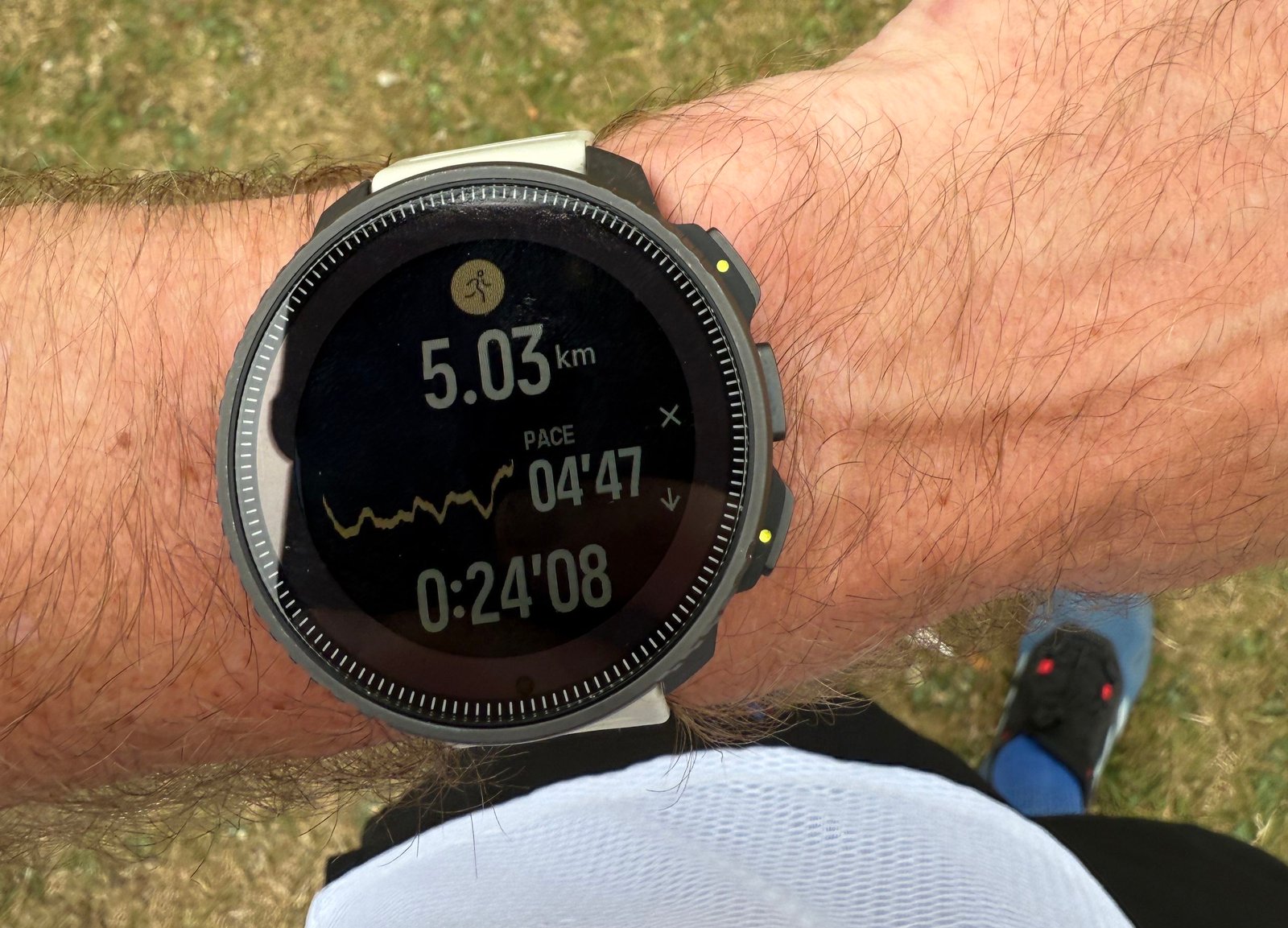
Where this watch falls down, even against my now ageing Fenix 6, is in heart rate monitoring. It regularly informed me I was running with an average heart rate of over 200 beats per minute, and it wasn’t a glitchy or fleeting reading either; it seemed insistent. I had to stop and count to reassure myself, because that’s certain death at the Park Run at my age, or at least a sign of tachycardia, so getting that news from my watch halfway round isn’t good for your PB.
The fact that I’m not in cardiac arrest and still here is yet more evidence that wrist-mounted heart rate monitors cannot always be trusted as harbingers of doom, and whilst not all of them even do a satisfactory job, this one is shocking at predicting imminent death or tracking zones.
The watch exudes class in terms of the materials. The strap features a nicely made switch to aid removal, but it didn’t feel as ‘never fail’ as a Garmin strap can.
(Image credit: Andy Carr)
Verdict and Value
The Suunto lives up to its billing as an adventure watch for exercise, looks smart on your wrist, and is easy to use. I tracked everything with it, including paddleboarding, and it covers all the main features, doing enough to gamify almost anything and provide some data to play with. As a device for navigating the High Alps, the endless battery life and excellent navigation are demonstrably pro-level, and I’d be surprised if there’s better available. Still, I didn’t test it in that extreme environment.
If you’re looking for the ‘right brand’ to go explore the mountains, or just add to your cosplay mountaineer wardrobe, this option has many merits and serves as a lovely alternative to the far less well-made or tactile Asian options, while offering a classier look than a Garmin and at a slightly lower price than something like the Fenix E.
It’s a good choice for a cycling and multi-activity watch. And perhaps an excellent choice for mountaineering. But, it’s not the rugged-looking, full-beard and frostbite-looking timepiece you might need when bragging about your off-piste excursion after the ski holiday. Which is a shame, as I did want to be the ‘Suunto Guy’ next time I’m in Dick’s Tea Bar.

(Image credit: Andy Carr)

