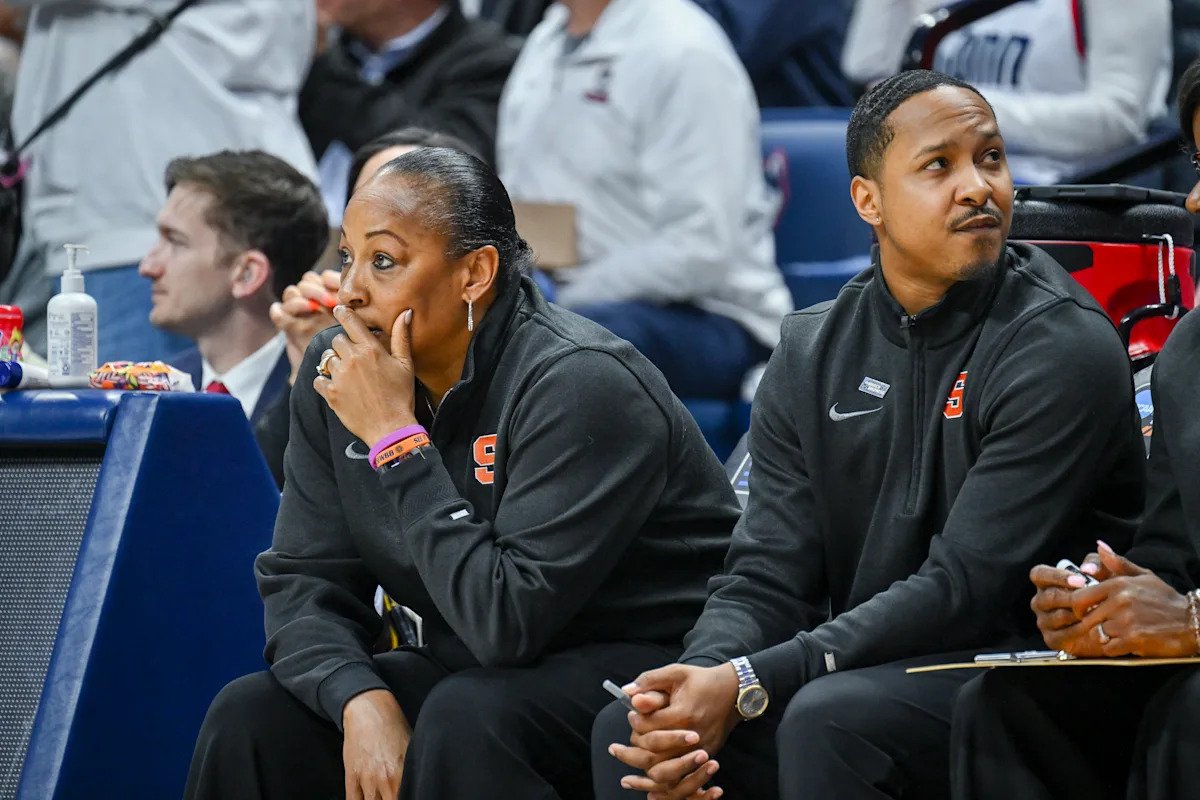
While Coach Jack acknowledged her claims might be critiqued as “spilled milk,” she has a point.
Syracuse head coach Felisha Legette-Jack took aim at her program constantly slotting into powerhouse Connecticut’s NCAA tournament pod, highlighting one of the growing issues with hosting the first weekend of games at schools’ campuses over neutral sites.
Advertisement
“After being in this business for 37 years, and to have to come and be in this particular bracket every fricking year is unacceptable,” Legette-Jack said in a lengthy opening statement after a 98-45 loss to No. 1 overall seed UConn in the second round of the Fort Worth 1 regional held at Storrs, Connecticut. “It’s wrong.”
For the third time in as many NCAA tournament appearances, Syracuse was bracketed into UConn’s pod for the first- and second-round games. And for the third time, the Orange were stopped by a team that has bulldozed its way to 16 Final Fours in the past 17 years. They’ve won seven of their record 12 national championships in that span.
The women’s tournament awards the top 16 overall teams the right to host the first weekend of games, giving those squads a massive home-court advantage that mid-major coaches throughout the country have pointed toward this week as a key reason there are fewer upsets than the men’s side.
Advertisement
It also means, in the case of programs geographically located in the region of consistent powerhouses, a near-certain dead end before the Sweet 16. Unless they earn their own hosting spot, they’re often slotted to the nearest location. Especially as conferences re-align to stretch the entire country, moving away from regionalized leagues.
Once the women’s tournament basketball committee selects and seeds the 68-team field, it builds a bracket using a series of principles, including travel distance. Teams are technically assigned to region and first/second-round sites in S-curve order, but taking into account travel distance to site, mode of transportation and fan accessibility. The committee prefers teams to travel by bus, if possible, and to allow for strong attendance numbers from each team involved.
One of the kickbacks of that altruistic approach is that certain programs are continuously at a disadvantage. And with other principles at play — namely ones that prevent rematches and conference meetings — it can get messy all around.
“What we’ve done and our body of work, to have to come and play the best team in the country, I mean, Geno [Auriemma] has this thing going, and I love what he’s done,” Legette-Jack said. “But we, I thought, deserved a little more respect.”
Advertisement
The committee seeded Syracuse at No. 36 overall at the bottom of the 9-seed line with, in order, Southern Cal, Princeton and Virginia Tech. USC went across the country to Columbia, South Carolina. In general, teams from the same conference (USC and UCLA) are kept apart until the regional final. Princeton, the only school geographically close to Storrs, also went across the country to Los Angeles in UCLA’s bracket. Virginia Tech went to Austin, Texas. Villanova, seeded at No. 37, was the only other Big East team in the field.
The Orange (24-9) finished seventh in the ACC, five spots above the 13th they landed in the ACC preseason coaches and Blue Ribbon poll. They returned to the NCAA tournament with a NET ranking of 39, a year after a struggle of a season that ended at 12-18. Freshman center Uche Izoje won the conference’s Rookie of the Year award as their engine inside.
Legette-Jack worried her lengthy opening statement would look like “spilled milk.” She makes a valid point that will continue to be an issue as the years of financial incentives stack. It is the first season the women’s tournament will utilize “units,” financial rewards awarded by the NCAA to conferences for each of their teams’ performances in the tournament.
Advertisement
“A lot of people talking about rev share; I just want the young people that’s in my locker room to have a fighting chance,” Legette-Jack said. “And I am grateful to be in an NCAA tournament, from where we’ve come from, but I think that we’ve earned the right to go anywhere outside of a four-hour radius.”
In 2024, No. 6 seed Syracuse lost to No. 3 UConn, 72-64. Dyaisha Fair, a guard who came with Legette-Jack from Buffalo, nearly led the Orange to an upset. The Huskies, as they have a habit of doing, went on to the Final Four.
In 2021, No. 9 Syracuse lost to No. 1 UConn, 83-47. The entire tournament was held in San Antonio the year after the COVID-19 pandemic. The committee did not use its geographic principles, so that matchup would appear to be coincidental. The two programs also met in 2017 in the second round, a 94-64 victory by No. 1 UConn over No. 8 Syracuse.
Legette-Jack questioned whether it was a personal attack on her. She also faced UConn in 2019 as head coach of Buffalo, a mid-major two hours west of Syracuse. The Bulls lost to UConn, 84-72, in the second round a year after becoming the tournament’s Cinderella by reaching the Sweet 16 as a No. 11 seed.
Advertisement
UConn held Syracuse to eight first-quarter points and rattled off a historic 31-point run in the second half to go into the break with a 65-12 lead. Azzi Fudd, one of two Huskies shortlisted for national player of the year, had 26 points at halftime and finished by tying career highs in points and 3-pointers made.
The Huskies are routing teams by an average of 38.8 points with a 52.3 net rating that would rank third all-time behind two of the Breanna Stewart-era teams. They’ve won seven games by at least 50 points. Legette-Jack said she noticed the distraction in her team and the looks of seeing the 12 national champion banners.
Advertisement
“I just think that we are way better than what we performed today,” Legette-Jack said. “But I think what you’re going to notice, that everybody that comes through Geno and UConn is going to get the wrath of what they can bring.
“I just know that this team right here had a strong chance of getting beyond this particular level.”

