Targeting penalties have steadily declined since 2020, dropping from about one in every four games to approximately one in every seven games last season, NCAA coordinator of officials Steve Shaw said Friday.
“It is a good news story,” Shaw said on a videoconference to explain the latest proposed rule changes, which were announced Thursday and highlighted a targeting proposal. “It is a slowly decreasing curve. … If you go back and watch them from 2017, 2018 versus today, the players play the game differently. Hits on quarterbacks, hits on receivers, defenseless players, the game has changed in a positive way, and our injury rates show that.”
The NCAA has also recorded its lowest three-year average concussion rate since “the statistics were meaningful,” Shaw said, but that data is still preliminary and being collected from last season.
The NCAA on Thursday announced a proposed one-year trial rule that would allow a player disqualified for targeting for the first time to play in his team’s next game regardless of which half the penalty was assessed. Currently, players disqualified for targeting have to sit out the rest of the game, and if the penalty occurs in the second half, they are disqualified from the first half of the next game.
The penalty increases with each subsequent targeting penalty, so under the proposal, if a player is flagged for targeting a second time during the season, he will sit out the first half of the next game. Only five players in the FBS committed a second targeting penalty during the same season, Shaw said. A third targeting ejection in the same season would mean the player misses the next game entirely. For the past two seasons, Shaw said, no player accrued three targeting fouls in the same season.
Last year, there were 117 total targeting fouls enforced and 64 occurred in the second half, so those players had to sit out the first half of the next game. Those players wouldn’t lose additional playing time under the proposed rule if it’s their first targeting call.
“This is an experimental rule,” Shaw said, “and so the commissioners want to see if we take away that carry-over, does that change behavior?”
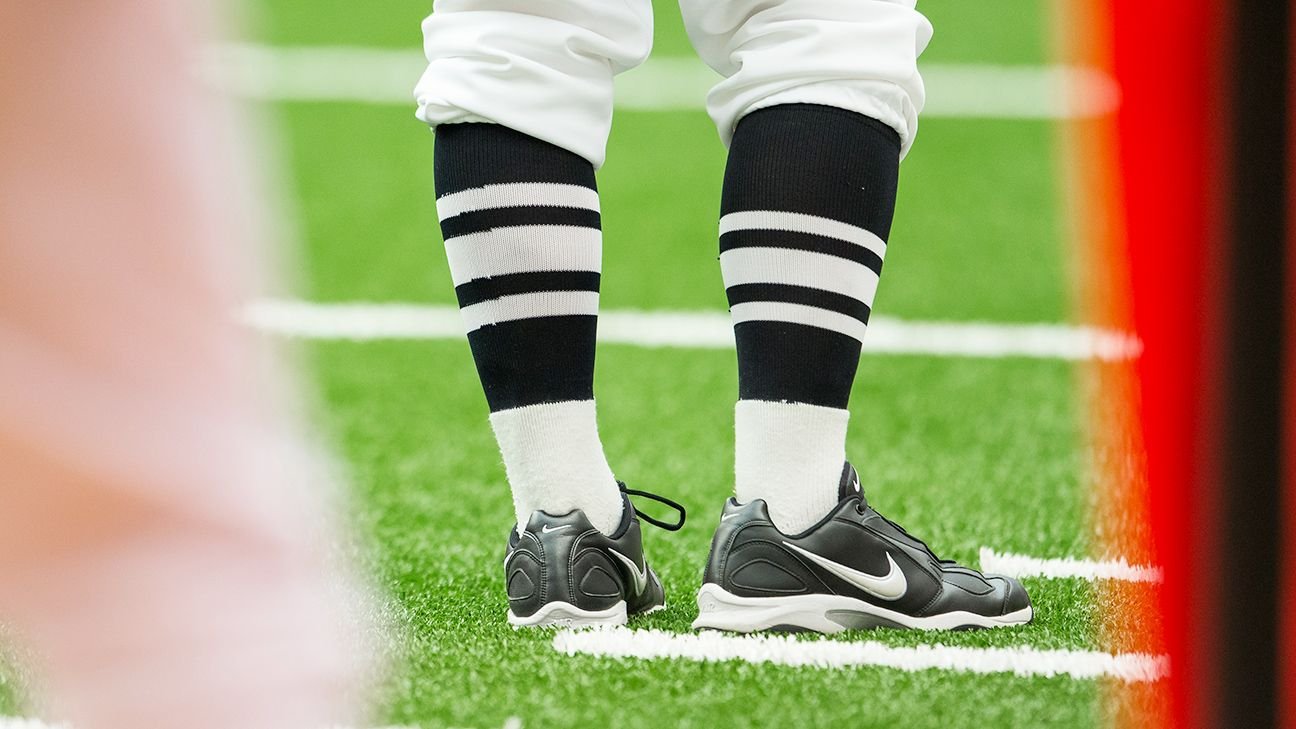
NCAA rules officials are also looking for a change to players’ unforms that mirrors the NFL by requiring “no skin gap” between the knees and shoes.
“You can either wear high socks that come up to the bottom of your pants, or you could wear some sort of leg covering — tights — whatever you want to call them,” Shaw said. “We’re looking for a no-skin gap. And if we have a skin gap and the officials recognize it, then they’re going to send the player out of the game. And they have to stay out at least for one play but get it fixed.”
If officials have to stop the game for a player, the athlete will be sent off the field and the coach will receive a warning. After that, if any other player comes out “improperly equipped,” the officials will stop the game again and assess a 5-yard penalty. The third and any subsequent stoppage will bring a 15-yard penalty.
“Our goal is just to clean it up,” Shaw said. “A lot of this is look of the game. We looked at a lot of pictures, a lot of still shots of players, and the trend had gotten worse and worse. You can describe them however you want to, but … very, very short shorts with little footy gold socks — it’s just not a good look for a game.”
Ty Halpin, the director of Division I football, said the uniform enforcement goes beyond the officials and to the coaches, players and equipment managers before they even arrive to the field.
“The rule really mirrors the NFL rule, and that’s where many of our players aspire to, and rightfully so,” Halpin said. “That’s what they’re going to be faced with when they get to that level, so I do think it’s on all of us to get to a better spot here. Game officials obviously have some role to play, but it’s not making them the uniform police. That’s really not what we’re going for here.”
The Division I Football Bowl Subdivision and Division I Football Championship Subdivision oversight committees must approve all proposals before they become official. The FBS oversight committee is scheduled to review rule recommendations March 19, and the FCS oversight committee will discuss the proposals March 23.

