Pan Pacific Championships, Night Three Finals: Team USA Snares Gold in 400 Freestyle Relay as Legendary WR Survives
Older fans of the sport can typically recall where they viewed. Younger fans have gone the digital route to watch the race. Regardless of age, the legend of the United States’ 400-meter freestyle relay from the 2008 Olympic Games in Beijing is well known. Of course, we’re talking about the relay that featured Jason Lezak’s comeback for the ages to defeat France, and preserve Michael Phelps‘ run to a record eight gold medals.
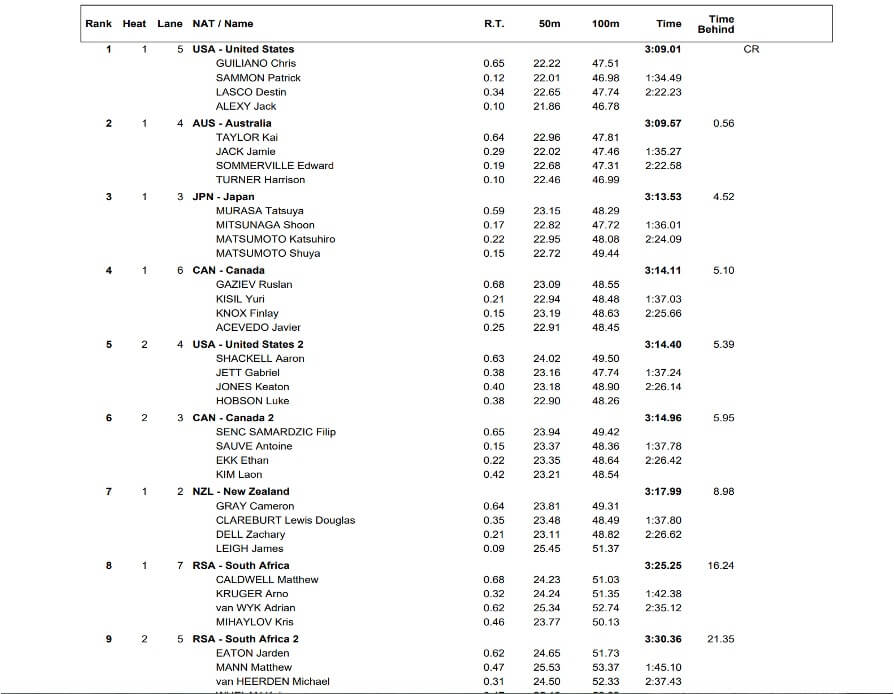
For 18 years (6,577 days to be exact), Team USA’s 3:08.24 from the Beijing Games has endured as the world record, no nation able to come closer than .73 to the standard. On Friday night at the Pan Pacific Championships, the U.S. made the latest run at the standard, falling just short with the fifth-fastest mark of all-time. The foursome of Chris Guiliano, Patrick Sammon, Destin Lasco and Jack Alexy popped a swim of 3:09.01 to fend off Australia, which claimed the silver medal in 3:09.57. The Aussies went to work with the quartet of Kai Taylor, Jamie Jack, Ed Sommerville and Harrison Turner.
The U.S. relay from Beijing is one of myth. It included Phelps leading off in an American record of 47.51 and had stellar middle legs from the tandem of Garrett Weber-Gale and Cullen Jones. But it was Lezak who became a hero inside the Water Cube, thanks to a 46.06 anchor split that allowed him – almost impossibly – to reel in Frenchman Alain Bernard and forever take his place in swimming lore.
Yet, since the United States produced its world-record time, with France second in 3:08.32, only two relays cracked the 3:09 barrier prior to Friday night. Team USA achieved the feat in 2021 and Australia pulled it off in 2025, both nations going 3:08.97 for No. 3 in history. The United States almost added another 3:08 at Pan Pacs.
“I was really excited about that. That record has been in a lot of people’s eyes for a long time, and I think we are on track for that to happen,” Alexy said. “It is always in the back of our minds when we represent Team USA. It is an honor to put that flag on our caps and when you step on the blocks for this relay it is kind of inevitable to think about it.”
Guiliano led off in 47.51, matching the time of Phelps from Beijing. Sammon followed with a sensational split of 46.98, and the United States was ahead of world-record pace at the midway point of the race. Lasco turned in a 47.74 marker on the third leg and Alexy closed out the victory in 46.78.
“That record has been in our eyes,” Alexy said. “This is good practice for us for Budapest (2027 Olympics) and LA (2028 Olympics). I don’t think we talked about it, but it’s been in the back of our minds. I’m confident we’ll get that record.”
Over the past few years, the United States has set the stage for a chase at the iconic world record, headlined by Alexy’s emergence as one of the premier 100 freestylers in the world. Beyond Alexy, considerable depth has been built and the chance to represent Team USA in international competition has generated an iron-sharpening-iron scenario. As the 2028 Olympic Games in Los Angeles approach, the relay should only get stronger.
The same can be said for Australia, which backed up its gold medal in the event from last month’s Commonwealth Games. The Dolphins were just .08 slower than in Glasgow and were missing the firepower of Kyle Chalmers and Flynn Southam, who opted to bypass Pan Pacs. Turner was sensational on the anchor, going 46.99, and followed Taylor’s 47.81, Jack’s 47.46 and Sommerville’s 47.31.
“I was pretty pumped by a 46. I haven’t even split 47 before. I am over the moon,” Turner said. “I am just a racer. Get me in there and I will give it a red-hot crack.”
Lasco was pleased with the latest title for the U.S. and sees the world record as attainable.
“It’s a process,” he said. “We have two years to figure it out.”

