Year two of Nick Caley’s run as offensive coordinator will reveal exactly where this Texans offense is headed. The plan is clear: ease the burden on C.J. Stroud and spread it across a roster built for defined, specialized roles. Every move Houston made this offseason points to that shift. Instead of stacking depth with similar players, the Texans have doubled down on assembling distinct skillsets at every position.
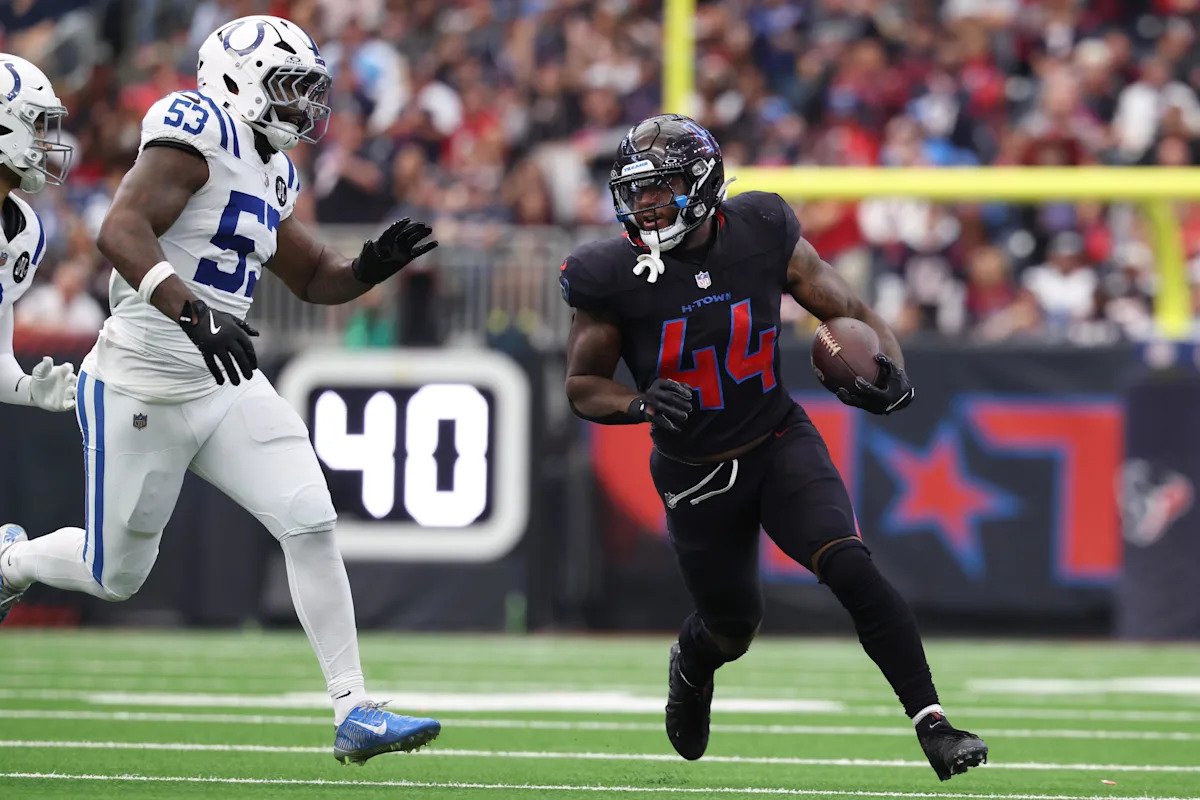
British Brooks fills one of the most specialized roles on Houston’s roster. Part running back, part fullback, part wingback, he gives Caley the backfield versatility that makes the system function. In I‑formation looks last season, Brooks served as the lead blocker, driving downhill on power concepts and clearing out the first defender in his path.
Advertisement
While Brooks was the unquestioned starter at fullback, what is interesting is how little he played on offense in 2025. He only accounted for offensive 73 total snaps out of around 1,300 plays on offense. That’s because the Texans leaned on 11 personnel the second-most in the league at 71%. Using the one‑back, one‑tight‑end groupings precluded Brooks from impacting the offense more. Thus, his primary role was on special teams. So why is Brooks such a vital piece of the puzzle in Houston?
Brooks’ utility is essential on a competitive 53-man roster. His blocking, special teams ability, and running capabilities allows the offense to be flexible and creative with its formations and skillsets.
Last season, he was primarily used in 21 personnel – two running backs and 1 tight end. A rare formation indeed, but one that allowed the Texans woeful offense to incorporate Blake Fisher, get a hat on a hat, and get Brooks matched up against a smaller linebacker. Anytime Fisher took the field in the game against the Baltimore Ravens, Brooks was in the backfield right behind him.
Heading into 2026, it’s well known the offense must evolve and improve, and Brooks appears to be making his own physical transformations too. In an interview with Texans Radio earlier this month, British Brooks admitted to losing 17 pounds this offseason to the astonishment of John Harris and Marc Vandermeer.
I’ve never heard John Harris ask a question as blunt as when he looked at Brooks and said, “Did you want to do that?” As if these athletes aren’t fully aware of what their bodies are telling them. Still, a fullback losing weight is genuinely puzzling. Anyone shedding that much mass is remarkable, GLP‑1 or not. And it raises a real possibility: Brooks might be positioning himself to compete outright for the third running back job rather than staying locked into a traditional fullback role.
Advertisement
Thanks to NFL Pro, I watched every single offensive snap British Brooks played in 2026. Brooks role truthfully did not have much impact on the outcome of the offensive plays. For the most part, he was neutralizing the linebacker or blocking out on a defensive end. He was included in play action plays as an additional blocker, but rarely went out for a route. Brooks struggled to lock on a linebacker and tended to bounce off after the initial blow. For all this, he did earn multiple carries on short yardage situations and 1st and 10s to gain positive yards.
17 times the Texans handed the ball off to British Brooks. Six of which were either goal line or short yardage situations. The majority of the carries occurred Week 18 when the Texans sat Woody Marks and Nick Chubb. He carried the ball 13 times for 63 yards in a slow but efficient performance. A poor and heavily rotated offensive didn’t help, but he ran hard as you’d expect out of a fullback playing running back in a meaningless game. Interesting enough, Brooks was more effective reading the defense and holes out of shotgun than with Davis Mills under center.
Given Nick Caley’s background as a tight end coach, that may be a strategic move. Caley will be more likely to keep a fourth or even fifth tight end over a blocking-specific back who cannot regularly run the ball. And for those wondering if Brooks can move inline to play tight end… keep dreaming. He’s 5’11 and only played two snaps at tight end last year. Brooks is miles better than tight end Cade Stover at blocking at full speed from the fullback position. He has much more reckless abandon and ability to maintain blocks – even if that is something he needs to work on before his third season.
If Brooks shifts completely to a running back role, that changes the entire complexion of the Rosterology.
Advertisement
The question will be: with the 17 pounds Brooks shed, is he going to convert to running back full time or try to stick at fullback. That will directly impact whether Brooks is seen as a situational blocker who will compete with the tight ends for a roster spot or as the third running back and compete with Jawhar Jordan for a roster spot. Either way, Brooks will be locked in a roster battle this training camp. Such is the life of a position player in a deep in a team’s depth chart.
This weight loss and shift to a running back position is savvy. Nick Caley is a former tight end coach on a team with a bevy of tight end options. Odds are, Caley will choose to keep a fourth or fifth tight end on the roster over a fullback. We know Brooks can play fullback, but the odds are better stacked in his favor if he can beat out one Jawhar Jordan over two tight end options.
Between running back and tight end, the Texans are likely to keep seven total players on the roster. The average number of each across all NFL teams in 2025 was 3.5 running backs and 3.7 tight ends. Based on the law of averages, the two options appear to be:
Option 1: RBs (4) David Montgomery, Woody Marks, Jawhar Jordan, British Brooks and TE (3) Dalton Schultz, Marlin Klein, and Foster Moreau
Advertisement
Option 2: RB (3) David Montgomery, Woody Marks, and British Brooks and TE (4) Dalton Schultz, Marlin Klein, Foster Moreau, and Brevin Jordan
If you ask me, Option 2 is the superior group. Brevin’s addition improves the offense and provides more speed and versatility. The blocking ability of Moreau and Klein improves the team’s scheme flexibility. However it shapes out for Brooks and the offense, his usage should improve in 2026 while the Texans improve their own offensive approach.

