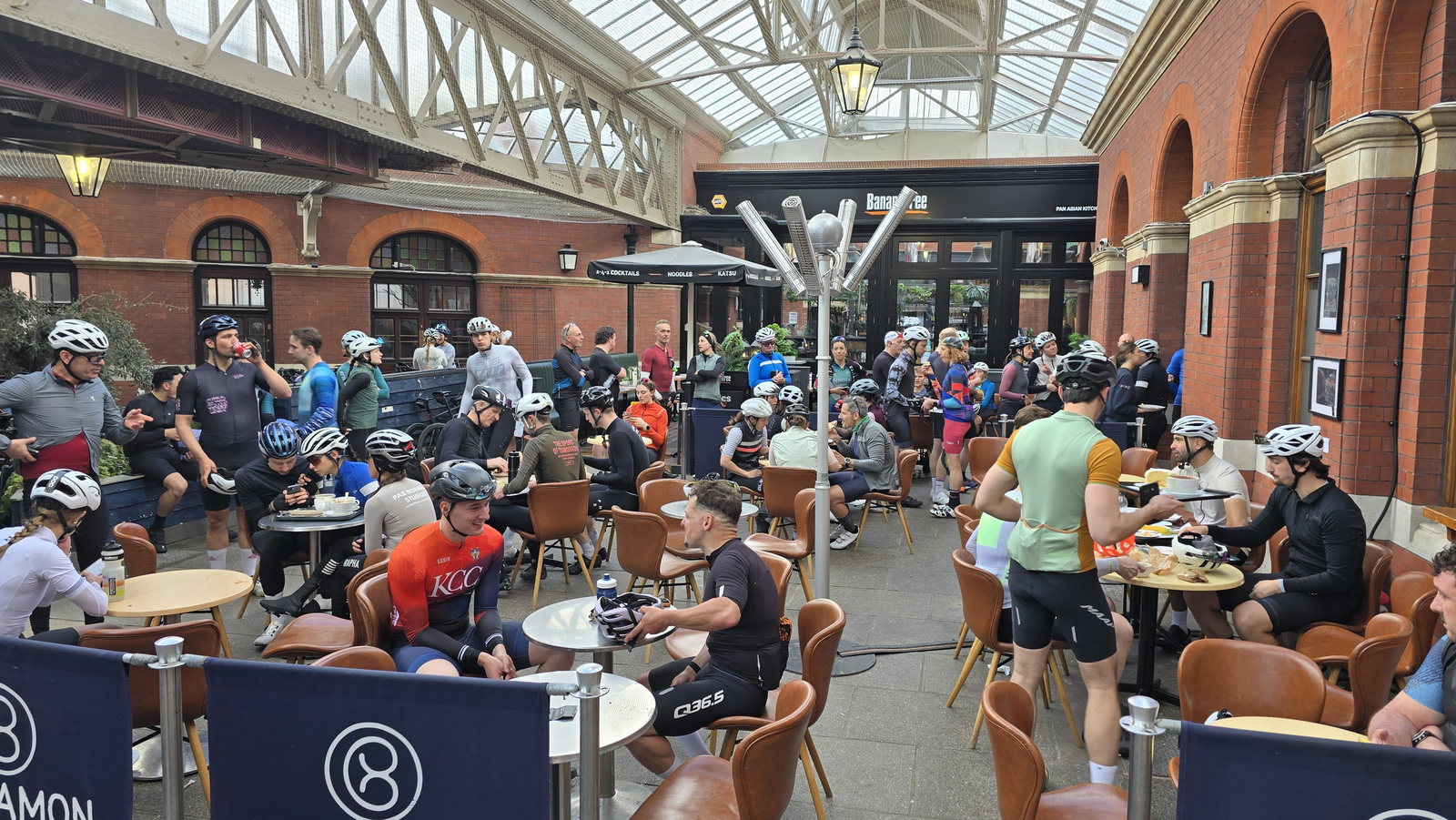
One café garnered national attention in the UK over the weekend for a so-called ‘lycra discount’: ten percent off food and drink for any weekend warrior decked out in active wear to walk through its doors.
According to one media outlet, such a discount has attracted ire from the local community, and has directly led to streets filled with cyclists and lined with bike racks.
But the cafe’s owner, Ian Jones, tells a different story.

“We’ve been offering the discount for fifteen years,” he tells Cycling Weekly, his baffled voice betraying the stress of the last 48 hours of unexpected media backlash. “Fifteen years and it’s still controversial!”
The lycra discount is in fact one of a few that Jones and his team offer for their customer base: there’s one for locals, one for morning coffee drinkers, another for military personnel. And yet the ten percent deduction on coffees for cyclists has attracted backlash; the latest chapter in the bizarre culture war between cyclists and drivers.
In 2023, the so-called culture war grew new tendrils when ex-Prime Minister Rishi Sunak pledged to stop the “war on the motorist” after launching a consultation on whether fining drivers for driving in cycle lanes was “fair” as part of a pre-election campaign. The Labour government promised “unprecedented funding” for active travel (though the £616 million deal was ultimately less than was invested in both 2021/22 and 2022/23).
So, where does this culture war come from? Cyclists are often also drivers. Slow road users can be, in the same way tractors or caravans are, occasional irritating delays to an otherwise speedy journey. But I see no vendetta against tractors on roads, or angry commentators red-faced about holiday makers. If you’re stuck for a story idea, take aim at cyclists: clicks (somehow) guaranteed.
“There’s always been a lot of cyclists around Windsor, and lots of people on the road,” Ian continues. “If there’s any congestion, it’s with cars and other vehicles.”
There is another story buried beneath the supposed scandal of a coffee discount. It’s about how one café became the accidental architect of a cycling town.
Jones first set up the Cinnamon Café in 2001, and soon his friends at the triathlon shop, Swim, Bike, Run, sourced him a bike to get him “out and about.” The two businesses banded together to equip the café with everything a cyclist might need: a pump station, a puncture repair kit and bike racks.
“It snowballed from there,” Jones says, though the real bicycle boom came in 2013, when a couple of cycling influencers visited Cinnamon Café.
“Cycling is about 20% of our business,” Jones explains, still reluctant to be pigeon-holed, “so it is important but it is by no means purely a cycling café.”
Positioned at the end of the ‘Bun Run’ (a 62-mile loop from Richmond Park), Jones says that on average, around 500 riders flock to the town each weekend. British Hill Climb champion, Harry Macfarlane and a roster of cycling influencers are now counted among the cafe’s Instagram followers.
“Cycling is a big part of what we are,” Jones continues. “In 2017, we nearly lost the café because the landlord was trying to put another chain there, and we got massive support from the cycling community who came out with placards and banners and supported us in a great way.”
After reading about the coffee shop, its ten percent discount and associated influx of unwelcome cyclists, I search for it on Google Maps. Visitor numbers are, it reports, “unusually high”, a red line shooting high above the curving monochrome of “business as usual.”
“The cycling community is always welcome in Windsor.” For the café and its community of cyclists, business is booming.

