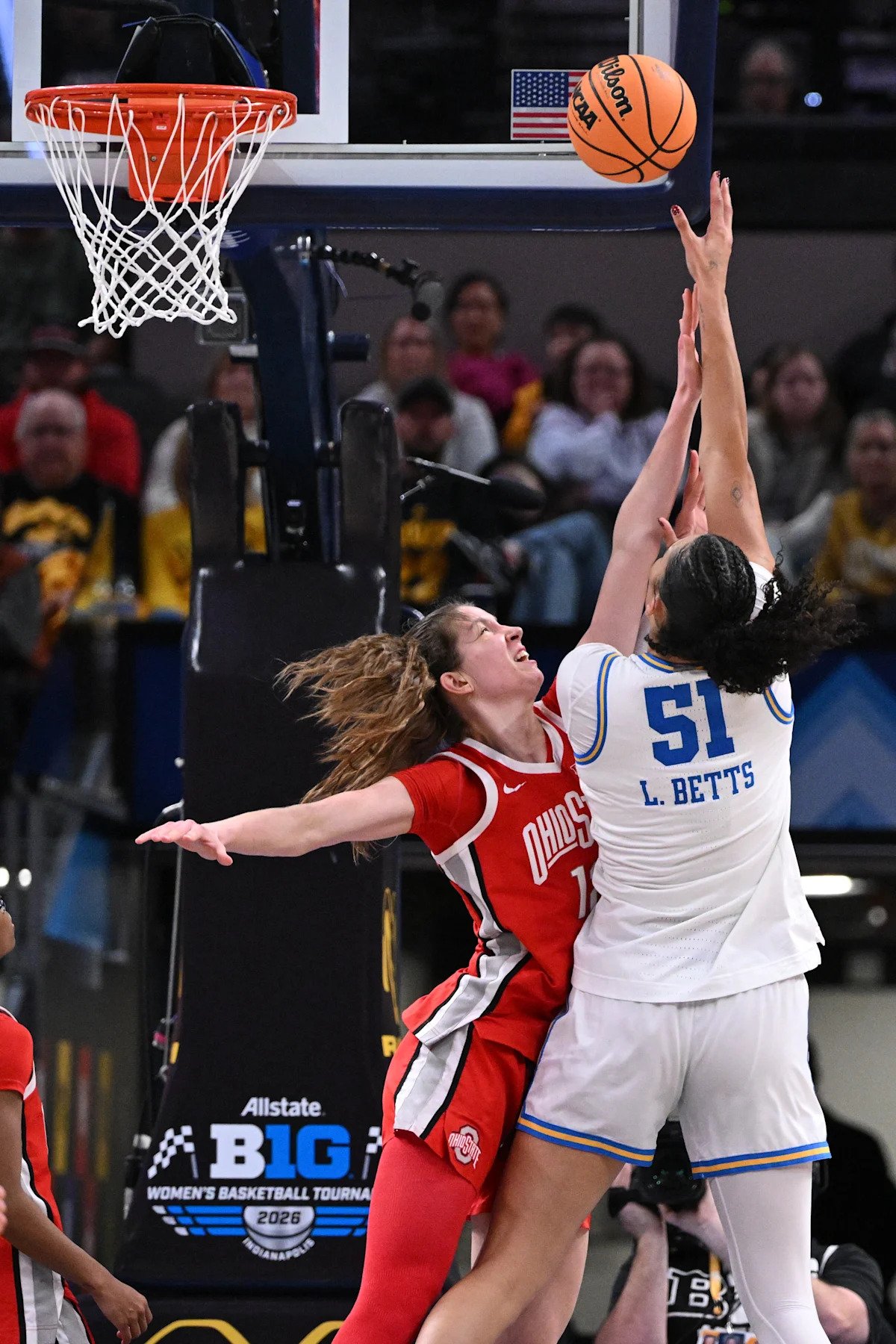
The first round of postseason basketball is in the books for Ohio State women’s basketball. After the Buckeyes missed a top-four spot and double-bye, head coach Kevin McGuff’s side won its first two games only to earn the right to face the nationally No. 2 ranked UCLA Bruins in a repeat outcome from their regular season matchup on Dec. 28. Ohio State’s trip to Indianapolis did not end with a trophy or needed banner edits in the Schottenstein Center, but there are positives and negatives from the three games that the team carries into March Madness.
The play of two Buckeyes not named Jaloni Cambridge, UCLA’s defense against Jaloni Cambridge, and more.
The Good: Chance Gray’s offense
It was a quieter scoring tournament for point guard Jaloni Cambridge (more on that later), but that was not a death sentence for the Buckeyes because of the play of senior guard Chance Gray. After an up-and-down first season in Columbus for the 2024-25 campaign, Gray has been the most consistent second scorer on the Buckeyes since the start of the 2026 calendar year.
Advertisement
That continued in the Big Ten Tournament, where the Cincinnati native averaged a team-high 18 points per game. Against UCLA, Gray had a game-high 23 points and was part of the reason why the game ended in only a 10-point defeat. The Buckeye was the lone Ohio State representative on the Big Ten All-Tournament Team for her work.
Gray averaged 17 points and 2.5 assists in 19 games in 2026. That production gives the Buckeyes some freedom offensively and takes pressure off Jaloni Cambridge. This play is especially important, combined with the leadership Gray provides to her teammates. From helping grow confidence in sophomore Elsa Lemmilä to being the one representing the side in the media after the Bruins ended the team’s tournament run.
If Ohio State makes it into the Sweet Sixteen and beyond, it will be in part because of Gray’s support on and off the court.
The Bad: Turnovers
There was one quarter when the Buckeyes did not have a turnover against the UCLA Bruins on Saturday. It is not a coincidence that it was the lone quarter that Ohio State bested UCLA in the points column.
Advertisement
It is no secret that the UCLA Bruins are good. They are so good that they cause teams to probably get inside their heads a little bit. That happened with Ohio State on Saturday. Turnovers are not new to any team, but the Bruins’ 15 forced turnovers are more than the Buckeyes’ 12.9 per game average entering Saturday’s matchup.
Ohio State does not have the size to match up with the Bruins’ roster, but that turned into forced, quick passes into lanes that were either occupied or nearly occupied by a UCLA player. Defensively, the Buckeyes held UCLA to 44.4% from the field, below its 50.3% season average, but the turnovers meant fewer shots for the Scarlet and Gray, six fewer to be exact. There are fewer baskets to cut the deficit or swing momentum to start a run.
“They’re good defensively, but we had some kind of turnovers that we normally don’t have, and when we did get some opportunities on some shots, we weren’t making them,” McGuff said.
Overall, the Buckeyes did limit UCLA’s effectiveness off of those turnovers. The Bruins had 13 points off the giveaways. It could have been much worse. If limiting mistakes and erasing deficits against UCLA was easy, more than one team would have done it this season against the 31-1 side.
The Good: Locking up NCAA Tournament hosting
A tournament that included the Bruins was always going to be a mountain to climb for the Big Ten Tournament title, as UCLA especially showed on Sunday in its 96-45 win over the Iowa Hawkeyes. The second-best thing Ohio State could do in the weekend tournament was play well enough to lock up its spot in the NCAA Tournament’s top-16 seeds, which earns the privilege to host the first two rounds of March Madness in a home gym.
Advertisement
With the final win of the Big Ten regular season, against the Michigan State Spartans, and two wins in the tournament did that and then some. The teams around the Buckeyes in the top-16 all had tough, or multiple, losses, so not only is it a strong possibility that Ohio State hosts, the Scarlet and Gray are likely to bump up to a No. 3 seed, according to the bracketology scientists.
Does that mean Ohio State has an easy road to the Sweet Sixteen and beyond? Not exactly. The Buckeyes hosted the last three years, and the first year needed a late Jacy Sheldon game winner, while the next two hosting duties ended with Second Round upsets to the Duke Blue Devils and Tennessee Volunteers.
The Bad: UCLA frustrating Jaloni Cambridge
All season, Jaloni Cambridge frustrated opposing coaches. All season, the Buckeyes entered games, and the opposition knew what they would do and how the point guard could punish their team. Even in Ohio State losses, Cambridge still got in her shots and rolled to a Big Ten season high points per game average. UCLA was a different story.
Advertisement
What is likely a compliment to the young guard is that UCLA had to put so many resources into Jaloni Cambridge. Oftentimes, Defensive Player of the Year Lauren Betts would get switched onto the sophomore, which heavily impacted her ability to get into the lane. Jaloni Cambridge’s first shot was a midrange basket against Betts, which the 6-foot-7 swatted away with ease. After that, the trajectory of Jaloni Cambridge’s shots over the center were obviously higher arching, but it threw off the effectiveness of the efforts.
There were chances at the end of the game for the Ohio State guard, but the Bruins’ defense never gave the guard an open lane, like she had late against the Minnesota Golden Gophers to put that game away. It was a game where the experience of six senior Bruins knew what to do to contain the sophomore.
While Cambridge’s scoring numbers were down in the tournament, the pass-first guard increased her assists on the season with 5.3 assists over her 4.9 assist average in Big Ten play.
“She [Jaloni Cambridge] takes a lot of pride in her game and how she impacts the team. I love the ball in her hands and the plays that she makes,” McGuff said. “I don’t think she took a lot of bad shots today at all. I think she took good shots, and they normally go in. And if we continue to get her those types of shots, I think we’re going to be in good shape.”
The Good: Elsa Lemmilä’s growth
While Gray’s productivity earned her a spot on the All-Tournament Team, the biggest growth for one player on the Buckeyes is the 6-foot-6 big, Elsa Lemmilä. Ohio State’s center averaged a double-double with 11 points and 10 rebounds, and had one double-double in the three games. Against the Minnesota Golden Gophers, and center Sophie Hart, Lemmilä tied Jaloni Cambridge with 17 points and made halftime adjustments to swing a 28-point lead in the paint in the first half for Minnesota into only six in the second half.
Advertisement
Saturday’s game against UCLA though, posed a whole different challenge for Lemmilä, and the Finnish big had the best game against Betts in her career, in four games.
Lauren Betts went head-to-head with Lemmilä on many occasions, doing what she could to back Lemmilä closer to the basket for easier shots, but Lemmilä mostly held her ground. Betts’ 14 points and nine rebounds are under her 17.4 and 9.9 averages, respectively. Of those 14 points, only six came from layups. Betts shot just under her 54.4% season average in a 7-for-13 day, and most of that had to come from deeper shots, a basket that Ohio State would likely take over easy trips to the lane, and potential extra free throws on contact. Instead, Lemmilä showed strength that has not been on display for most of the season, as the sophomore continued her recovery from offseason surgeries.
It is a tournament that should skyrocket the confidence of the young Buckeye center.
“At the beginning of the season, I definitely did not think I would be in the position, this point in the season, where I can play three games in three days, but very happy about how my body held up, hopefully hold up a bit longer for the NCAA tournament,” Lemmilä told reporters.

