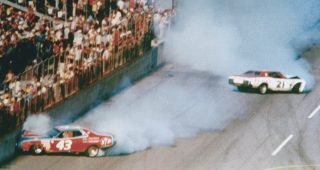
Although not quite in focus, perhaps because of the stunning surprise of the moment, the photograph is a NASCAR classic, one reprinted so many times it is embedded in the mind‘s eye of longtime stock car racing fans.
The landscape is the frontstretch of Daytona International Speedway. It is the final lap of the 1976 Daytona 500, and chaos has erupted. The cars of Richard Petty and David Pearson are spinning and sliding, and smoke from the tires clouds the image. Petty‘s bright red and blue No. 43 is meeting the outside wall, and Pearson‘s No. 21 with the gold numbers is twirling toward the infield grass.
Advertisement
Vintage NASCAR drama in a single image.
“I‘ve signed that picture thousands of times,” said Richard Petty, remembering the events a half-century gone. “That race never goes away. It‘s been replayed over and over and over and will be some more. It wasn‘t especially good for the Petty crowd, but it was good for the sport.”
RELATED: Watch the 1976 Daytona 500 on Classics | See this weekend’s Daytona 500 schedule
Famously, Pearson recovered from the contact the two drivers had in the fourth turn and their run-ins with the outside wall, kept his engine turning and chugged across the finish line to win the race.
Advertisement
The bizarre finish, a highlight of the sports world on Feb. 15, 1976, was immediately labeled one of the greatest — if not THE greatest — in NASCAR history.
Three years later, some modified that view.
It was the Daytona 500 again — Feb. 18 this time, and there was another last-lap crash, Donnie Allison and Cale Yarborough smashing their cars in the third turn racing for the win. Their cars fell off the banking, and the victory was left to the third-place driver — it‘s Richard Petty! The No. 43 won, with Darrell Waltrip racing in his shadow.
Spiking the drama was what happened after the checkered flag. Donnie Allison and his brother Bobby, who had stopped his car at the scene of the accident, became embroiled in a disagreement with Yarborough, and Bobby and Cale proceeded to attempt to settle matters with a brief scuffle.
Advertisement
CBS cameras caught the fight, and water-cooler talk across the country the next morning put NASCAR in focus for thousands of people who perhaps had known little of the sport before another round of Daytona drama.
Track emergency workers try to break up a fight between Cale Yarborough, Donnie Allison and Bobby Allison after Yarborough and Donnie Allison crashed on the final lap while battling for the lead in the Daytona 500 at Daytona International Speedway.
Did the 1979 500 then become NASCAR‘s greatest finish? Was the 1976 race superseded?
Support for both sides of this debate, one that is likely to continue as long as there are bars and social media, is easy to find.
“When I think of what‘s grown and elevated the sport and brought it to a national level, that 1979 race — I‘ve seen that replay over and over and over again and listened to the commentators and tried to understand what seeing that live was like,” said Jeff Gordon, who later would win three Daytona 500s. “That was a game changer for us. And the Petty-Pearson one is pretty important. It‘s hard to say which one, but one thing I‘ve learned over the years is that fighting seems to get more attention than other things, even a great battle to the finish.”
Advertisement
RELATED: Watch the 1979 Daytona 500 on Classics
Ricky Rudd, then 19, was one of more than two dozen drivers who failed to qualify for the 1976 500. In 1979, he finished 31st in the race after blowing an engine and was on his way home when the Allisons and Yarborough crashed and clashed.
“Both of those races had unique qualities about them,” Rudd said. “It was two different times in history. The Pearson-Petty thing had everybody on the edge of their seats, but the 1979 finish had the brawl, which was of course pretty exciting to watch. That finish was emotional and down to the wire, and there was some aggressive driving. Those cars didn‘t stick to the ground like they do today. They tended to drift around a lot.”
Ask Hall of Fame crew chief Ray Evernham about the greatest finish, and he‘s quick — understandably — to pick a race other than the ‘76 and ‘79 500s. That would be the 1997 Daytona 500, which ended in a three-way sweep for Evernham and Hendrick Motorsports: Jeff Gordon first, Terry Labonte second and Ricky Craven third.
Advertisement
But Evernham appreciates the importance of both previous 500s.
“The Petty-Pearson thing was pretty exciting to me because I was just starting to understand the draft and the slingshot and guys letting off,” he said. “What‘s the greatest one? 1979 had the greatest effect on the sport — 100 percent. But, from a racer‘s standpoint and wanting to watch, that was probably the Petty-Pearson all-out battle. That was the true battle to the finish line.”

David Pearson celebrates in Victory Lane after winning the 1976 Winston Cup Daytona 500 at Daytona International Speedway on Feb. 15, 1976 in Daytona Beach, Florida.
Although the 1979 race is credited with boosting NASCAR‘s national profile, the 1976 Daytona 500 attracted bigger television numbers.
About 18 million watched Petty and Pearson collide via the ABC Television Network, which broadcast the final 100 laps of the race as part of its Wide World of Sports anthology program. NASCAR shared the ABC stage that day with coverage of the Winter Olympics from Innsbruck, Austria, and the calamitous Daytona finish led ABC Sports to extend its race coverage into time previously scheduled for Olympic coverage. Bumping the Olympics was a big deal for NASCAR.
Advertisement
The television package was entirely new for the 1979 500. Before NASCAR and its tracks worked out contracts to broadcast every Cup race from flag to flag, typical coverage included only the final portions of races. After months of debate, CBS Sports agreed to televise the 1979 500 from start to finish for the first time, a somewhat risky decision that turned golden on race day. A powerful snowstorm blanketed much of the country that weekend, increasing the potential for TV viewership, including people who had no previous NASCAR connection. Fifteen million watched at some point during the 500 miles — and the aftermath.
MORE: Watch NASCAR Channel for more great Daytona replays
Terry Labonte was among those who watched 1979‘s big finish, and he had a unique viewpoint.
“That was my first Daytona 500, and I was sitting in my car on the backstretch when they finished,” Labonte said. “My car had a clutch problem with about 10 laps to go, and I pulled in on the back straight in an opening where the safety truck was. I was standing in the back of the truck with a safety worker and watched Cale and Donnie coming down the back straight and then banging and beating on each other. They went out of sight when they fell off the track, and I couldn‘t see them. Another guy standing there said, ‘They‘re fighting down there. Bobby Allison and Cale.‘ I said, ‘No, no, no. That was Donnie Allison.‘ He said, ‘No, I heard it was Bobby.‘ ”
It was Bobby.
Labonte was one of hundreds of thousands who engaged in conversations about that finish. It‘s still talked about today, as is Pearson-Petty in 1976.
The races, and the debate, roll on.

