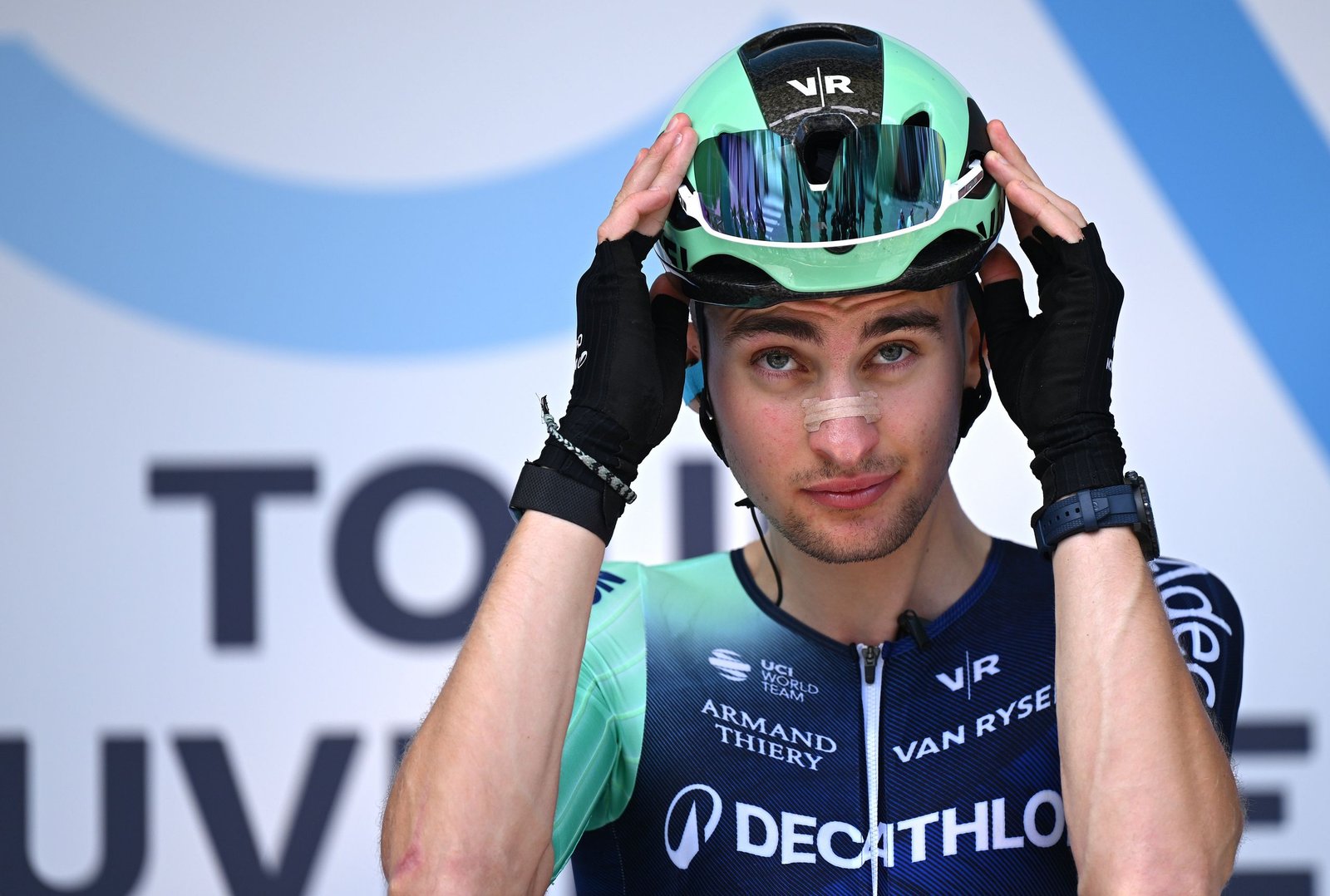
Paul Seixas is three minutes late for his press conference. Inside a side room of Barcelona’s former Sant Pau hospital, a grand auditorium with yellow tiles on the ceiling and stained glass windows, the suspense is building. The 90 or so chairs are not enough for the more than 150 journalists that have turned up. Those that came last are standing along the wings, waiting cross-armed for the rider of the moment: France’s teenage darling, the youngest Tour de France debutant in 89 years.
Hushed whispers announce Seixas’s arrival. Fresh-faced and dressed in a white shirt and cream chinos, he could be mistaken for a teenager on work experience as he files through the crowds. He steps up onto the small stage, drops into a chair, and relaxes his body against the armrest. Alone, he then looks out to the back of the room, where 10 television cameras point back at him.
It’s unheard of for the Tour to host a pre-race press conference for a 19-year-old debutant. These events are usually only reserved for the reigning yellow jersey, world champions, and multiple stage winners – in two hours, Tadej Pogačar will sit in the same seat. But the furore around Seixas demanded the occasion.

How does he feel, then, at the centre of it all? “It’s a bit particular,” Seixas says, rushing his words slightly. “It’s true that the Tour brings a new dimension, and this is the proof of that. It’s a new experience for me.”

Seixas sat alone in front of the media in Barcelona on Thursday evening.
(Image credit: Getty Images)
Such is the excitement in Barcelona around the Decathlon CMA CGM rider that the French media couldn’t contain their questions before he arrived; in Mathieu van der Poel’s press conference, held just before, one reporter asked the Dutchman what he expected of the race’s youngest rider, purely because the two share French ancestry. “He’s capable of doing great things,” Van der Poel said. “He has shown he has the level to compete with the best.”
That same belief is shared in the room. This spring, the world watched Seixas finish runner-up to Tadej Pogačar at Strade Bianche and Liège-Bastogne-Liège. People were in awe when he won Flèche Wallonne in April, soaring up the final climb as if shot out of a canon.
One journalist begins his question by comparing Seixas to Lamine Yamal, the FC Barcelona footballer, who at 18 years old is already among the best in the world. The rest of the room laughs, but the parallel isn’t so far-fetched.
Does the hype faze Seixas at all? It appears not. “The priority is the general classification,” he says, focused, two days before the Grand Départ. He may be the youngest rider on the start list, but he’s here to win; he’s been saying the same ever since his Tour participation was announced in May.
“What position [I can finish], I don’t know yet,” he says. “But I won’t take any risks for anything else other than the general classification.”
The risks, perhaps, are a nod to his crash at last month’s Tour Auvergne-Rhône-Alpes. Seixas left his final tune-up race early, his arms bandaged in gauze after crashing into a ravine. “It was a mistake on my part… It happens,” he says of the crash, but there’s no worry about any painful after-effects.
Instead, stepping into the unknown of a three-week Grand Tour, he’s approaching the race as he would any other: with the will to learn, and a desire to win.
“Of course there are different ways to win on a course like this,” Seixas says. “I will see how it goes, how I can perform, at which level, and in which place.”
The cycling world will watch closely, too.
Explore More

