March Madness is so ingrained as a national spectacle at this point the controversial selections and snubs are an inevitability, and even an expected part of the show when college basketball fans gather on Selection Sunday for the reveal of the bracket.
Bracketology sprouted from our collective thirst to know what teams must do to hear their name on Selection Sunday, and where those teams might be ranked. So too did a collection of rankings based on computer models and formulas and, like last year, seven of those metrics will be listed on the team sheets used by the selection committee as it meets heading into Selection Sunday to determine the field for the 2026 NCAA tournament.
Advertisement
Toppmeyer: As Alabama loses with Charles Bediako, it reeks of desperation
Dust up: Tom Izzo, Dusty May complain about dirty play in Michigan win vs. MSU
Each ranking or rating is separated into two distinct categories — predictive metrics and results-based metrics. The NCAA Evaluation Tool (NET), KenPom, ESPN’s BPI and the Torvik rankings are considered predictive rankings that measure how good a team is based on its offensive and defensive efficiency, adjusted for opponent strength and location. The KPI, ESPN’s Strength of Record (SOR) and Wins Above Bubble (WAB) are results-based rankings that judge how hard it was for a team to attain its résumé.
For many teams, the two types of ratings largely converge by the end of the season. For others, however, there can be a wide swath of outcomes based on how a game was played and whether it was won or lost. These are the schools from major and mid-major conferences that could inspire the most robust conversation and debate among committee members, either over their selection into the 2026 NCAA tournament as an at-large and/or their potential seeding in the field, due to the differences between their ranking in predictive metrics and results-based metrics.
Advertisement
Here’s an early look at 10 teams with polarizing profiles ahead of Selection Sunday based on the metrics used for the men’s NCAA tournament:
MARCH MADNESS BRACKETOLOGY: Houston, Florida rise in NCAA tournament seeding
March Madness 2026: NCAA tournament metrics’ most polarizing teams
All records and rankings through games played on Feb. 2
How the NCAA tournament selection committee seeds the defending national champions is developing into a fascinating subplot for Selection Sunday after Florida didn’t get wins in high-profile nonconference games against Arizona, Duke and UConn. But the Gators remain in the SEC driver’s seat with a huge matchup against Texas A&M looming on Feb. 7. Predictive rankings have them already in contention for a top-two seed, but results-based metrics have Florida hovering just inside the top-20. Will committee members give the Gators the benefit of the doubt over teams with fewer losses?
Advertisement
The Cardinals are 11-2 when freshman Mikel Brown is in the lineup, with losses to only Duke and Arkansas, and look poised to return to the NCAA tournament in coach Pat Kelsey’s first season. But Louisville is 4-4 without Brown, including three losses in four games last month as ACC play got underway. So the Cardinals are positioned as high as No. 11 in predictive metrics as a result of their ceiling with Brown, but their results-based rankings are as low as No. 32. If those dynamics remain the same over the next month, there will be lingering questions about how Louisville will be seeded by the selection committee.
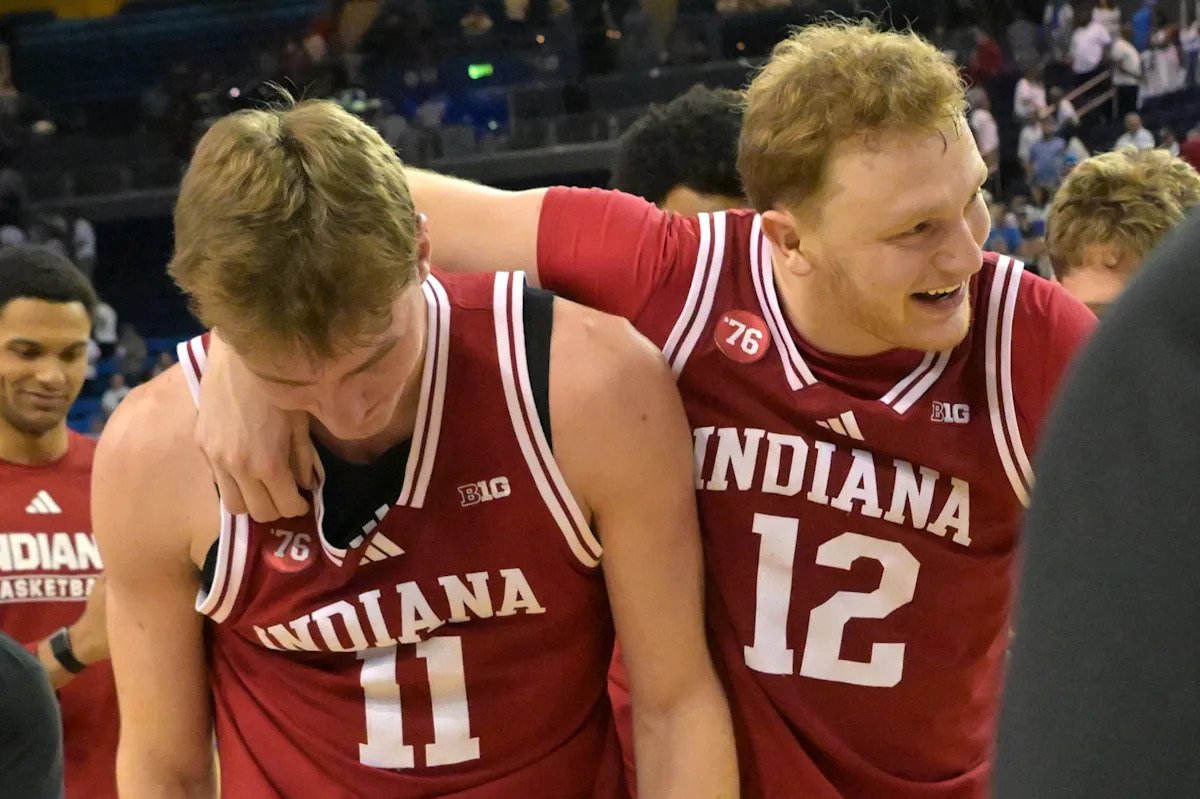
The Hoosiers are as high as No. 23 and as low as No. 49 among the seven metrics used by the NCAA tournament selection committee, with a weak schedule and lack of significant wins until recent triumphs over Purdue and UCLA leaving them in an interesting spot to start February. Indiana has slipped up against inferior competition and had several metric-boosting blowouts to help juice its predictive metrics. The Hoosiers would likely make the NCAA tournament field as an at-large team if Selection Sunday were this week, but they’re only a loss or two away from being on the wrong side of the bubble again.
Advertisement
UCF (17-4)
UCF Knights guard Riley Kugel (2) dunks the ball during the second half against the Oklahoma State Cowboys at Gallagher-Iba Arena on Jan. 6, 2026.
The Knights’ résumé won’t be straightforward for selection committee members if UCF continues on its current trajectory, with the predictive metrics of a bubble team and results more in line with a top-six seed. The Knights didn’t test themselves much in the nonconference schedule, but got a key road win over Texas A&M, already beat Kansas and Texas Tech in Big 12 play and have no bad losses. Coach Johnny Dawkins is having his best season since he last made the NCAA tournament in 2019.
The Longhorns could present challenges for the committee if they linger along the NCAA tournament bubble around Selection Sunday. Their predictive metrics rank among the top-40 after some impressive SEC wins over Vanderbilt and Alabama last month, but they’ve also got a Quad 3 loss at home to Mississippi State and only one nonconference win of note on their résumé. Texas still has chances to boost its profile with games looming against Florida, Texas A&M and Arkansas at the end of SEC play, but its profile can’t withstand too many more setbacks.
Advertisement
The Huskies would be a fascinating test case if Selection Sunday were this week instead of next month as no Big Ten team has a wider gap between its metrics. The predictive rankings are all mostly the same, ranging from No. 43-47, and put Washington on the bubble. The results-based rankings are similar as well, only those range from No. 60-64 because of the team’s 10 losses. That would put the Huskies in danger of missing the NCAA tournament. None of those defeats, however, are outside of the first two quadrants.
The predictive metrics haven’t caught up to the results-based metrics after Cal knocked off UNC, Stanford and Miami to emerge from a three-game losing skid. The Golden Bears have played their way onto the NCAA tournament bubble and have no bad losses on their ledger. A few closer-than-expected results facing a weak nonconference schedule leaves them limited margin for error the next month.
Advertisement
The Cowboys look like they could provide a window into how the NCAA tournament selection committee judges a team that does well in nonconference play only to then stumble in conference action. Oklahoma State is considered the 12th-best team in the Big 12 by predictive metrics after it started league play with five losses in eight games. But it’s nearly 22 spots higher nationally, on average, in results-based metrics thanks to early wins over Texas A&M, USF, Northwestern and Grand Canyon that have aged better than expected. The Cowboys still have a shot based on the strength of the Big 12.
This one-time Final Four darling could be poised for another mid-major NCAA tournament run involving a borderline Selection Sunday résumé. The Patriots have won 20 of their first 22 games, but both losses came in rare Quad 1 or 2 opportunities. Their predictive metrics continue to lag significantly when compared to their results-based rankings. It doesn’t help that George Mason won’t face Atlantic-10 Conference favorite Saint Louis until its regular-season finale. The Patriots need more quality win opportunities.
Advertisement
The undefeated darlings of the MAC could present the NCAA tournament selection committee with a real issue to sort through if they were to get upset before claiming the league’s automatic berth into March Madness. KenPom and ESPN’s BPI have Miami rated outside the top 75 with no Quad 1 wins, but the RedHawks rank among the top 35 in ESPN’s strength of record and the NCAA’s wins above bubble metrics thanks to their unblemished record. Would Miami with one or two losses merit an at-large berth on Selection Sunday?
This article originally appeared on USA TODAY: NCAA bracketology 2026: March Madness metrics unsure of these 10 teams

