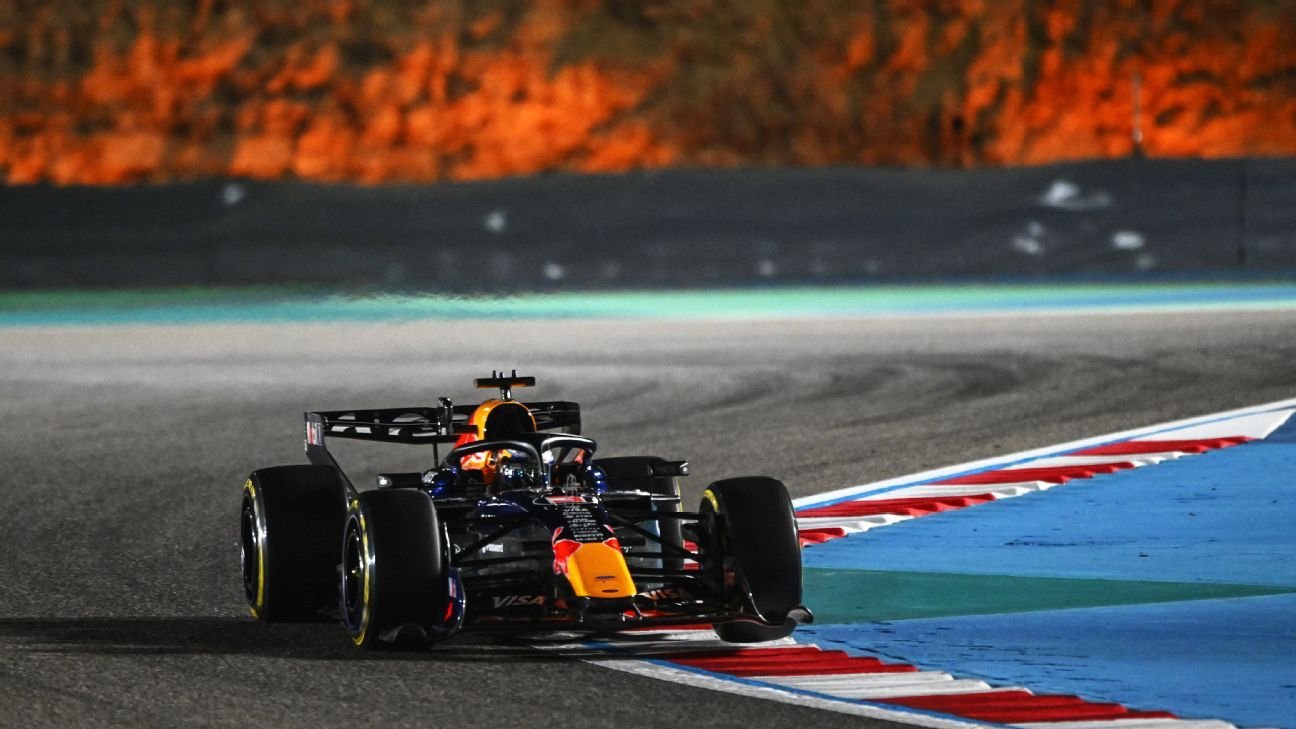
Mercedes team boss Toto Wolff believes Red Bull have set the early benchmark for power unit performance under Formula 1’s new regulations despite questions swirling over Mercedes’ interpretation of the new rules.
Mercedes was tipped as the preseason favourites after the first five days of testing in Barcelona last month, but Wolff said he has been most impressed by Red Bull’s start to the year.
After splitting with Honda at the end of 2025, Red Bull has produced its own power unit for 2026 — a huge undertaking that included poaching a number of high-profile engineers from Mercedes’ engine programme.
Asked to assess Red Bull’s achievement as an engine manufacturer, Wolff said: “Well, I was hoping that they were worse than they are, because they’ve done a very good job.
“The car, the power unit are the benchmark at the moment, I would say. And then obviously you have Max in the car. That combination is strong.”
New regulations for 2026 put extra emphasis on the electrical element of the hybrid power units, with the battery capable of harvesting and deploying three times as much power compared to last year.
The extra emphasis on electrical power means recharging the battery and effectively deploying energy around the lap will become key factors in lap time performance.
Wolff said data from Wednesday morning’s test session in Bahrain indicated Red Bull was able to deploy more energy on the straights than its rivals, both over a single lap and over multiple laps.
“Look at the energy deployment today,” he said. “They are able to deploy far more energy on the straights than everybody else.
“On a single lap we’ve seen it before, but now we’ve seen it on ten consecutive laps with the same kind of straight line deployment.
“I would say that as of today, which is the first official day of testing, which is always with the caveat of that, they’ve set the benchmark today.”
Asked if Mercedes could match that level of deployment, Wolff added: “Today, no.”
Wolff spent the vast majority of Wednesday’s media session fielding questions on a row over the interpretation of this year’s engine regulations.
The controversy centres around the V6 engine’s compression ratio, which was reduced from 18:1 in 2025 to 16:1 this year to make it easier for new power unit manufacturers to compete in the sport.
The regulations state that the engine’s compression ratio will be measured at ambient temperatures, but it seems Mercedes has found a way to comply with the legality test while achieving a higher compression ratio — and therefore more power output — when the engine is running hot.
The issue has already been discussed at length among power unit manufacturers and the sports’ governing body, the FIA, after it was first raised by Mercedes’ rivals at the end of last year.
“I think that the lobbying from the other engine manufacturers has massively ramped up over the last few months,” Wolff said. “I mean, secret meetings, secret letters to the FIA, which obviously there’s no such thing as secret at this point.
“And that has brought it to the situation. So there’s been three meetings that we know of between FIA and power unit manufacturers over the past couple of weeks. Nothing seems to have been resolved.”
The FIA has declared its intention to “solve” the issue before the first race of the season and avoid the situation being referred to the stewards or decided in court.
One possibility is to change the rules so that the compression ratio limit of 16:1 also applies when the engine is hot, but it would require approval from the FIA, led by its president Mohammed Ben Sulayem, and Formula 1, led by Stefano Domenicali.
“I believe that fundamentally the president of the FIA and Stefano will look at it in a holistic way and avoid too much gamesmanship,” Wolff added.
Four teams are powered by Mercedes engines this year, including customer teams McLaren, Alpine and Williams.
Asked if there was a possibility that eight cars might not be on the grid at the opening race in Australia if the rules are changed, Wolff gave a vague answer.
“Well, if it becomes a regulation, you need to adhere to the regulation,” he said.
“And if you can’t adhere to the regulation, then the FIA needs to come up with some kind of invention of how to adjust for that. And that’s unclear to us.”
He added: “You know, I’ve been here for a while, and you’re being misled and you’re misleading all the time. So there is no such thing as surprises anymore.
“The wind can change suddenly. Bernie Ecclestone [Former F1 CEO] would say, ‘change of circumstance.’ I said A yesterday, but today my opinion is B. And that happens all the time.”

