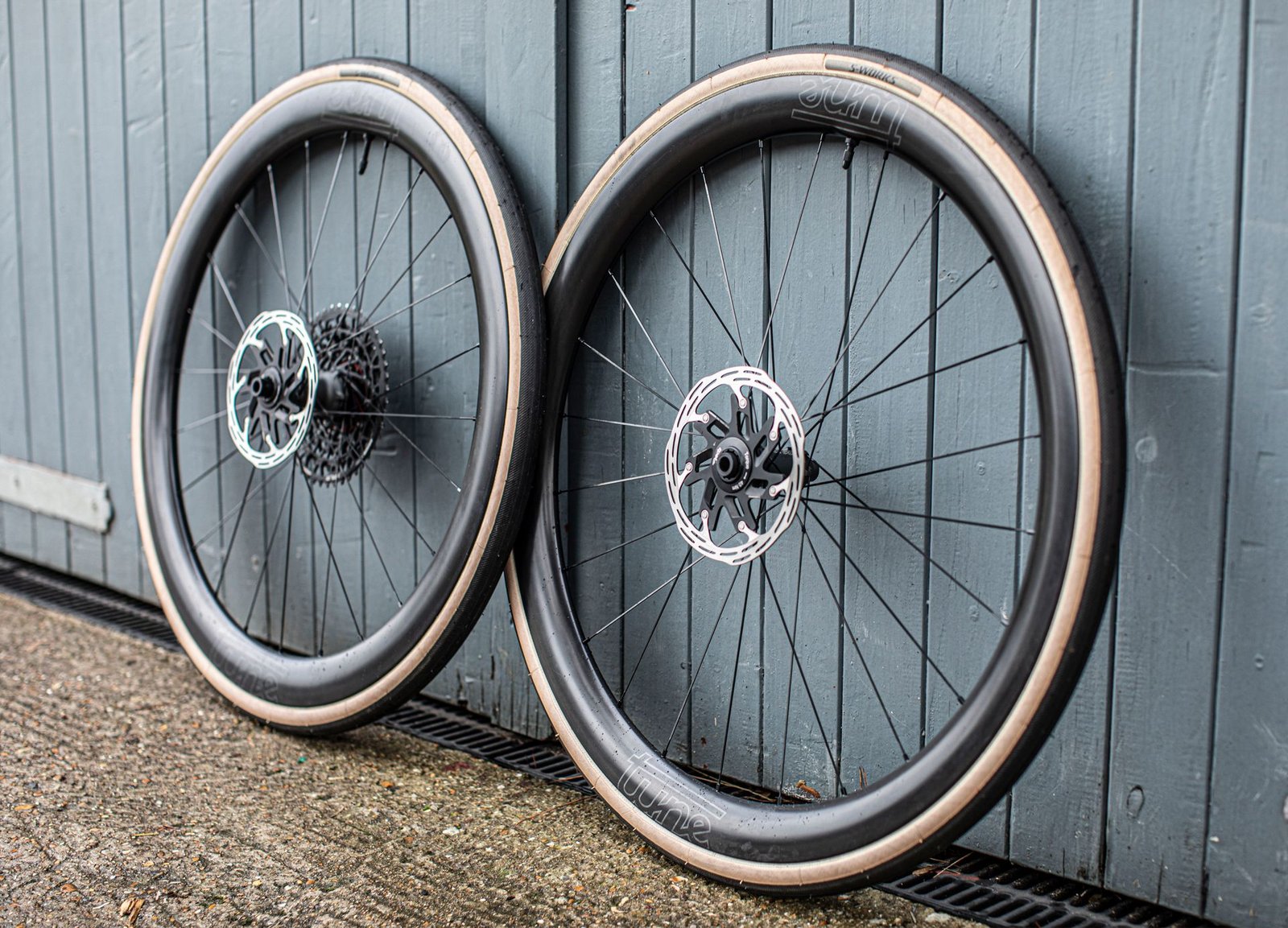
Tune might be better known for its lightweight hubs and components, but the German brand also makes a selection of wheelsets spanning disciplines such as road, gravel and cross-country mountain biking. The wheels pictured here are Tune’s all–new Yokto 4550, named after the very hubset and mixed rim depth they utilise, designed to balance weight, durability, and aerodynamics. While it’s not an out-and-out weight-weenie offering, given its use case and specifications, it’s as feathery as its rivals, if not lighter in some instances.
Having changed ownership in 2023 after being acquired by Carbovation, the parent company of Lightweight, the Tune Yokto wheels are among the first new products to come out of the merger, and they’re looking to challenge the best options on the market for race-tuned performance.


The Yokto 4550 wheels feature a mixed 45/50mm front/rear rim depth and a hooked 25/32mm internal/outer width
(Image credit: Aaron Borrill)
Technical details
In terms of visuals, the Tune Yokto 4550s are quite stealthy-looking wheels with muted graphics that should see them pair well with most bike brands and colourways. The branding is lowkey with Tune wordmark logos set upon a unidirectional carbon-fibre backdrop and matched to black-titanium hubs and spokes. It all looks very posh and refined.
As the name suggests, the Tune Yokto 4550 wheels feature a mixed 45/50mm front/rear rim depth and a hooked 25/32mm internal/outer width. While this means you can fit wider tyres that blur the lines between road and all-road, the rear hub is limited to a maximum 1:1 easy gear ratio owing to the lightweight internals of the new Poetry Freewheel System. While I did test the Yokto 4550 wheels on both my Cannondale SuperSix Evo 4 with regular two-by gearing (48/35T, 10-33T) and a SuperX Lab71, the latter utilised a 46T, 10-46T gearing configuration, which falls within the manufacturer’s recommended limits.

The hubs are machined from high-grade aluminium and constructed to tighter tolerances than before
(Image credit: Aaron Borrill)
The hubs are one of the centrepieces of the new wheels. The 24-hole front/rear hubs have been machined from high-grade aluminium and constructed to tighter tolerances than before – no pre-load adjustment needed here. Both hubs feature new lip seals with hybrid-ceramic Enduro bearings as standard fare and weigh 225g for the pair (XDR version). The rear hub features Tune’s new Poetry Freewheel System, which uses two hardened, oversized steel pawls and 40 points of engagement to handle drive and coasting duties. Tune claims the new free-wheel system provides better power transfer and reduces drag, but more on this later.
Another feature of the Yoktos is the spoke configuration and lacing technique, a nod to the solder-tied spoke crossings of yesteryear. Both the front and rear wheels are laced with 24 lightweight Sapim spokes in a two-cross pattern and wrapped in a special carbon-filament sheath at the spoke-to-spoke interface, which is said to add stiffness and reduce weight. Whether this indeed bolsters stiffness, I couldn’t quantify, but the wheels are notably quiet under load and during sprinting, with no pinging from the spokes.
All this makes for an impressively light wheelset, 1,290g to be precise. Put the test on our Park Tool scale, the front wheel weighed in at 600g and the rear at 690g, which is spot on with the claimed figure. They’re not the lightest option in the Yokto range, that belongs to the 1,030g 3030 wheelset, and lack the aero benefits of the taller architecture of 4550 rims.

Carbon-filament sheath at the spoke-to-spoke interface is said to add stiffness and reduce weight
(Image credit: Aaron Borrill)
Performance
There’s nothing particularly special about how the Yoktos perform – they roll well at typical riding speeds of between 25-30km/h and respond eagerly when pushing on the pedals in anger as well as in sprinting scenarios. Speeds across the board feel on par with rival brands, and the engagement of the rear hub is impressive for a two-pawl system – there’s no notable lag as experienced on some of the brand’s previous wheel iterations. Unlike the brand’s Poetry 60 and 138 hub systems, users cannot add or remove pawls and springs to switch between engagement levels.
The Yokto 4550 wheels perform flawlessly in crosswinds, with no front-end twitchiness, just predictable handling that promotes peace of mind and confidence on descents. Sure, the rim depths aren’t anything too extreme, but these wheels feel planted and precise, and are easily up there with the most stable and confidence-inspiring options on the market for cycling in the wind.
While I tested them during the depths of winter – in mixed conditions and temperatures – I’d have liked to try them in drier, faster conditions. That said, there was a sense of reliability that made the entire two-month test period issue-free – even during some appreciably wet and rainy rides, the bearings and hub engagement remained smooth and effective, something that should provide prospective users confidence in using the Yoktos all-year round, not just for events or target races.
Considering Tune designed the wheels around 28-35mm tyre widths, I wrapped the Yoktos in 28mm Specialized S-Works Turbo TLR tyres at my go-to road bike pressure of 50-55psi front/rear. While this did help reduce road imperfections and vibrations and improve cornering grip, the ride quality remained notably firm, as expected given the wrapped spokes. A wider tyre at an even lower pressure should add a little more compliance if you’re after softer ride quality. That said, I wouldn’t fault them for the stiffness – after all, these are performance wheels, and Tune doesn’t make any marketing noise about comfort and compliance – they are an out-and-out racing wheel, and they excel in that context.

The branding is lowkey with Tune wordmark logos set upon a unidirectional carbon-fibre backdrop
(Image credit: Aaron Borrill)
Value
The Tune Yokto 4550 wheels are an impressive option that does very little wrong – in fact, I can’t pinpoint any real foibles. They’re easy to set up and do everything you’d expect of a contemporary tubeless aero wheelset; they’re predictable, stiff, and robust enough to get you through the worst of winter and then some. The only thing letting them down, perhaps, is the pricing, which falls short of two of its most notable mixed-wheel-depth rivals from Parcours and Roval.
In fact, it’s the Parcours Strade GT that poses the biggest threat, given its lower price. Not only are the Strade GTs cheaper (£2,719 / US$3,589 / €3,489 with ceramic bearings) and lighter at 1,140g, they’ve also got a fairly similar 49/54mm front/ear mixed-depth. They’re also manufactured using reclaimed carbon fibres that soften road buzz and boost performance. I currently have a pair of Strade GT wheels on test, and they really do minimise vibration and improve speed and compliance over poor surfaces. They’re superb and represent a genuine performance option worth considering.
Roval offers the mixed-depth Rapide CLX III in a reverse configuration, with a 63/58mm front-to-rear arrangement. They also come standard with ceramic bearings and gain carbon spokes, but have a narrower internal width and weigh more than both the Parcours and Tune wheels at 1,305g for the pair. They’re marginally cheaper at £2,998 / $3,500 / €3,499, so there’s a lot to consider here, too.
If you’re looking for something different yet still performance-focused and lightweight, the new Tune Yokto 4550 wheels won’t disappoint. I appreciate the low-key aesthetics, relatively low weight, and the way they handle crosswinds to deliver predictable handling.

Author Aaron Borrill tested the Yokto 4550 wheels together with 28mm Specialized S-Works Turbo TLR tyres
(Image credit: Aaron Borrill)
Tech specs
- Price: £3,050 / $3,695 / €3,495
- Weight: 1,290g (actual)
- Hubset: Ceramic bearings XD15
- Freehub options: Shimano HG11/12, SRAM XDR, Campagnolo
- Rim depth: 45mm front, 50mm rear
- Rim width: 25mm internal, 32mm external
- Spoke count: 24 front/rear
- Rim: Hooked

