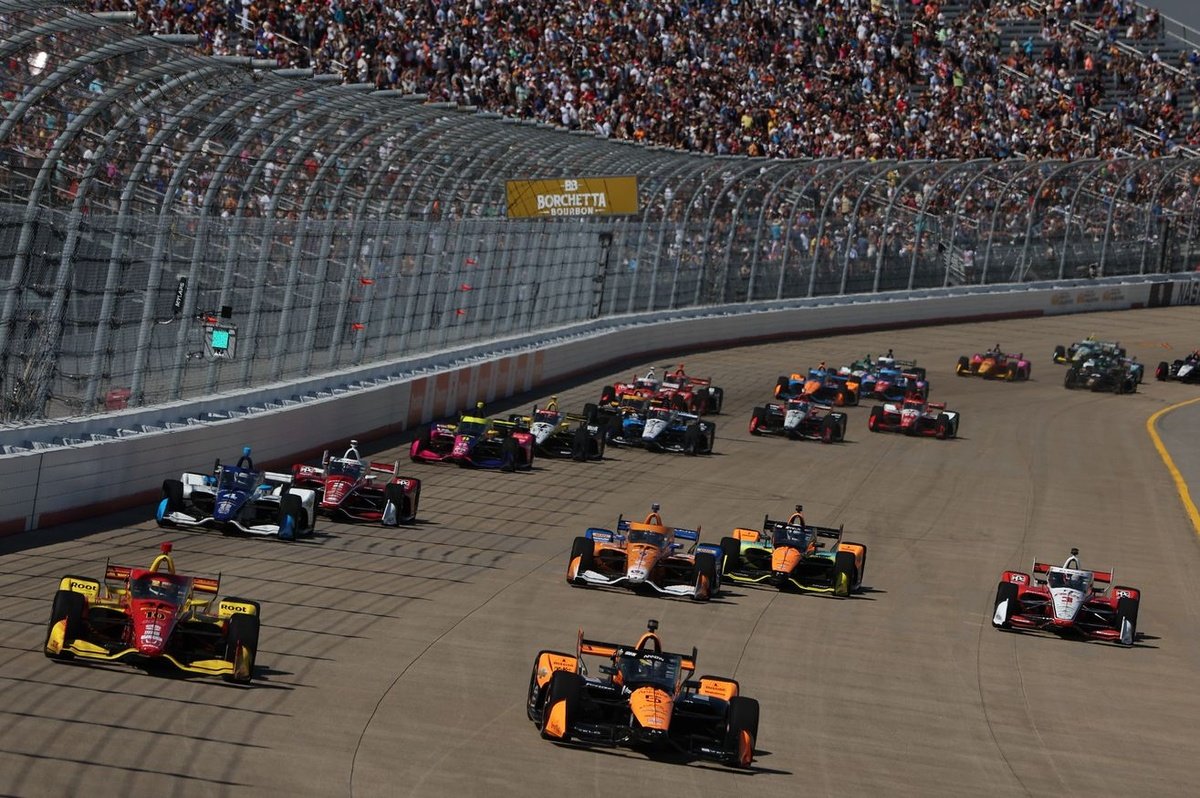
There are a number of unique things that have gone into the new multi-year deal IndyCar secured with Chevrolet and Honda.
The agreement for the Original Equipment Manufacturers (OEMs) doesn’t begin until 2027, with the next year – 2028 – beginning a different era for the sport as each will have ownership of one charter, lining up with the timeline the new car and engine package is scheduled to debut.
Advertisement
During a small media session following last Thursday’s announcement, IndyCar and Indianapolis Motor Speedway President Doug Boles shared that conversations over this endeavor a year ago – roughly the same time he took on the additional role to oversee IndyCar following Jay Frye’s departure as series president.
“We really didn’t know where the negotiations were going to go, what we wanted to talk about,” Boles said. “We were still in the early days of FOX, what was going to grow there, trying to get through the season.”
Conversations continued to trend about the value for the IndyCar Series, with Boles noting that although Chevrolet and Honda recognized it from a competitive standpoint, there was a greater emphasis on overall growth.
Advertisement
“There’s pride that goes along with having your cars competing and winning in the IndyCar Series, but how would you go back to a boardroom when at the end of the day, Chevrolet and Honda are car companies,” Boles said.
“Their job is to sell cars, but they have racing in their DNA. Knowing that they’re spending tens of millions of dollars a year to compete in the IndyCar Series, when we first started talking about where’s a way that the manufacturers could literally have something when they go to the boardroom and say, ‘We have a stake in the ground that’s going to grow with the IndyCar Series as it grows.’ It just came organically out of conversations of how to get there.”
The additional stake helped keep Honda from leaving when its current contract expires at the end of the 2026 season. The past two years saw the Japanese manufacturer open about needing to see various changes within IndyCar if there would be a continued relationship.
Advertisement
Additionally, though, Honda’s renewal to stay in North America’s premier open-wheel championship doesn’t mean it has shut the door on exploring a venture into NASCAR.
“We evaluate all series on their merit,” said David Salters, President of Honda Racing Corporation USA. “Joining IndyCar doesn’t preclude us from other things, so we evaluate things on their merit. We’re thrilled to be in IndyCar, but we evaluate all the series continuously.”
Alex Palou, Chip Ganassi Racing Honda, podium, David Salters of Honda HRC
Alex Palou, Chip Ganassi Racing Honda, podium, David Salters of Honda HRC
Honda had been critical with how the sport was being operated in recent years in wake of push-to-pass scandal of 2024 and the rear attenuator penalties at the Indianapolis 500 last year, which were both committed by IndyCar and IMS owner Roger Penske’s team. Interestingly, though, the establishment of the Independent Officiating Board in December had little impact on Honda’s decision to extend.
Advertisement
“I think with any decision, there’s many things that go into it and it’s one of the things that was helpful in this decision, for sure,” Salters said. “But there’s many, many things that go into it. I wouldn’t say this was a major thing, but of course, it’s part of what we think about.”
Although the agreement is vague with the term “multi-year,” Boles mentioned that both manufacturers cannot sell their respective charter until after 2030 to ensure that it follows the value of the current charter holders.
With 25 charter members expanding by two for 2028, it puts a challenge to any prospective ‘open’ teams looking to break into the sport as the field capacity is capped at 27 in every event with the exception of the Indy 500. The only regular non-charter participant currently is PREMA, who are enduring a run of offseason dramas and are in doubt of starting its second season in the opening round at St. Petersburg.
Advertisement
“Obviously, we’re all sort of on the sidelines waiting to see what happens with PREMA,” Boles said. “I don’t think we believe that they’re going to be able to answer the bell, at least at the beginning portion of the season.
“Right now, I think you’re looking at 25 cars this year, and then when we get to ‘28, we’re probably 27. I think there was probably some thought that when we got to the new engine format in 2028 that we would be at a point where the IndyCar Series, with the exception of the Indianapolis 500, was just those charter members. Now, we haven’t completely finalized that, but my guess is that when we get to 2028, we’ll be at a point where 27 is probably the number that we have, with the exception of Indianapolis.”
So, how does a prospective team that wants into the sport even break in at that point?
Advertisement
“There’s conversations, rumors going around that we have current charter holders that are talking to other people who are interested in buying charters to become members of our series,” Boles said.
With charters limiting the IndyCar field even more in 2028, prospective owners may have to start in Indy NXT.

With charters limiting the IndyCar field even more in 2028, prospective owners may have to start in Indy NXT.
Another pathway Boles pointed to was Indy NXT, the developmental category for IndyCar, which will have 24 cars on the grid to start the year.
Advertisement
“There’s an opportunity there for teams to get started going forward,” Boles said. “But if we limit the number where we are in charters, it’s going to add some value to our team owners who’ve invested millions of dollars over time. So really, I think that’s really where it’s going to come from.”
While both manufacturers can align with a team that possesses two or less charters, with Honda already confirming talks to have its factory program with Meyer Shank Racing (the same team for its IMSA effort), an IndyCar representative confirmed to Motorsport.com that this new deal does not allow for manufacturers to buy charters from teams.
Under the new guidelines that are now set and still being built out, it will become an interesting situation in the event that the long-wished-for third manufacturer joins the series.
Advertisement
Boles admitted “it’s a complicated answer” if an incoming manufacturer would receive a charter.
“We obviously had 25 charter holders going into this,” Boles said. “We had to work with our charter holders to get to the point where 27 was something that our paddock and we all agreed to.
“At this point in time, we have not made it a confirmation or a firm thing that we would add additional ones. We’ll just see how the conversations go.”
Read Also:

Romain Grosjean returns to IndyCar, signs with Dale Coyne Racing for 2026
To read more Motorsport.com articles visit our website.

