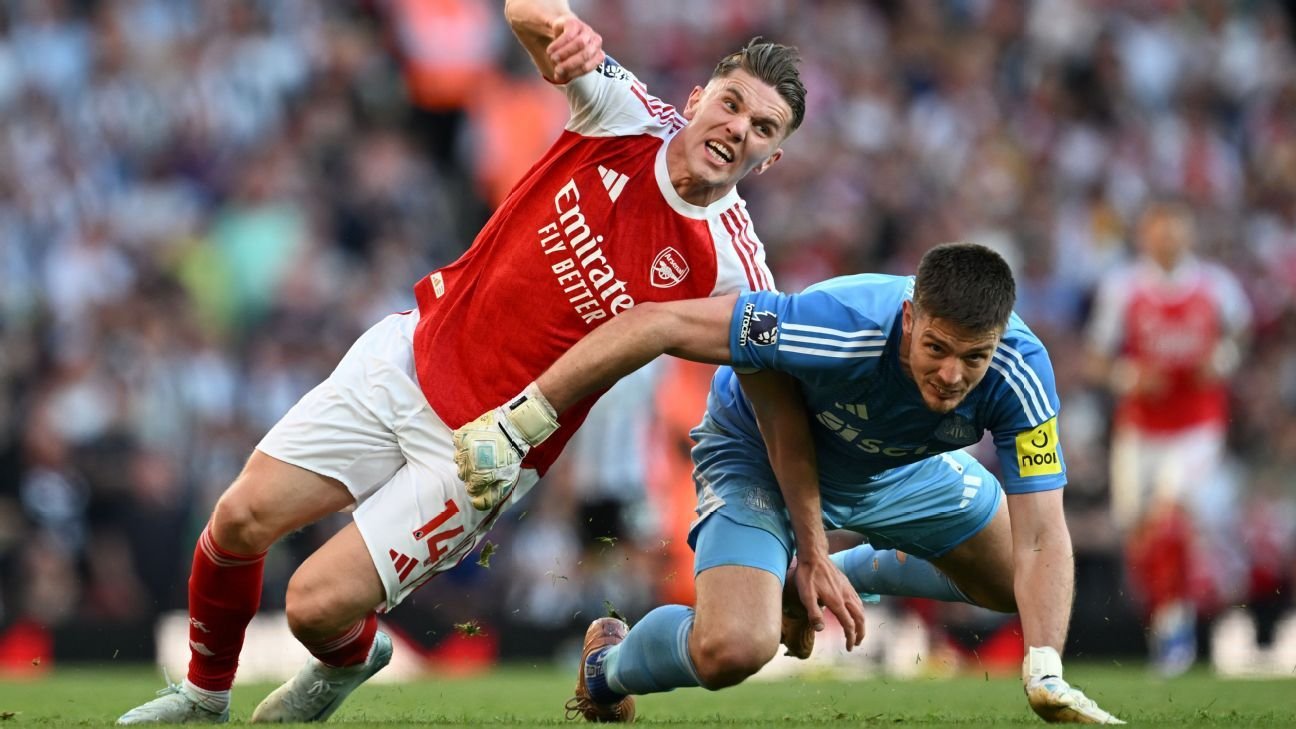
Video assistant referee causes controversy every week whether it be the Premier League, Champions League or FA Cup, but how are decisions made and are they correct?
This season, we take a look at the major incidents to examine and explain the process both in terms of VAR protocol and the Laws of the Game.
Andy Davies (@andydaviesref) is a former Select Group referee, with over 12 seasons on the elite list, working across the Premier League and Championship. With extensive experience at the elite level, he has operated within the VAR space in the Premier League and offers a unique insight into the processes, rationale and protocols that are delivered on a Premier League matchday.
Arsenal 1-0 Newcastle United
Referee: Sam Barrott
VAR: Jarred Gillett
Time: 74 minutes
Incident: Possible red card for DOGSO (denial of an obvious goal-scoring opportunity)
What happened: A ball played over the top of the Newcastle United defence left Arsenal attacker Viktor Gyökeres beyond the last defender, chasing the loose ball. Newcastle goalkeeper Nick Pope left his area and he too chased the loose ball — however he slipped, panicked and then illegally held the Arsenal striker, stopping Gyökeres from retrieving the ball. Referee Sam Barrott produced a yellow card deeming the offence did not deny an obvious goal scoring opportunity.
VAR decision: The referee’s call of yellow card to Pope was checked and confirmed by VAR. They deemed that he did not deny an obvious goal scoring opportunity due to the close proximity of a Newcastle defender, who had the possibility to claim possession of the ball.
VAR review: The on-field decision is always the foundation for all VAR checks, and only when the replays show there has been a clear error in this process will VAR intervene. VAR Jarred Gillett was very comfortable with referee Barrott’s interpretation of this situation and cleared the yellow card as a correct decision. Gillett agreed that the circumstances in this incident did not meet any of the criteria for a red card to be issued.
Law 12 criteria: In a possible DOGSO situation, the following must be considered:
• Distance between the offence and the goal
• General direction of the play
• Likelihood of keeping or gaining control
• Location and number of defenders
Verdict: Arsenal manager Mikel Arteta went on an extended rant about the lack of a red card after the match, telling reporters that Saturday’s call coupled with a similar non-call against Manchester City a week ago was evidence of officiating going against the Gunners.
“I have to say as well in my opinion, it is a clear red card,” Arteta said. “I have watched it ten times. If you have ever played football, it is a red card.”
Despite Arteta’s moans, it was a correct on-field decision by referee Sam Barrott and non-intervention by VAR.
Nick Pope was rash with his actions, absolutely. However, the direction and angle of the play, distance from goal and the level of doubt as to whether Gyökeres would gain control of the ball. When the covering defenders are considered, meant that the criteria for a red card was not met.
In truth, this was a relatively straightforward decision for the referee and Arteta’s comments were a surprise.
In fairness to Arteta, he can feel aggrieved by the decision in the Man City game a week prior, when Kai Havertz was unfairly challenged by Abdukodir Khusanov and referee Anthony Taylor failed to penalise the offence where the sanction for the Man City defender would have been a red card. Arsenal lost that game, 2-1.

