At the tail end of winter 2014, I walked into a bike shop for a bike-fit. At 163cm tall, long in the leg and short in the torso, I had grown used to folding myself onto frames that felt not quite my size. When the fitter told me I needed a 53cm – a size rarely seen on shop floors – I ordered a Bianchi Dama Bianca, one of the era’s women-specific road bikes. Back then, “women-specific design” meant in-between sizes, shorter top tubes, taller head tubes, narrower handlebars, and wider saddles. The premise was clear: women’s bodies are different, so women’s bikes should be too.
A dozen years on, most brands have folded women’s ranges into “unisex” platforms, arguing that male and female rider proportions overlap too widely for gender to be a meaningful design guide. The industry now speaks of data sets, bell curves, and size resolution rather than female geometry. But does its tidy narrative mask a more complicated reality? Are women being underserved as women-specific models vanish while bike-makers consolidate production lines to protect their bottom line?
(Image credit: Richard Butcher)
When I ordered that Bianchi in 2014, women-specific bikes were widely available. You could walk into almost any bike shop and spot frames with the “WSD” – women’s specific design – decal or a woman’s name scripted along the top tube: Specialized had the Ruby and Dolce models, while Trek offered the Lexa and Silque, and Cannondale the Synapse Women’s. Some of those bikes were carefully engineered, while others were little more than smaller frames in more feminine colourways. The most ambitious idea had arrived in 2008, with the launch of Liv, backed by Giant and positioned not as a sub-category but as a standalone brand. It offered bikes, kit, ambassadors, and race teams built around female riders. A bold declaration had been made: women were not simply a smaller segment of the same market.
Article continues below
Part of that contraction was philosophical, and part was commercial. Sales volumes for women-specific road bikes rarely matched their men’s equivalents, and maintaining parallel moulds, stock, and marketing streams carried significant cost. Every additional frame platform multiplies tooling, forecasting and inventory risk. Rationalising ranges into single platforms promised conceptual clarity and operational simplicity.
The most visible shift came in 2019, when Specialized announced it would go “Beyond Gender”, citing data from more than 8,000 Retül fits suggesting that body proportions “vary as much within a gender as between them”. The company concluded there was “likely more difference between two male cyclists than a male and female”, and retired the Ruby and Dolce in favour of single platforms offered across broader size ranges.
Specialized was not alone. Trek moved to gender-neutral sizing across its road range, arguing that its own fit data showed no meaningful correlation between gender and frame geometry. Cannondale had already begun sharing frames across men’s and women’s models, altering only contact points. Canyon, which had previously invested in WMN-specific platforms (including smaller 650b wheels on some models), gradually reabsorbed those lines into its main ranges as integration and standardisation took precedence.
Yet the industry never spoke with one voice. Liv and Giant continued to argue that global anthropometric data reveal meaningful average differences between women and men, including longer legs relative to torso length, narrower shoulders and, on average, lower system weight; and that these trends justify distinct geometry and component tuning.
Varying approaches
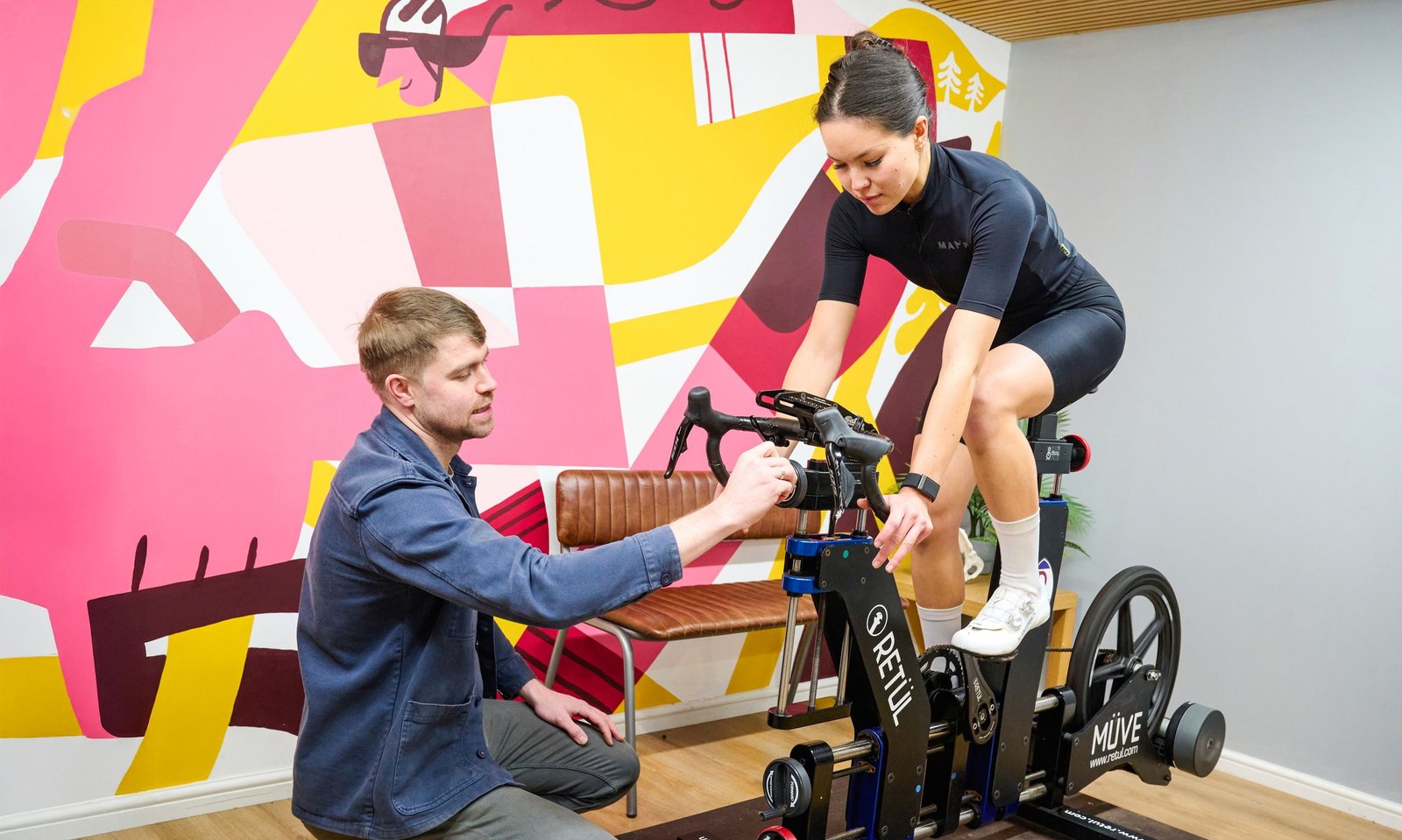
At Specialized, the move away from women-specific frames in 2019 was not positioned as a retreat, but as a correction. “The big myth was that all women have short torsos and long legs, and men do not,” says Todd Carver, head of human performance at Specialized. After analysing body-segment data and positional coordinates across tens of thousands of Retül sessions, he says the team found “two big overlapping bell curves”. There may be small average differences, but “the variability within a gender was huge. So we decided to design bike frames for the individual, not the gender.”
The data set behind that claim is substantial. In 2025, 16.7% of Retül fits were from women, with just under 28% of sessions coming from riders on 52cm frames and smaller. Jamie Stafford, Specialized’s director of industrial design, describes the shift as “human-centric and not gender-centric.” Small men and tall women routinely fall into the same size brackets, he notes, challenging the idea that geometry should track neatly along gender lines. “It’s not a gender problem,” Stafford says. “It’s an every-rider-and-the-size-of-your-body problem.”

(Image credit: Richard Butcher)
Carver notes that while frames are now shared platforms, the company adjusted contact points in response to fit trends. “We made the decision to actually serve women better by putting wider saddles on our smaller bikes,” he says, noting that the difference in saddle preference between men and women is far greater than it is for frame geometry. Bikes under a 52cm now ship with 155mm saddles out of the box, a move intended to reduce costly swaps.
Cannondale, meanwhile, frames the debate less around gender data and more around the engineering process. Unlike Specialized, it does not draw from a centralised fit database. Instead, geometry decisions are informed through a combination of professional athlete feedback, rider and retailer insights, prototype testing, and internal engineering analysis, with women representing roughly 25% of its professional athlete fit data. The brand says it has not produced fully separate geometries for women in over a decade.
“What works for a rider on a 56cm frame doesn’t automatically work for someone on a 48 or a 62,” says Steve Smith, a Cannondale engineering manager. Rather than focusing on gender-based data sets, Cannondale frames the issue as one of proportional scaling. Each size is treated as its own engineering project, with lay-ups, tube proportions, and stiffness targets adjusted to suit the likely rider weight and load. What would it take to justify a women-specific platform? “[From] the data I’ve looked at, it’s not really a gender thing,” he says. “There are just smaller people, and there are bigger people.” On the latest SuperSix Evo, Cannondale added an additional size, offering a 50 and 52 instead of just 51. Crank lengths have dropped, and handlebar widths narrowed to as small as 340mm.
Trek did not respond to requests for comment, but its bikes surfaced repeatedly in conversations with independent fitters. Several noted that certain Trek race platforms tend to scale predictably through the smaller sizes, allowing shorter riders to find a sustainable position without extreme stem swaps or excessive spacer stacks. For Kate Corden of Hackney Bike Fit, the point was not brand loyalty but a geometry principle: what matters is whether stack, reach, and front-centre are scaled sensibly down the size range – and thereby “land in a workable place” for smaller riders.
Male-biased data
Large anthropometric databases, from NASA to military cohorts, have long shown that limb proportions do not just fall into gender categories. More recent cycling research complicates things further. A 2024 international consensus on bicycle set-up and kinematics concluded that even within sports science, the field has historically lacked consistent standards for measuring and reporting rider position. Before we argue about women’s geometry, in other words, we have not always agreed on how to measure a bike-fit in the first place.
Biomechanical modelling tells a similar story. Early optimisation studies relied too heavily on the “average 18–25-year-old male” body as their biomechanical baseline. As data sets broadened, the models shifted enough to underline a key point: population averages exist, but the overlap is wide. Flexibility, strength, injury history, and riding style often influence position as much as gender does.

(Image credit: Richard Butcher)
Independent fitters describe an even more complicated reality from the workshop floor. Bearing in mind the caveat that most riders seeking a bike-fit are either in discomfort, chasing performance gains, or sitting at the edges of the size spectrum, fitters say they see recurring patterns – women more frequently presenting with longer legs relative to torso length, narrower shoulders and often greater flexibility.
Greater mobility often means a rider can tolerate a wider geometry ‘window’, further complicating the debate. Fitters report most commonly adjusting touchpoints for women, rather than other dimensions.
Julian Wall of Cycle Fit UK has noticed that women are more likely to accept discomfort as “normal”. Numb hands, aching backs, or saddle pain are often tolerated as “how cycling is supposed to feel.” In Wall’s experience, many women put up with discomfort for longer than they should. Sports medicine research supports this idea that female athletes, in some settings, are more likely to internalise or normalise discomfort before seeking intervention.
Another problem is manufacturers producing fewer bikes at the extremes of the size spectrum, and smaller frames are not always proportionally re-engineered. “The riders who struggle most are the super small and the super tall,” says Corden. “[Riders] under 165cm and over 190cm. They’re the ones who end up spending more time and money trying to make bikes work.” Wall argues that, commercially, simplification has narrowed choice: “We’ve got loads of amazing technology now, but fewer size options… From a fitting perspective, that makes it harder, not easier.”

(Image credit: Richard Butcher)
Liv argues that the modern geometry debate cannot be separated from the question of representation. In many global fit databases, female riders still account for a minority of entries, raising the possibility that “general” geometry reflects a male-skewed norm. For Jen Audia, a marketing manager at Liv, the brand’s position stems from its founding in 2008 under Bonnie Tu, with the goal of building bikes “dedicated exclusively to women”. While Audia acknowledges that “there are more differences between one rider and the next rider than between gender,” she argues that small differences in reach, head tube length or top tube can still matter when applied across an entire size range.
For this reason, Liv uses dedicated frame moulds on models such as the Langma and Pique, which Audia refers to as a “significant financial investment”. For her, credibility depends on bikes being “exclusively designed from the ground up for women”, with the aim that a rider can roll a bike “out of the store without any adjustments”. More broadly, she sees the brand’s continued existence as evidence that women “deserve product and investment across all sports”.
Underserved outliers
In an online reader survey conducted for this feature, just over 80% of respondents said a new bike either “almost never” felt right out of the box or required changes. For many, that meant immediate swaps to stems, saddles, or handlebars; for others, it meant booking a professional fit simply to make a brand-new purchase rideable.
Among those who did make adjustments, saddle type or width (74%), stem length or angle (71%), and handlebar width or reach (61%) were the most common changes, with nearly a third also altering crank length. More than 60% of respondents had undergone an in-person professional bike fit, suggesting these views come from experienced riders rather than first-time buyers. As one reader put it, “I feel like the idea of a bike just fitting well out of the box is maybe a myth.”
Smaller sizes were repeatedly described as difficult to locate on the shop floor, with some riders advised to order unseen or “size up and adjust”. Taller riders at the opposite end of the range echoed similar frustrations. The survey also revealed a clear divide in perception. Nearly 40% reported feeling either overlooked by current sizing options or having to “make it work”. The recurring refrain was not that fit is impossible, but that it often requires extra cost, extra effort, or compromise.
Womens-specific bike sizes were not so much erased as absorbed. Separate moulds gave way to shared platforms; explicit “women’s geometry” was recast as improved scaling and broader size runs. The language shifted from gender to resolution. Economically, the logic is clear: fewer platforms, deeper runs, lower risk. Technically, it promises fairness through overlap.
But standardisation is not the same as neutrality, and designing around the statistical middle will always favour the statistical middle. The riders who feel the strain are those furthest from it, the ones for whom stock specifications and proportional scaling matter most.
The question, then, is less whether bikes should be gendered and more whether the industry is willing to engineer and invest beyond the centre of the curve. If “unisex” is to mean anything more than consolidation, it must result in fewer compromises on the shop floor, particularly for those who have spent years making do.
Does unisex clothing really suit everyone?

(Image credit: Richard Butcher)
When Specialized closed Machines for Freedom in 2023, it marked the loss of a label built around extended sizing and explicit inclusivity. Its XXS–XXXL range and measurement-based sizing tool had offered a corrective to an apparel industry long shaped around a narrow sample size.
Some brands had anticipated this need earlier. Velocio, for example, launched in 2014 with a full women’s collection. It continues to maintain distinct fits and functionality rather than scaling from a single template. Elsewhere, brands are exploring unisex alternatives. Labels such as Van Rysel, Santini and Varlo have experimented with unisex ranges, aiming to create a “fit for everyone” through fabric stretch and pattern development. But these moves also simplify production.
Riders’ experiences suggest limits remain. On forums, complaints tend to be practical: bib straps pulling tight on taller riders, shorts extending beyond knees on shorter ones, and jerseys bunching because “sizes are all for tall people, varying only in width”. Avril Porter, a 6ft rider, told CW she has “spent all of [her] cycling life wearing men’s kit” to find adequate length.
This feature originally appeared in Cycling Weekly magazine on 5th March 2026. Subscribe now and never miss an issue.

