Reaching the Final Four of the NCAA Tournament should always be achievement.
And yet, exiting in the national semifinals or final, just on the precipice of a national championship, also will never not be disappointing. That’s especially true for No.1 seeds that, with conference champion trophies and honors for indivdual players and coaches already in hand, fall short.
Advertisement
That was the fate experienced by UConn, Texas and South Carolina.
So, what’s next for the Huskies, Longhorns and Gamecocks? All three were also here last year. Will they again be back next year?
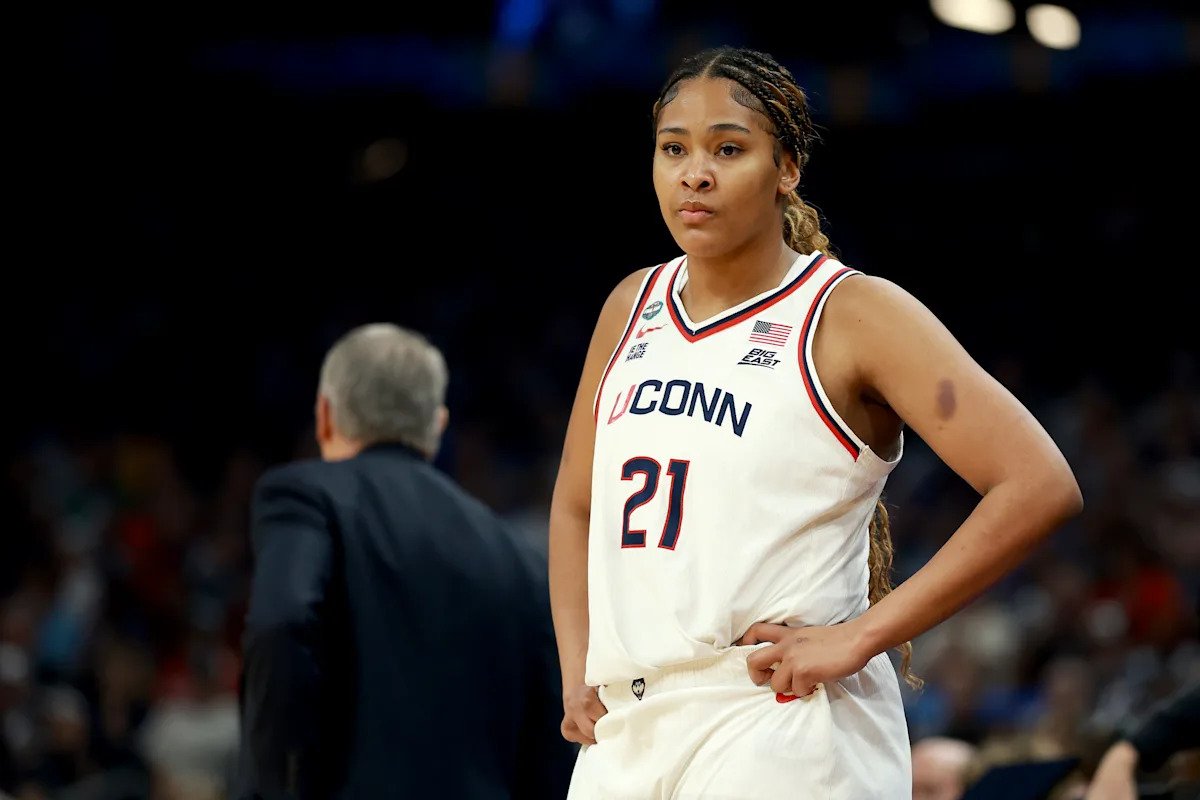
Will UConn’s Strong-driven dynasty be revived in 2026-27?
Sarah Strong is still the salve protecting UConn from any persistent problems. (As long as the head coach avoids more meltdowns.)
Situated on an escalator to all-time Storrs excellence, Strong’s ascendance will now encounter some adversity. That’s not to suggest that the hype was premature or overstated, nor that the National Player of the Year honors were undeserved. A subpar sophomore showing on the Final Four stage, punctuated by a ripped jersey, doesn’t diminish her accomplishments or derail her future.
Next season, Strong should have ample opportunity to prove and improve upon her legend in the making.
Advertisement
Likely to be tasked with a larger offensive burden, Strong will need to increase her resiliency. The “Raven adjustment,” when South Carolina head coach Dawn Staley defended Strong with guard Raven Johnson rather than a post player, exposed some of Strong’s limitations.
A 6-foot-2 forward, Strong is way too skilled for the more traditional posts usually tasked with defending her. The smaller, yet very strong and smart, Johnson, in contrast, made Strong more uncomfortable. Although few, if any, other 5-foot-8 guards are capable of effectively defending Strong like Johnson, Staley introduced a defensive wrinkle that more UConn opponents should be inclined to try.
That’s especially true since UConn, at least as currently constituted, features no red-alert offensive threats beyond Strong.
Advertisement
While bursting with star promise, Blanca Quiñonez is a great at getting her own, but has a ways to go when it comes to creating for others in the halfcourt. KK Arnold and Kayleigh Heckel are too limited as primary offensive initiators at the highest level. Kelis Fisher did not receive enough playing time as a freshman to credibly conceive of her as a consistent and ready-to-contribute ball handler as a sophomore. It would be surprising if incoming freshman point guard, Jovana Popovic, is fully empowered to run the show in Storrs.
Nabbing an experienced point guard in the portal, akin to getting Kaitlyn Chen ahead of the 2024-25 championship-winning season, would be a boon for UConn, inspiring more confidence in their ability to cruise back to another Final Four.
If the portal does not deliver such a player to Storrs, UConn’s path to Columbus, the site of the 2027 Final Four, is more likely to run through their frontcourt, with incoming freshman Olivia Vukosa, the No. 3 recruit in the class of 2026 according to ESPN’s SportsCenter NEXT 100, teaming with Strong to spur the Huskies’ success.
UConn is UConn. They’ll burnish their credibility with a couple of big non-conference wins, bully their way through the Big East and likely be back in the Final Four.
Advertisement
It’s at that point where the referendum on UConn will again be meted out. Will the rebirth of the Strong-driven dynasty be back on? Or, will the Huskies, and especially their head coach, have to accept that they are now among, not above, the best programs in women’s college basketball?
Is Texas already Booked for a third-straight Final Four?
Of the Final Four teams that failed to cross the finish line, Texas seems best situated to break the tape in 2027.
The heart, hustle and steady hand of Rori Harmon will be missed, but Madison Booker will be back, motivated after an underwhelming Final Four and bolstered by the No. 1 recruiting class in the nation. Three top-20 recruits—Brihanna Crittendon, Addison Bjorn and Lizzy Spaight—are on their way to Austin.
Plus, the Longhorns already have players ready to assume bigger roles.
Advertisement
Behind the trusted Harmon, Bryanna Preston saw limited minutes as a sophomore, but head coach Vic Schaefer shouldn’t have any hesitation handing over the keys to the buzzy and bursty Preston. Aaliyah Crump, who likewise did not receive extended minutes as a freshman, seems poised to follow the path blazed by Jordan Lee, who established herself as valuable piece as a sophomore and seems sure to grow her impact as a junior.
Kyla Oldacre could be an underrated loss for the Longhorns. Even as she came off the bench in all but two games, she frequently was a force who could swing or solidify Texas’ hold on a game due to her ownership of the glass. Using the portal to replenish big depth should be a priority for Texas.
If the program cannot secure such a player or players, it will be interesting to see if Schaefer might abandon some of his more old-school principles in favor more modern philosophies that could optimize a roster full guards and wings with good size who can handle the ball, score off the bounce and shoot from distance.
A space-and-pace small-ball Schaefer team that fires off 3-pointers? Such an offensive style, still complemented by a top-ranked defense, could, finally, return the national championship to Austin.
Advertisement
Vic, however, seems more likely to trade in his suit for a quarter zip before embracing a wholly new and modern offensive system.
His tried-and-true methods have gotten him to two straight Final Fours, and sticking to them will probably have the Longhorns in position to make it three in row. But, can those tactical truisms take Texas to the final two, and then the final one?
Can South Carolina capture title No. 4 in 2027?
The story is similar for South Carolina.
Like UConn and Texas, they’re on track to retool and remain elite around top-notch returners and high-ranked recruits, although losses a key position group could prevent them from reaching another Final Four.
In contrast to the Huskies and Longhorns, however, the Gamecocks will benefit from the expected return of two vets: Chloe Kitts and Ashlyn Watkins.
Advertisement
Those well-established frontcourt stalwarts, combined with Joyce Edwards’ fast-rising star, should return the strength of South Carolina to their frontcourt. If Madina Okot is granted another year of eligibility, and if Alicia Tournebize, whose inexperience, understandably, was evident during her freshman stints, makes a second-year leap, it is hard to imagine any team matching the depth and dominance of the Gamecock frontcourt.
They may not have the singular interior star that has been at the center of South Carolina’s title-winning teams—although Edwards could elevate her name alongside of those of A’ja Wison, Aliyah Boston and Kamilla Cardoso—but, as a cohort, the Gamecock bigs could provide the punch needed to push South Carolina to title No. 4.
There are questions about South Carolina’s backcourt, as Staley can no longer turn to Raven Johnson’s trusted two-way play.
Advertisement
Because of her size and lack of jump shooting, Maddy McDaniel doesn’t profile as a starter, suggesting South Carolina should look to the portal for a primary ball handler, hopefully convincing another Te-Hina Paopao type to come to Columbia. Top-five recruit Jerzy Robinson will have the chance to prove her scoring chops as big guard who is comfortable scoring with physicality in the midrange. The 3-point shooting of Tessa Johnson also will be as essential as ever.
The wildcard is Agot Makeer, whose potential as a ball-in-her-hands wing introduces a player archetype that South Carolina hasn’t really had under Staley.
If Makeer can progress as a creator for others, while also refining her own shooting and driving game, on top of the already-present danger she poses to opponents as a defender, the Canadian sophomore can guarantee that the promise she flashed in 2026 NCAA Tournament was just the start of a special career.
Advertisement
Makeer might be the x factor who determines if, after two-straight losses in the national championship game, South Carolina cuts down the net again in 2027.

