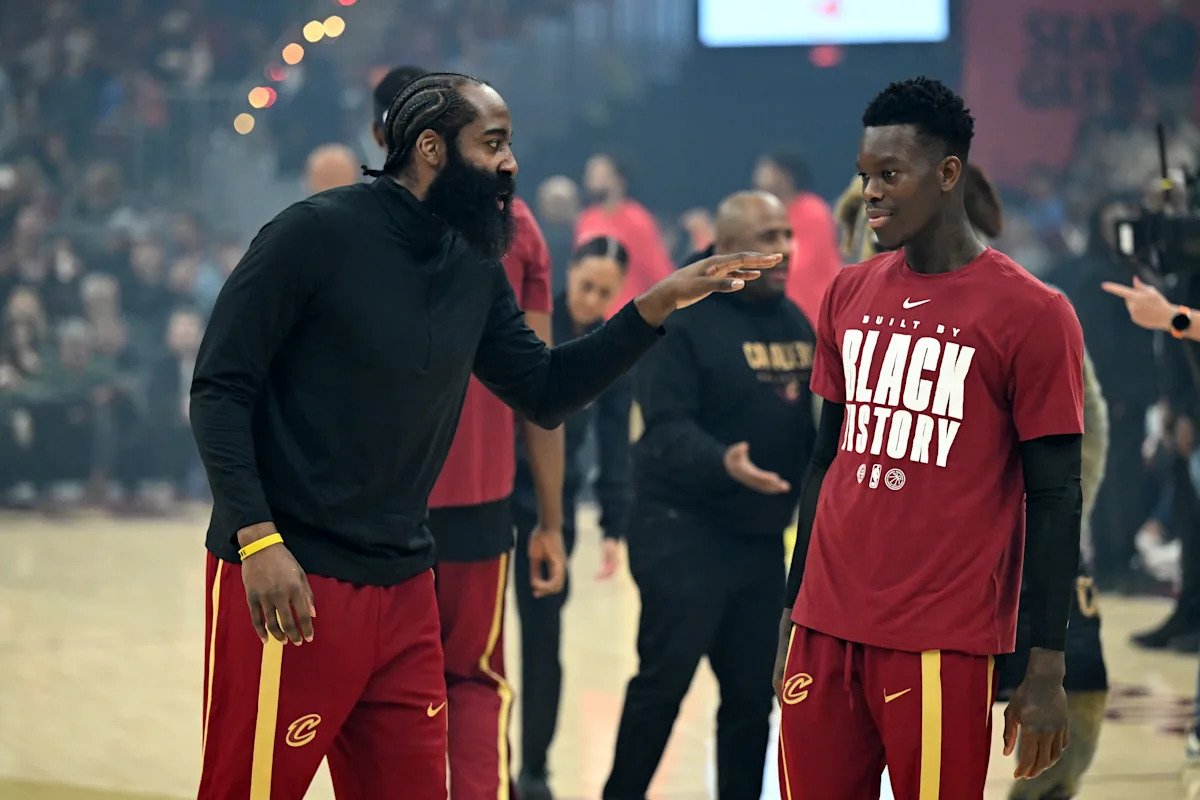
The Cleveland Cavaliers drastically changed their team at the start of the month when they traded multiple rotation players for James Harden, Dennis Schroder, and Keon Ellis.
They’ve played eight games since their first trade for Schroder and Ellis. That isn’t a huge sample size — and they haven’t exactly played the best defensive teams during that stretch — but it’s large enough to make analyzing some of the impact stats worthwhile, even if nothing conclusive should be drawn.
Advertisement
With that in mind, let’s look at some of the new strengths and weaknesses of this team based on the numbers.
Harden has taken the offense to another level
Harden was brought in to boost the offense, and he’s done just that. The Cavs have registered an absurd 128.1 offensive rating (99th percentile) when Harden is on the court. That’s nine points better than it has been without him during that same timeframe. And for context, the Cavs had a 116.3 offensive rating (61st percentile) with Darius Garland playing this season.
There’s multiple areas Harden has been able to help the offense.
First, the Cavs have gotten to the rim much better due to his ability to drive inside and playmake for the bigs.
Advertisement
They’re taking 3.4% more of their shots at the rim with Harden on the floor than they are without him (89th percentile). More importantly, they’re converting 69.8% of them (82nd percentile), which is 5.7% better than they are when he isn’t playing (93rd percentile).
Second, the Cavs are getting to the line much more easily. The Cavs have had a free-throw rate of 28.2 with Harden on the floor (99th percentile). For context, their season-long free-throw rate is 20, which is good for 22nd in the league.
Lastly, the Cavs are hitting more threes.
Cleveland has connected on 37.3% of their triples with Harden on the court. That’s above their season-long average of 35.9%. Harden shooting 47.1% from distance certainly helps.
Advertisement
The three most efficient ways to score are getting to the basket, getting to the free-throw line, and making more threes. Harden has helped drastically in each of these areas. From that perspective, it isn’t a surprise the offense has helped boost an already great offense.
Harden has made the offense work no matter who he plays with
It was fair to wonder how Harden and Donovan Mitchell would pair offensively. It usually takes time for two high-usage players to coalesce. That hasn’t been an issue as the offense has put together an out-of-this-world offensive rating of 132 (100th percentile) when both are on the court. This has led to the Cavs outscoring opponents by 10 points per 100 possessions in such lineups (91st percentile).
The same can be said of just about every other Cavalier Harden has played alongside.
Advertisement
Harden has stabilized the minutes without Mitchell
The Cavs have really struggled when Mitchell sits. On the season, groups that feature neither Harden nor Mitchell have put up a 111.9 offensive rating (27th percentile) and a -3.6 net rating (36th percentile).
These numbers actually got worse when Garland was forced to carry the Mitchell-less lineups. The Cavs registered a -9.5 net rating (15th percentile) and a 111.1 offensive rating (22nd percentile) when Garland was on the court without Mitchell. There’s context behind why this was the case, but the ineffectiveness of those lineups was a major issue.
Harden has changed that dynamic. The Cavs have outscored opponents by 3.5 points per 100 possessions (68th percentile) when Harden is on the court without Mitchell, while posting a 122.7 offensive rating (94th percentile).
Advertisement
It’s difficult to find a guard who can both play well with Mitchell and hold things down when he isn’t on the floor. Harden has done that extraordinarily well so far in his time in Cleveland.
Support us and Let ‘Em Know with Homage!
Anything bought from the links helps support Fear the Sword. You can buy the Mark Price shirt HERE. You can also shop all of Homage’s Cavs gear HERE.
The offense has been elite since the trades
I don’t want to give Harden all the credit for the offense being better, even though he deserves plenty of praise. The Cavs as a team have played well on that end since the initial trades for Schroder and Ellis.
Advertisement
Since the beginning of February, the Cavs have had the second-best offense in the league with a 124.9 offensive rating.
They’ve done this by being elite in the halfcourt (107.6 half-court offensive rating, second best in the league in that span) and by consistently getting to and converting at the free-throw line (23.2 free-throw rate, fourth best in the league). Both are things they’ve struggled with at various points this season.
This has all led to the Cavs having a +12.9 net rating since the start of February, which is good for fourth-best in the league.
The defense has been rough with Harden
Harden isn’t a good defender. Even though he can hold his own in the post, the rate at which he gets blown by on the perimeter far outweighs that. So far, the Cavs haven’t found a good way to mask his ineffectiveness on that end.
Advertisement
The Cavs have registered a poor 120.8 offensive rating (16th percentile) when Harden is on the floor. That’s 20.8 points worse than it is with Harden off the floor since the trade. That disparity is artificially high due to the defense being uncharacteristically good with Harden off the floor, but it does speak to some of the issues.
Harden hasn’t helped the Cavs’ rebounding problem
Cleveland is 29th in defensive rebounding percentage since the beginning of February. In that time, opponents are collecting 34.2% of their missed shots.
Defensive rebounding has plagued the Cavs all season, but it’s actually worse when Harden is on the floor. Opponents are collecting 35.1% of their misses when he is playing (second percentile).
Advertisement
The Cavs have been great defensively with Ellis and Schroder
In contrast, the defense has been incredibly impressive with either Ellis or Schroder on the floor. Lineups with Ellis have registered a 105.6 defensive rating (96th percentile). With Ellis, they’ve had a 106.1 defensive rating (95th percentile). And with both, they’ve had a 100 defensive rating in 140 possessions (100th percentile).
It’s worth noting that these lineups have been good offensively as well. The defense, however, has been elite. That means something on a team that has struggled on that end with Harden in the lineup.
Lineups with Ellis and Harden have been good defensively
The Cavs have played some of their best basketball when Harden and Ellis share the floor. Those lineups have a +27.5 net rating (100th percentile), 139.3 offensive rating (100th percentile), and a 111.9 defensive rating (79th percentile) in 117 possessions.
Advertisement
The interesting part about these lineups is that there isn’t much commonality with the other three players. The Cavs have run this duo out in many different combinations, and nearly all of them have worked so far.
This is a pairing I would stick with.
Schroder has fit better with Mitchell so far
It’s a small sample size, but lineups with Schroder and Mitchell, but without Harden, have been great. The Cavs have a +26.4 net rating (100th percentile), 125.7 offensive rating (98th percentile), and a 99.4 defensive rating (100th percentile) in 167 possessions. It really doesn’t get better than this.
Groups with Schroder and Harden, but without Mitchell, have worked well. They’re in the 64th percentile for net rating (+2.7) due to being good offensively in their 85 possessions together. That is perfectly fine, even though it doesn’t live up to the other grouping.
Advertisement
This makes sense conceptually. Mitchell needs to play with a point guard, and Schroder fits that mold well. Harden needs additional spacers, not ball handlers. Schroder can do that, but that isn’t his area of expertise.
What do we make of all this?
It’s dangerous to read too much into the data that we have. The sample size is still incredibly small, the Cavs have played some horrible defenses, some good offenses, and the rotations haven’t been set yet.
That said, the numbers do conclusively show that the offense is much more well-rounded than before. They’re getting to the rim and the free-throw line more than they have in the past. Their attack is much more diversified, so that they don’t have to live and die by the three-ball as much as they have in the past.
Advertisement
Additionally, they need to find ways to make it work defensively with Harden. They haven’t figured out a system that best hides his deficiencies. It’s difficult to have a solid defense if your back court with him and Mitchell is that susceptible to being blown past. Going with more zone defenses could be a solution, but I’m not sure if having him at the top of a 3-2 zone is the best way to do so.
I would lean more into playing Harden with Ellis. It’s not a huge sample size, but their fit matches the eye test. Harden just needs floor spacers on offense, and that’s one of the few things Ellis can do well on that end. And Harden also needs people who can cover for him defensively. Ellis can do that as he’s one of the most disruptive defenders in the league for his size.
The main takeaway, however, is that the Cavs are implementing many changes in their rotations and style of play. It takes time to work those things out, and that’s not something this team has.
Right now, Atkinson will need to decide if he values trying as many lineup combinations as possible or if he wants to do less experimenting in an effort to establish some continuity. I would opt for the latter, but neither is a perfect solution.
Advertisement
These trades were a bet on Atkinson’s ability to figure out the rotations and style of play. So far, he’s done a great job, but there’s still plenty of work to be done before the playoffs. We’ll see if Atkinson can get this group to reach their potential.
Lineup data was taken from Cleaning the Glass.

