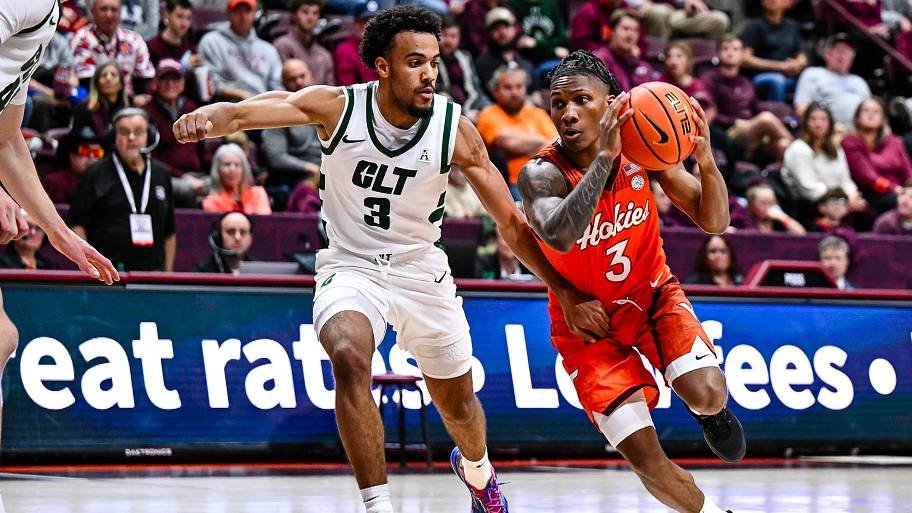
Entering the 2026-27 season, there are several plausible candidates to lead Virginia Tech in scoring. Transfer guard Isaiah Elohim arrives in Blacksburg after averaging 12.4 points per game at Florida Atlantic, while Oklahoma transfer Kuol Atak brings intriguing upside after flashing elite shooting efficiency in a limited role. Returning forward Amani Hansberry should also command a significant offensive workload in the frontcourt.
Still, the safest bet in my eyes is junior Ben Hammond.
Advertisement
As a sophomore in 2025-26, the 5-foot-11 guard averaged 13.2 points, 3.2 assists and 2.0 steals per game while shooting 43.1 percent from beyond the arc and 86.5 percent from the free-throw line. He led the Hokies in minutes played, paced the team in three-point percentage and finished among the ACC leaders in steals, assist-to-turnover ratio and free-throw shooting.
Most importantly, Hammond’s scoring increased when the competition stiffened. He led Virginia Tech in ACC play at 14.9 points per game.
His late-season surge offered another glimpse of what could be ahead. Hammond closed the year with 23 points against Wake Forest in the ACC Tournament and scored 21 in the regular-season finale against Virginia. Earlier in the season, he exploded for a career-high 30 points in a memorable triple-overtime win over the Cavaliers Dec. 31.
Opportunity also works in Hammond’s favor.
Advertisement
Virginia Tech underwent significant roster turnover for the second consecutive offseason, retaining only four contributors from last year’s team (five total, but freshman center Solomon Davis redshirted). While Mike Young added proven transfers, Hammond enters the season as the established centerpiece of the backcourt and one of the program’s unquestioned leaders.
As the primary ball-handler, Hammond will have the ball in his hands more than anyone else on the roster. That matters. Lead guards naturally accumulate scoring opportunities through pick-and-roll, transition chances and late-clock plays. Add in his elite shooting efficiency and ability to get to the free-throw line, and it’s a reasonable proposition to envision his scoring average climbing into the 15-to-17-point range.
That doesn’t mean there aren’t challengers.
Kuol Atak, in my opinion, is an intriguing sleeper. The 6-foot-9 wing averaged 7.0 points in just 12.4 minutes per game as a redshirt freshman at Oklahoma while shooting 41.3 percent from three-point range.
Advertisement
The per-minute production jumps off the page. If Atak earns a starting role, bulks up and sees his playing time double, his scoring ceiling could be substantial.
However, Atak remains more of a projection than a certainty. His freshman sample size was limited, and questions remain about how he’ll handle a larger offensive role over the course of an ACC season. Hammond, meanwhile, has already demonstrated he can carry a scoring load against conference competition.
Virginia Tech needs more offensive consistency after narrowly missing the NCAA Tournament last season for the fourth consecutive season. If the Hokies are going to end their postseason drought in 2026-27, Hammond will presumably be the engine driving that push.
And when projecting who finishes the season atop the scoring leaderboard, betting on the player who has already done it in league play in 2025-26 feels like the safest call.
This article was originally published on www.si.com/college/virginiatech as Who Could Lead Virginia Tech Men’s Basketball in Scoring In 2026-27?.

